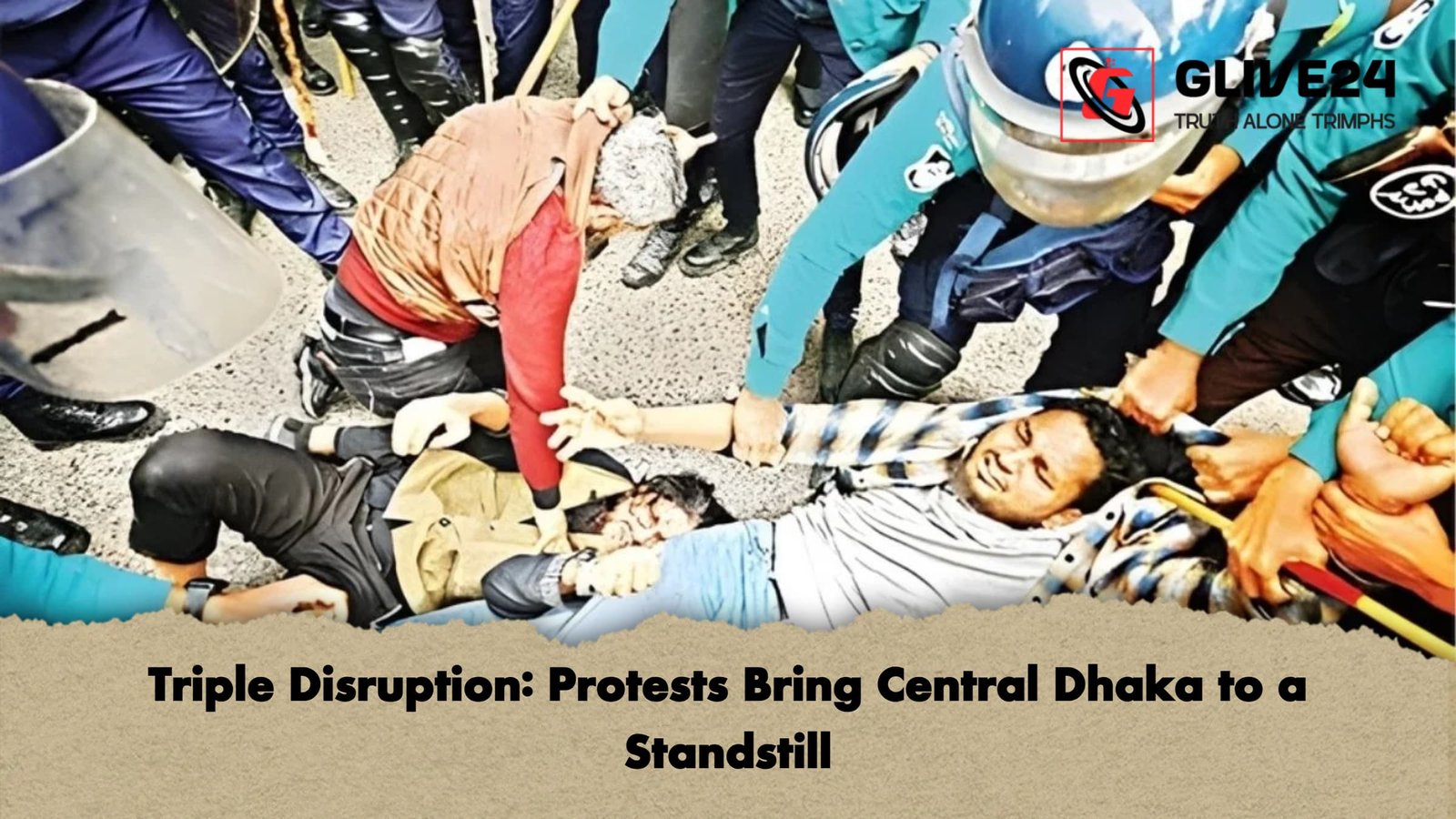
The administrative and commercial heart of the capital was crippled yesterday as three distinct protest movements converged on the city’s main thoroughfares. From the early hours of Monday—the week’s first full working day—demonstrations by mobile phone traders, bereaved students, and political activists created a logistical nightmare, leaving thousands of commuters stranded and leading to violent clashes with law enforcement.
Table of Contents
Violent Standoff at Kawran Bazar
The most volatile scenes occurred at the SAARC Fountain intersection in Kawran Bazar. Hundreds of mobile phone traders, under the banner of the Mobile Business Community Bangladesh (MBCB), occupied the streets to protest the implementation of the National Equipment Identity Register (NEIR). Protesters claimed the new BTRC regulations threaten to bankrupt small-scale retailers.
The demonstration took a poignant turn as many traders brought their wives and young children to sit on the tarmac, signalling their desperation. However, the peace was short-lived. By mid-morning, police deployed water cannons and sound grenades to disperse the crowd. The area transformed into a battlefield of chase and counter-chase, with traders retreating into Bashundhara City and surrounding alleys before regrouping to pelt officers with brickbats.
Student Blockade at Farmgate
Simultaneously, the Farmgate intersection—a vital artery for North-South transit—was seized by students of Tejgaon College. The pupils were demanding justice for their classmate, Sakibul Hasan Rana, a science student who died on 10 December after being critically injured in a dormitory clash.
Refusing to vacate the road, the students formed human chains and set up barricades, chanting slogans demanding the immediate arrest of the prime suspects. While the police confirmed that two individuals are already in custody, the protesters insisted they would not leave until “visible justice” was served. This blockade caused a tailback that stretched for several kilometres, affecting areas as far as Mohakhali and Bijoy Sarani.
The ‘March for Justice’ in Shahbagh
Further south, the Inqilab Mancha activists held their “March for Insaf” (March for Justice) at Shahbagh, seeking accountability for the killing of Sharif Osman Hadi. The influx of protesters into the already congested Shahbagh area created a bottleneck that halted traffic near the Dhaka University campus and the city’s major hospitals. The group has announced that their marches will continue for the next 48 hours, suggesting that the gridlock may persist.
Comparison of the Day’s Major Protests
| Location | Lead Group | Key Grievance | Police Response |
| Kawran Bazar | MBCB (Traders) | NEIR system & arrests | Water cannons, riot cars, and tear gas. |
| Farmgate | Tejgaon College Students | Murder of Sakibul Hasan Rana | Negotiation and increased surveillance. |
| Shahbagh | Inqilab Mancha | Justice for Hadi | Traffic diversion and heavy monitoring. |
Official Commentary
Deputy Commissioner (Tejgaon Division) Md. Ibne Mizan noted that while the police respect the right to protest, the traders’ decision to block a major intersection seemed calculated to “coerce the government by causing maximum public distress.” Conversely, Additional Deputy Commissioner Md. Jewel Rana expressed sympathy for the students’ cause, assuring them that law enforcement is working tirelessly to apprehend the remaining suspects in the Rana murder case.