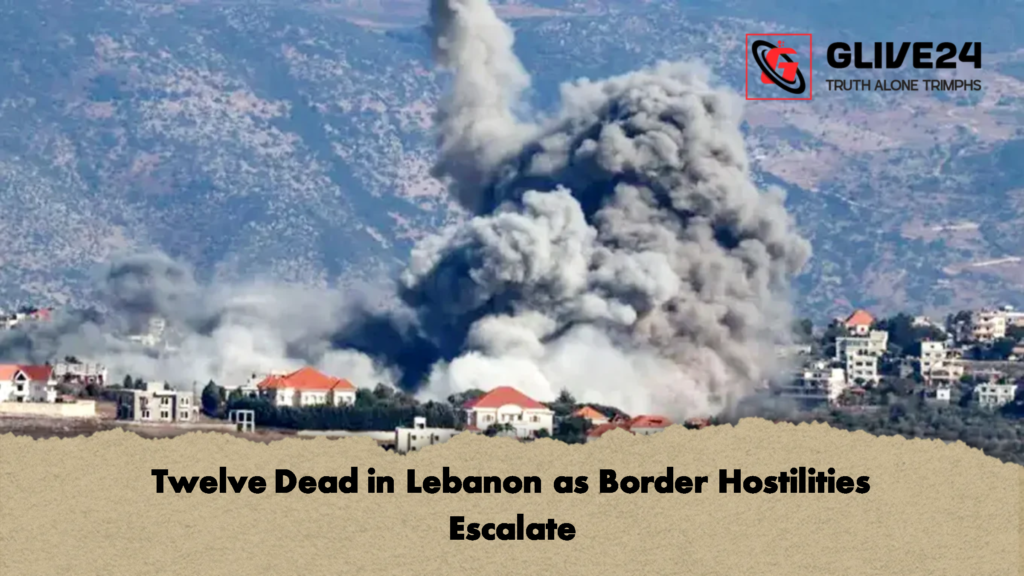
Hostilities between the Israel Defence Forces (IDF) and the Lebanese armed group Hezbollah have intensified, resulting in at least twelve fatalities in Southern Lebanon and injuries to three Israeli servicemen. Despite the formal ceasefire announced by United States President Donald Trump on 16 April, the security situation along the Blue Line remains volatile, with both sides engaging in significant military exchanges on Saturday.
Table of Contents
Escalation of Strikes in Southern Lebanon
On Saturday morning, the Israeli military issued urgent evacuation warnings to residents of nine villages in Southern Lebanon, signalling an imminent expansion of kinetic operations. Following these directives, the IDF launched a series of targeted strikes across the region. While Israel maintains that its operations are focused on neutralizing Hezbollah infrastructure and operatives, Lebanese media outlets have reported that strikes also impacted areas where no prior warnings had been disseminated.
The Lebanese Ministry of Public Health and local news agencies confirmed that at least twelve individuals were killed during the Saturday incursions. Reports indicate that the shelling and aerial bombardments have caused substantial damage to residential properties and civilian infrastructure. These actions follow a period of sustained tension in which Israeli ground forces have been accused of destroying homes in Southern Lebanon as part of a strategy to create a buffer zone and dismantle Hezbollah’s forward positions.
Hezbollah Drone and Rocket Counter-Attacks
In response to the Israeli offensive, Hezbollah escalated its counter-attacks, deploying a combination of explosive-laden unmanned aerial vehicles (UAVs) and rocket salvos. The IDF confirmed that three of its soldiers sustained injuries when a Hezbollah drone successfully struck a position near the Israel-Lebanon border. The wounded personnel were subsequently evacuated to a medical facility for treatment.
The Israeli military’s aerial defence systems were reportedly active throughout the day, intercepting several rockets launched from Lebanese territory. According to an official statement from the IDF, while some projectiles were neutralised, at least one drone managed to penetrate Israeli airspace and land within the country’s interior. However, military sources noted that this particular UAV failed to detonate upon impact, resulting in no casualties or structural damage in that specific instance.
Status of the April Ceasefire Agreement
The current wave of violence poses a significant threat to the ceasefire brokered by the United States last month. On 16 April, President Donald Trump announced a cessation of hostilities intended to end months of attrition and prevent a wider regional conflagration. The agreement was designed to facilitate the return of displaced civilians on both sides of the border and establish a framework for long-term stability.
However, the implementation of the truce has been fraught with difficulty. Hezbollah has accused the Israeli military of persistent violations, including continued ground incursions and the demolition of civilian dwellings. Conversely, the Israeli government maintains that it reserves the right to act against any perceived threats or movements by Hezbollah fighters that contravene the security arrangements of the ceasefire.
Regional Humanitarian Implications
The resurgence of heavy fighting has exacerbated an already dire humanitarian crisis in the border regions. Thousands of Lebanese citizens have been forced to flee their homes once again following the Saturday evacuation orders, contributing to the growing number of internally displaced persons (IDPs). On the Israeli side, the threat of UAV and rocket fire continues to disrupt daily life in northern communities, many of which remain largely evacuated.
As the death toll rises and military engagement deepens, international observers have expressed concern that the 16 April agreement is nearing a total collapse. Diplomats continue to urge both parties to exercise restraint and adhere to the terms of the ceasefire, though the intensity of Saturday’s exchanges suggests a move toward further escalation rather than de-escalation.