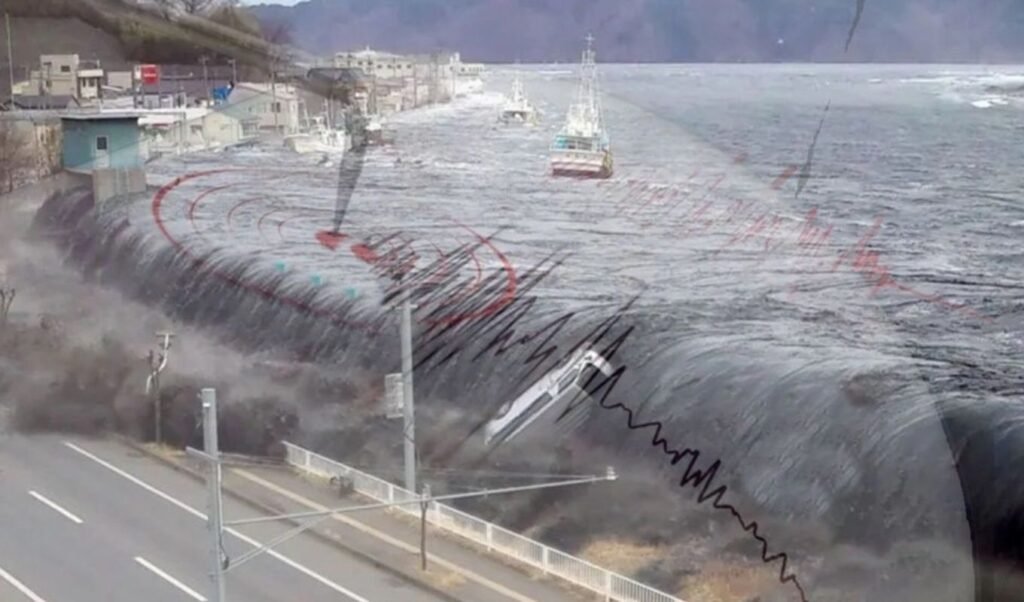
Bangladesh has experienced several earthquakes over the past week. Among them, a magnitude 4 earthquake was recorded in the Bay of Bengal on the night of Wednesday, 26 November. The following day, a magnitude 6.6 earthquake occurred in Indonesia, but no major tsunami was reported. Experts warn that a significant earthquake in Indonesia or the Andaman-Nicobar region could pose a tsunami risk to Bangladesh.
In 2004, a 9.1 magnitude earthquake in Indonesia claimed over 200,000 lives, with tsunami waves reaching as far as Africa. Bangladesh was also affected, with two reported fatalities.
Farzana Sultana, Assistant Meteorologist at the Earthquake Observation and Research Centre, explained that a sea earthquake exceeding magnitude 6.5 may trigger a tsunami. Tsunami service providers assess the potential wave height and timing to issue early warnings. Typically, earthquakes of magnitude four or below in the Bay of Bengal pose little threat of major damage.
Earthquakes occur due to movements of tectonic plates on the Earth’s surface—plates push, slide past, or subduct under each other. These movements cause ground shaking. Geological evidence shows that 230–280 million years ago, the supercontinent Pangaea existed before splitting into current continents.
Tsunamis are generated when strong earthquakes displace large volumes of water on shallow seabeds. Bangladesh lies at the junction of two major tectonic plates extending from Chittagong-Arakan to the Andaman region. However, experts suggest the likelihood of a major tsunami close to Bangladesh is relatively low.
In 1962, an 8.5 magnitude earthquake off the Arakan coast produced a significant tsunami. Professor Dr. Syed Humayun Akhtar noted that a repeat of such a major earthquake on the same plate typically takes 500–900 years. Therefore, the immediate risk of another large quake is low. Nonetheless, Bangladesh’s “funnel-shaped” geography could amplify some effects if a tsunami occurs in the Andaman or Bay of Bengal region.
Early warning systems can provide advance notice of tsunamis, though for Bangladesh, the risk from onshore large earthquakes is of greater concern than undersea tremors.
GLIVE/TSN