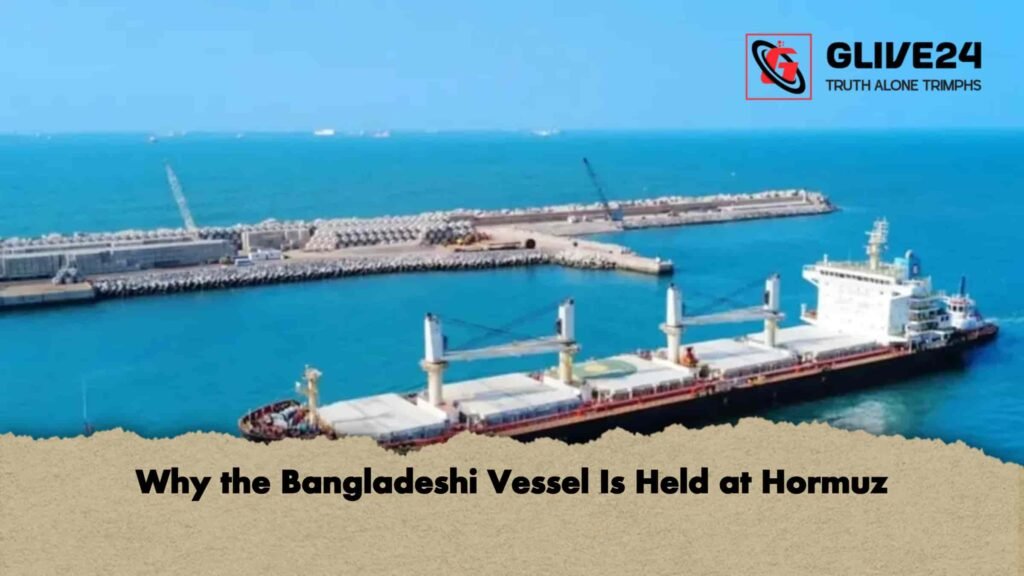
Iran’s tightening control over maritime movement through the Strait of Hormuz has affected international shipping operations, including a Bangladesh-flagged vessel, amid ongoing regional tensions involving the United States and Israel.
The vessel Banglar Joyjatra, owned by the Bangladesh Shipping Corporation (BSC) and operated under charter by a Singapore-based company, has reportedly been unable to pass through the strategic waterway due to the absence of clearance from Iranian authorities, including the Islamic Revolutionary Guard Corps (Islamic Revolutionary Guard Corps). The ship, carrying approximately 37,000 tonnes of fertiliser, is currently positioned near a port in the United Arab Emirates after repeated attempts to secure permission to transit the Strait of Hormuz were unsuccessful.
Bangladesh’s Ministry of Foreign Affairs confirmed that the matter was raised by Foreign Minister Khalilur Rahman on Sunday, 19 April, during a meeting in Türkiye with Iran’s Deputy Foreign Minister Saeed Khatibzadeh. During the discussion, Bangladesh requested assistance to facilitate the safe passage of the vessel through the strait.
In addition, reports indicate that another vessel, registered under the Cayman Islands flag and carrying Arabian Light crude oil from the Saudi port of Juaymah to Chattogram, was also unable to proceed on its scheduled route due to the lack of Iranian clearance for transit through Hormuz.
Although Iran’s ambassador in Dhaka had previously stated on 1 April that assistance would be extended to six Bangladeshi vessels awaiting permission to pass through the strait, subsequent developments indicate that transit approvals have not been consistently granted.
The Banglar Joyjatra had planned to proceed beyond Hormuz towards South African ports, including Cape Town and Durban, following its regional cargo operations. However, despite two separate attempts to navigate the strait, Iranian naval authorities and the IRGC reportedly denied passage, resulting in the vessel remaining in a holding position in international waters near the United Arab Emirates.
Summary of key developments
| Date | Development |
|---|---|
| Late March | Iranian authorities indicate conditional passage for selected vessels |
| 1 April | Iranian ambassador in Dhaka comments on support for Bangladeshi shipping requests |
| 5 April | Bangladesh seeks Iranian cooperation in Dhaka diplomatic meeting |
| 8 April | Vessel prepares for transit following regional maritime developments |
| 19 April | Issue formally raised again in Türkiye diplomatic discussions |
Diplomatic sources in Dhaka suggest that recent regional military developments and differences in official statements have contributed to the current situation. A former Bangladeshi diplomat noted that Bangladesh’s longstanding foreign policy principle is to avoid supporting military aggression, and that consistency in diplomatic messaging is essential to maintaining clarity in bilateral relations.
Iranian representatives have previously expressed concern regarding Bangladesh’s official responses to recent regional events, including statements issued by Dhaka following military escalation in the Middle East. These concerns were reportedly conveyed during engagements with the Iranian embassy in Dhaka, where dissatisfaction was expressed over perceived ambiguity in Bangladesh’s position.
The Strait of Hormuz remains one of the world’s most strategically significant maritime chokepoints, linking the Persian Gulf with major international shipping routes. Any restrictions in this passage directly affect commercial shipping schedules, requiring diplomatic coordination between flag states, port authorities, and regional actors to ensure uninterrupted transit.