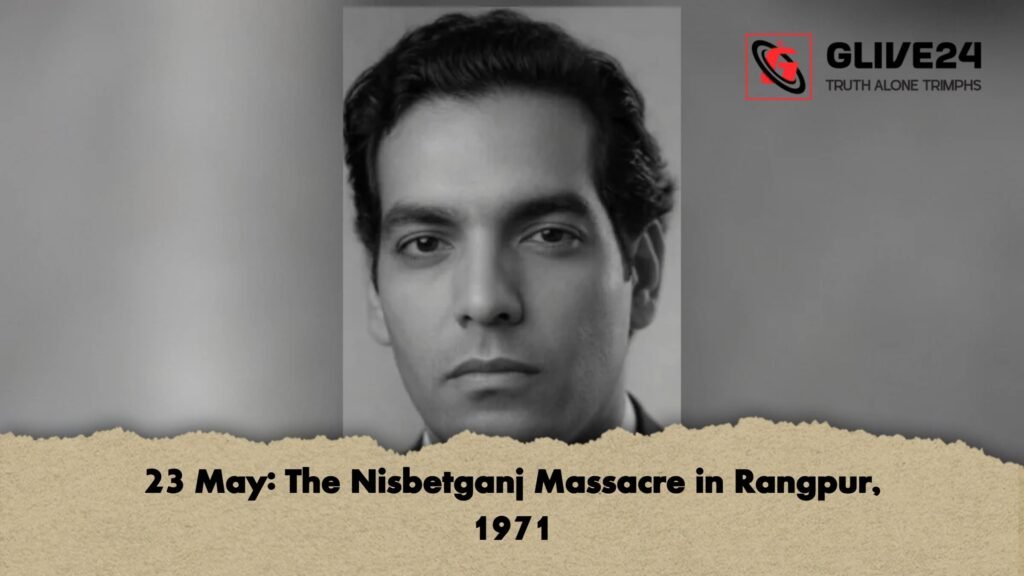
The history of the Bangladesh Liberation War in Rangpur is marked by the tragic events of 23 May 1971. On this Sunday night, the Pakistan Army, supported by local collaborators known as Razakars, conducted a systematic and brutal operation across several key areas of Rangpur city, including Litchu Bagan, Gomastapara, Dewanbari Road, and Nisbetganj. This operation resulted in the extrajudicial killing of numerous civilians and prominent intellectuals.
The Abduction and Execution of Civilians
During the late hours of 23 May, military forces targeted specific households. Shailen Dutta, an electrician, was forcibly removed from his residence while eating dinner. Simultaneously, the forces apprehended Advocate Purnachandra Sarkar, a senior lawyer, and Shankar Banik, a well-known businessman.
The execution of Shailen Dutta was particularly harrowing. While Purnachandra Sarkar and Shankar Banik were transported in a military jeep, Shailen Dutta’s legs were bound to the rear of a vehicle. He was dragged along the road from Litchu Bagan towards the Nisbetganj execution site. Witness accounts from the period indicate that his body was mutilated by the friction of the road surface during the transit. The following day, only his blood-stained garment (lungi) was recovered.
The Nisbetganj Killing Field
The Nisbetganj site served as a primary execution ground (Boddhyobhumi) during the conflict. Records suggest that over fifty innocent Bengalis were executed there during this specific period. Among the victims were esteemed members of the Rangpur intelligentsia who had chosen to remain in the country despite the escalating violence.
One notable figure was Advocate Bijoy Chandra Moitra, affectionately known as ‘Pakhida’. A central figure in Rangpur’s cultural and intellectual circles, he famously refused to flee the country, stating that deserting one’s motherland during a crisis was a profound injustice. He was eventually abducted on the night of 25 May and executed at the Nisbetganj site.
Summary of Identified Victims and Incidents
| Name of the Victim | Profession/Identity | Date of Incident | Method of Execution |
| Shailen Dutta | Electrician | 23 May 1971 | Dragged behind a military vehicle |
| Adv. Purnachandra Sarkar | Senior Lawyer | 23 May 1971 | Abducted and executed at Nisbetganj |
| Shankar Banik | Businessman | 23 May 1971 | Abducted and executed at Nisbetganj |
| Adv. Bijoy Chandra Moitra | Intellectual/Lawyer | 25 May 1971 | Abducted and executed at Nisbetganj |
| Unknown Victims | Civilians/Students | May 1971 | Mass execution at Nisbetganj |
Historical Significance and Remembrance
The massacre at Nisbetganj remains a significant chapter in the regional history of the 1971 war. The targeted killing of professionals and intellectuals was part of a broader strategy to deprive the Bengali nation of its leadership and cultural heritage.
Today, the Nisbetganj Boddhyobhumi stands as a memorial to those who perished. The events of 23 May are observed annually in Rangpur to honour the sacrifices of the martyrs who contributed to the eventual independence of Bangladesh. The documented bravery of individuals like Bijoy Chandra Moitra continues to be cited as a testament to the patriotic resolve of the local population during the nine-month-long struggle for sovereignty.