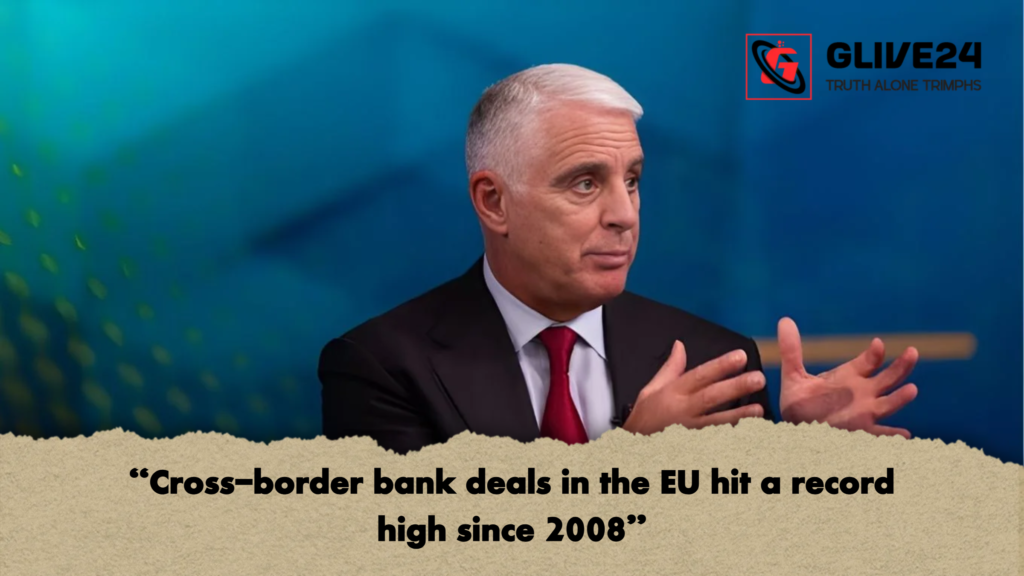
Cross-border mergers among European Union banks have surged to their highest level since the 2008 financial crisis, signalling a marked revival in dealmaking across a sector long hindered by regulatory and political barriers. Analysts say rising profits and buoyant share prices are making international consolidation increasingly attractive, despite ongoing challenges.
According to data provided to the Financial Times by Dealogic, the total value of cross-border EU banking deals reached €17 billion in 2025, a significant jump from just €3.4 billion the previous year. Several multibillion-euro transactions were central to this growth, highlighting renewed strategic interest among European lenders to expand beyond national borders.
| Year | Total Value of EU Cross-Border Banking Deals (€bn) |
|---|---|
| 2024 | 3.4 |
| 2025 | 17 |
For years, policymakers in Brussels have urged greater consolidation within the EU’s fragmented banking sector, arguing that the proliferation of smaller, domestically focused banks has left Europe trailing behind larger US rivals in efficiency and competitiveness. Regulatory complexity and political resistance, however, have long constrained cross-border expansion, keeping deal activity subdued.
Despite these hurdles, European banks appear undeterred. Executives are increasingly pursuing mergers to achieve scale, improve profitability, and leverage technological innovation. UniCredit chief Andrea Orcel, a longstanding advocate for stronger pan-European banks, warned that the competitive landscape is set to shift dramatically in the coming years.
“The competitive landscape is going to change dramatically,” Orcel said last week, citing both technological transformation and the rise of fintech competitors. “I’m pretty convinced that there will be fewer banks by 2030. There will be winners and losers, and the dispersion between them will be much, much greater. Some institutions will consolidate, others will be wiped out.”
Industry observers note that European banks are now weighing mergers not just for market expansion but also as a strategic response to disruptive technologies. Fintechs and digital banking platforms are reshaping customer expectations and forcing traditional lenders to rethink cost structures, product offerings, and regional footprints.
If the current momentum continues, the EU banking sector could see a wave of consolidation reminiscent of the post-crisis period, ultimately producing a smaller number of larger, more competitive institutions capable of challenging American and global peers. Analysts warn, however, that cross-border deals remain complex, often requiring lengthy regulatory approval processes and delicate negotiation between national authorities.
In short, while regulatory red tape persists, the combination of strong balance sheets, rising valuations, and technological pressures is driving European banks toward a new era of international consolidation, potentially reshaping the sector over the next decade.