
Khabor Wala Desk
Published: 26th May 2026, 1:49 AM
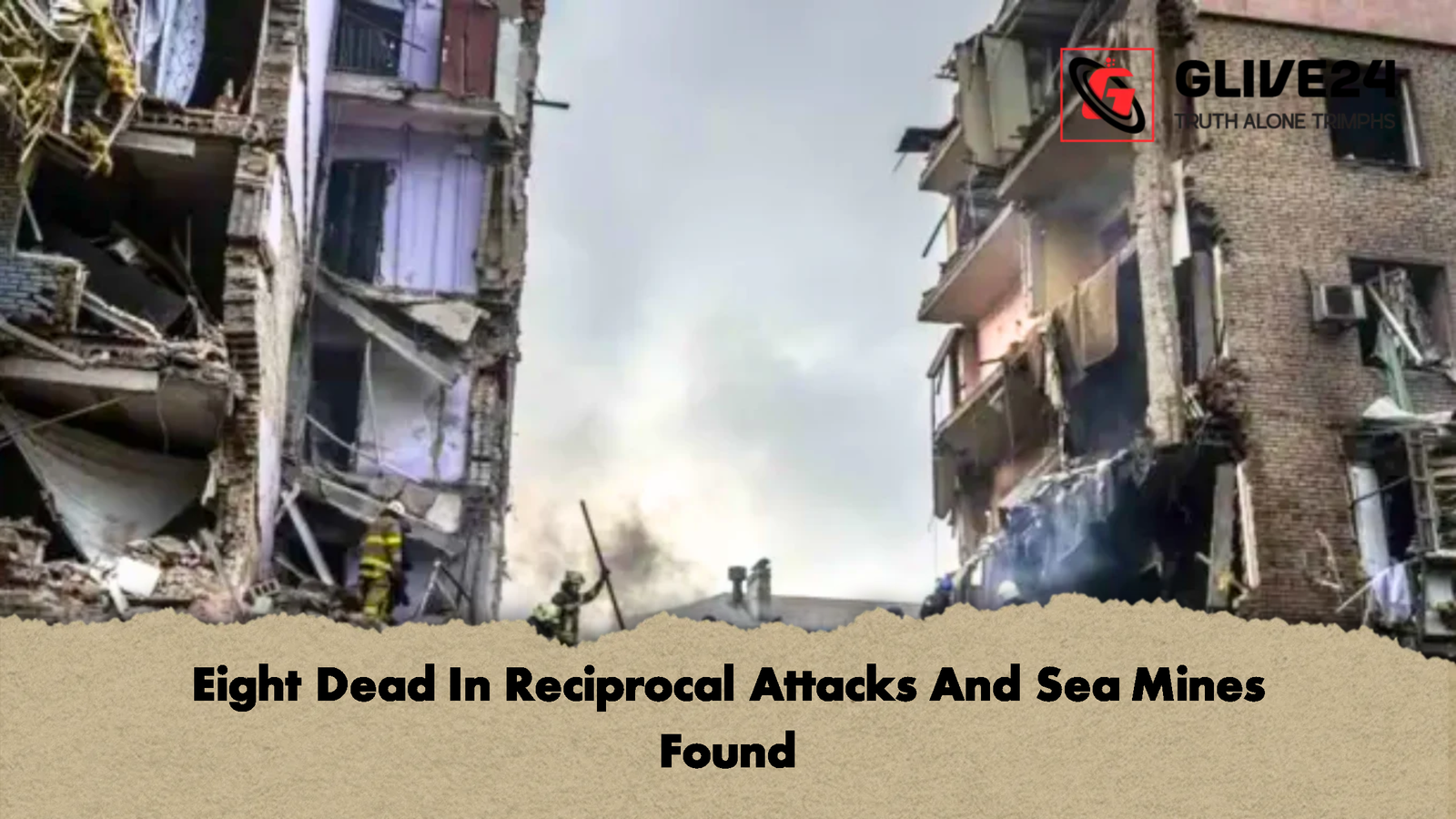
A series of intense cross-border missile and drone strikes conducted by Russian and Ukrainian forces over a 24-hour window has resulted in the confirmed deaths of at least eight individuals. Local administrative and municipal authorities from both sovereign nations verified the casualties on Monday, 25 May. The reciprocal bombardments caused severe structural damage to critical energy infrastructure within Russia’s western Belgorod region, leading to widespread disruptions to local electricity and water utility networks.
The latest escalation followed an official declaration from Moscow vowing retaliation for an earlier drone strike that struck a student dormitory in the Russian-occupied Luhansk region. Following this declaration, Russian aerospace forces launched what has been described as one of the most intense aerial assaults directed at the Ukrainian capital, Kyiv, in the past four years. The Ukrainian military high command systematically denied targeting civil infrastructure, asserting instead that their strike in Luhansk successfully neutralized an elite Russian drone command unit stationed within the area.
The human cost of the latest 24-hour cycle of tactical strikes spans multiple conflict zones across eastern Russia, the occupied territories, and southern Ukraine. The following data details the verified distribution of casualties and wounded civilians across the affected regions:
| Affected Territory | Controlling Authority | Confirmed Fatalities | Confirmed Wounded |
| Horlivka City | Russian-Controlled East Ukraine | 4 (including 2 teenagers) | 0 reported |
| Belgorod Region | Russian Federation Sovereignty | 1 | 1 |
| Kherson District | Ukraine Sovereignty (Southern) | 2 | 16 |
| Derhachi City | Ukraine Sovereignty (Near Kharkiv) | 1 | 2 |
| Dnipropetrovsk & Zaporizhzhia | Ukraine Sovereignty | 0 | 8 (including a 6-year-old child) |
In the Russian-controlled city of Horlivka, located in eastern Ukraine, a targeted Ukrainian bombardment resulted in the deaths of four individuals, including two teenagers. The localized data was officially published via the Telegram messaging application by the city’s mayor, Ivan Prikhodko. Concurrently, Ukrainian missile and drone strikes targeting the Russian border region of Belgorod killed one individual and wounded another, causing a complete collapse of local electricity and water supply grids.
In southern Ukraine, the regional Governor of Kherson, Oleksandr Prokudin, confirmed that Russian artillery and missile strikes killed two individuals and left sixteen others wounded. Further north, a Russian missile strike hitting the town of Derhachi, located near Kharkiv, claimed the life of one resident and injured two others. Additionally, eight civilians, including a six-year-old child, sustained injuries across the Dnipropetrovsk and Zaporizhzhia regions. In the city of Pavlohrad, situated within the Dnipropetrovsk oblast, a drone strike directly impacted a nine-storey residential building, generating thick columns of smoke over the urban area.
Both combatant nations have consistently denied intentionally targeting civilian populations or residential infrastructure during their respective operations. The operational timeline of the latest escalation and its diplomatic aftermath moved through several critical phases:
In a separate development, the Investigative Committee of the Russian Federation announced on Monday that its maritime security teams had discovered multiple magnetic sea mines manufactured by North Atlantic Treaty Organisation (NATO) member states. The explosive devices were found attached to the hull of a commercial oil tanker docked at the strategic Russian Baltic Sea port of Ust-Luga.
The security breach was uncovered during a routine underwater hull inspection conducted by specialist military divers. The targeted vessel was identified as the Arrhenius, a commercial tanker flying the Liberian maritime flag. The vessel had arrived at Ust-Luga from the Port of Antwerp in Belgium to load a cargo of liquefied petroleum gas (LPG) and was structurally scheduled to depart for the Port of Samsun in Turkey.
The official spokesperson for the Russian Investigative Committee, Svetlana Petrenko, confirmed that military bomb disposal units had successfully defused and removed the magnetic mines. Preliminary forensic investigations indicate that it would have been operationally impossible to deploy these specialized mines within Russian territorial waters, suggesting the explosive devices were attached to the tanker’s hull at an international port prior to its entry into the Baltic Sea. Officials representing NATO have declined to offer any immediate comment regarding the forensic findings or the deployment of the ordnance.



Comments