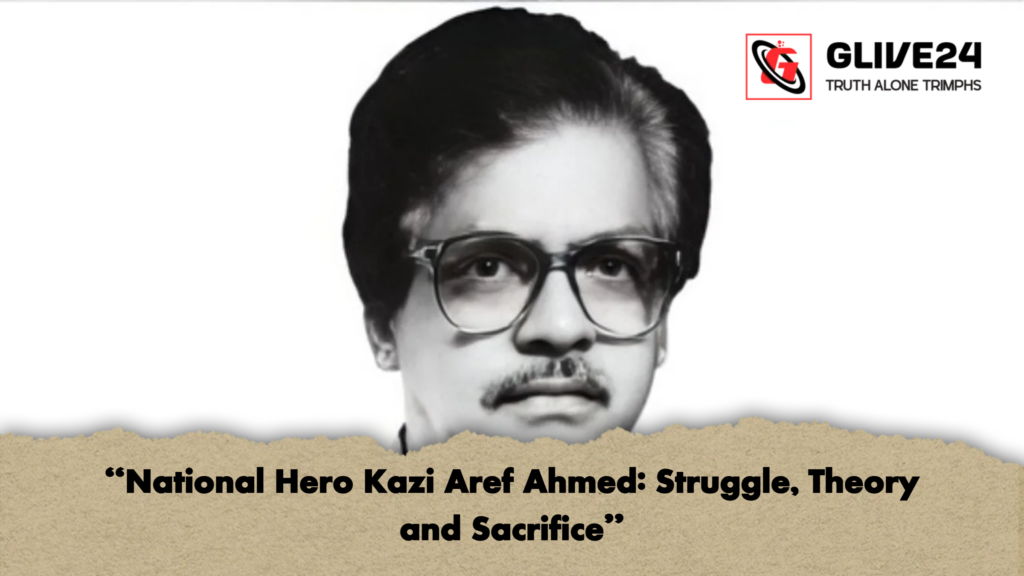
Today, 16 February, marks the death anniversary of National Hero Kazi Aref Ahmed, a pioneering leader in the Bengali liberation and democratic movements, a founding member of the Jatiya Samajtantrik Dal (JASAD), and a visionary for post-war societal transformation. On this day, we pay homage to his profound contributions, insightful political analyses, and indomitable spirit of struggle.
1960s: Shaping Modern Bengali Nationalism
During the 1960s, Kazi Aref played a pivotal role in developing the theoretical foundations of modern Bengali nationalism, resisting the discriminatory policies, cultural aggression, and political repression of the Pakistani state. He did not merely envision an independent nation; he questioned the nature of that independence—its social foundations, the distribution of state power, and the principles guiding its governance. For him, true liberation extended beyond territorial sovereignty to the creation of a society free from exploitation and oriented towards socialist ideals.
Liberation War and Revolutionary Leadership
In 1971, Ahmed actively contributed to the preparation for armed struggle, the strategic planning of a people’s war, and the infusion of socialist ideology into the liberation movement. Following independence, he advocated for the establishment of a revolutionary national government, urging the completion of the unfinished work of liberation. In line with this vision, he took a leading role in founding the Jatiya Samajtantrik Dal (JASAD), organising revolutionary democratic movements to pursue a socialist state.
Post-1975 Politics and New Theoretical Frameworks
The assassination of Sheikh Mujibur Rahman on 15 August 1975, followed by the political upheavals of November, drastically altered the character of national politics. In response, Kazi Aref redefined the “principal conflict” in Bangladesh’s political landscape: the confrontation between pro-liberation and reactionary forces. This theoretical insight facilitated the consolidation of pro-liberation forces and led to the formation of the 10-party alliance in 1979 and the 15-party alliance in 1983, which he guided in resisting military authoritarianism.
People’s Tribunal and Justice for War Crimes
Ahmed also spearheaded the National Coordination Committee and the historic People’s Tribunal in 1992, demanding accountability for the atrocities of 1971. These initiatives symbolised public defiance against state inaction and laid the moral and political groundwork for later war crimes trials.
Stance Against Communalism and Reactionary Politics
Throughout his life, Kazi Aref opposed communalism, religious fanaticism, feudalism, and colonial mentalities. He saw politics not merely as a struggle for power but as a question of conscience, values, and responsibility to future generations.
A Leader Across Three Decades
From the 1962 student movements to the liberation struggle, post-independence political reconstruction, anti-military campaigns, and the democratic uprisings of the 1990s, Ahmed combined theoretical insight with on-the-ground leadership. His political philosophy fused intellectual rigor with practical courage—a rare synthesis in Bangladesh’s political history.
Today, on his death anniversary, we honour Kazi Aref Ahmed with profound respect and gratitude. His dream of a secular, democratic, and socialist Bangladesh continues to inspire generations.
Key Contributions of Kazi Aref Ahmed
| Period | Contribution | Impact |
|---|---|---|
| 1960s | Theoretical framing of modern Bengali nationalism | Foundation for liberation ideology |
| 1971 | Strategic planning for Liberation War | Shaped people’s struggle and socialist ideals |
| 1975–1983 | Formation of political alliances against military rule | Strengthened pro-liberation forces |
| 1992 | National Coordination Committee & People’s Tribunal | Paved the way for war crimes trials |
| Lifelong | Advocacy against communalism, feudalism, and authoritarianism | Promoted secular, democratic, and socialist values |