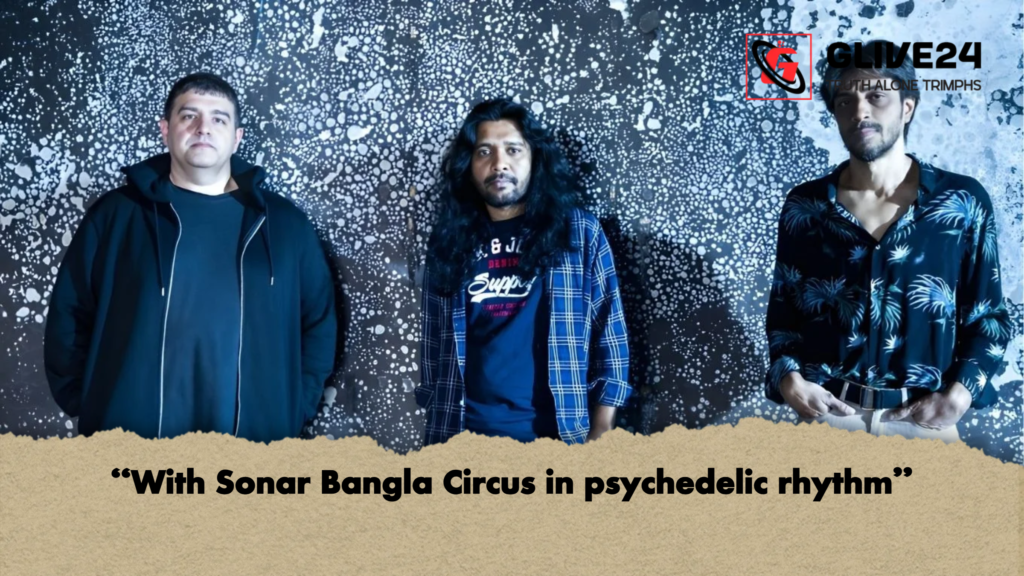
After a six-year interlude following their 2020 release Hyena Express, the indie rock outfit Shonar Bangla Circus has returned with an ambitious dual studio album. Released last month, Mohashoshan 1 and Mohashoshan 2 together feature 17 tracks that blend hypnotic rhythms, intricate arrangements, and lyrics designed to provoke thought and unsettle comfort zones.
While the band’s signature style remains—a fusion of intense lyricism with experimental rock—these new albums mark a broader musical exploration. When three members, Probar Ripon, Shakil Haque, and Saad Chowdhury, visited The Daily Star office, discussion quickly expanded beyond the music itself, exploring how the band cultivates its distinctive sound, resists conventional Bangladeshi rock traditions, and experiments with what they term “Bangla funk.” Electric guitarist Seth Panduranga Blumberg, affectionately known as Pandu, joined the conversation remotely from California, adding a transcontinental dimension to the discussion.
(L-R) Seth Panduranga Blumberg, Saad Chowdhury, Shakil Haque, with Probar Ripon at centre. Photo: Tanzim Bijoy
Probar Ripon elaborated on the creative process behind the albums. “It took nearly three years to complete these albums because of the sheer scale—17 songs with intricate arrangements,” he explains. Unlike Hyena Express, recorded in just four days with a conventional rock setup, Mohashoshan employs multiple layers of instruments, including dhols, violins, and experimental textures, crafting a rich, immersive soundscape.
Pandu emphasises the cultural depth that shaped the albums. “Bangladesh’s music runs as deep and funky as its rivers. Its grooves, philosophies, performers, and sounds are profound—true treasures. The cosmic energy and bodily resonance of these grooves inform everything I play,” he says.
Other factors, such as ongoing live performances—approximately 12 shows per month—and the country’s political climate, slowed production. “But the time allowed the albums to mature into what they needed to be,” Ripon notes.
Shonar Bangla Circus consciously diverges from conventional Bangladeshi rock. “Our approach is psychedelic, almost like lyrical theatre or opera,” Ripon says. “We are a collective that thinks alike, allowing the music to emerge naturally.” Pandu adds, “Our sound is collaborative. I complement my bandmates while following my instincts. Music bridges the seen and unseen.”
Keyboardist Saad, who joined the band later, stresses the unifying power of music despite language barriers. “Even if I don’t fully grasp the lyrics, I connect with their essence musically. The band’s open-mindedness, especially Pandu’s freedom on guitar, is inspiring,” he observes.
Bassist Shakil reflects philosophically on Mohashoshan, noting its exploration of universal experiences like birth, death, and suffering, emphasizing a timeless, global perspective rather than specific events. Ripon echoes this ethos: lyrics are meant to confront, provoke, and reveal uncomfortable truths, mirroring the unfiltered reality of life.
On the intersection of music and technology, all members agree that AI cannot replace human emotion or live performance. Pandu sees AI as a supportive tool rather than a creative substitute, while Shakil stresses that the band’s energy comes from human interaction. Ripon adds an optimistic note: despite technological advances, audiences will continue to value human-made art.
Financial challenges persist, particularly regarding royalties. “Digital platforms pay based on views, but rates are lower than international standards,” Ripon notes, highlighting ongoing inequities for Bangladeshi artists.
Mohashoshan Album Overview
| Album | Tracks | Notable Features | Recording Time |
|---|---|---|---|
| Mohashoshan 1 | 9 | Multi-layered instrumentation, dhols, violins | 3 years |
| Mohashoshan 2 | 8 | Experimental sounds, Bangla funk, psychedelic motifs | 3 years |
| Total | 17 | Dual album concept, immersive soundscape | 3 years |
With Mohashoshan, Shonar Bangla Circus asserts itself as a band unafraid to challenge conventions, craft complex sonic tapestries, and provoke thought—all while remaining rooted in the rich musical heritage of Bangladesh.