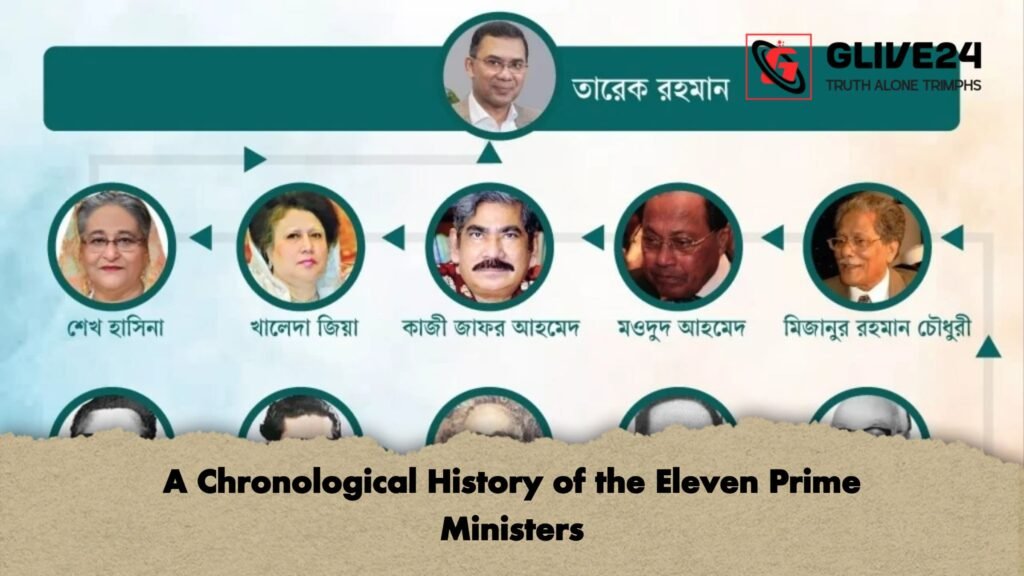
In the wake of a definitive landslide victory in the 13th General Election, Tarique Rahman, Chairman of the Bangladesh Nationalist Party (BNP), has officially taken the oath of office. His inauguration on 17 February 2026 marks a significant generational shift, as he becomes the 11th Prime Minister in the nation’s history.
From the foundational years of the liberation struggle to the contemporary era, the office of the Prime Minister has seen various leaders navigate the complexities of governance. Below is a refined retrospective of the figures who have held the nation’s highest executive office.
Table of Contents
The Foundation and Early Years
The lineage began with Tajuddin Ahmad, who led the Mujibnagar Government during the 1971 Liberation War. Following the return of Sheikh Mujibur Rahman, the executive structure shifted, with the latter serving as the second Prime Minister until the transition to a presidential system in 1975. This era was followed by the brief tenure of Muhammad Mansur Ali, which ended amidst the political upheaval of August 1975.
The Transitional and Multi-Party Era
As the nation transitioned through different administrative styles in the late 70s and 80s, figures such as Shah Azizur Rahman and Ataur Rahman Khan held the mantle. The 1980s, largely dominated by the presidency of Hussain Muhammad Ershad, saw a succession of Prime Ministers including Mizanur Rahman Chowdhury, Moudud Ahmed, and Kazi Zafar Ahmed, each serving varying terms under the presidential framework of that period.
The Rise of Modern Democracy
The 1991 general elections heralded a new dawn for parliamentary democracy. Begum Khaleda Zia made history as the nation’s first female Prime Minister, eventually serving three terms. Her political rival, Sheikh Hasina, also held the office across multiple terms, including a continuous stretch of over fifteen years that concluded in August 2024.
Executive Timeline: Prime Ministers of Bangladesh
| Order | Prime Minister | Tenure Duration | Key Milestone |
| 1 | Tajuddin Ahmad | 8 Months, 26 Days | First PM; led the Mujibnagar Government. |
| 2 | Sheikh Mujibur Rahman | 3 Years, 13 Days | Founded the first post-independence cabinet. |
| 3 | Muhammad Mansur Ali | 6 Months, 21 Days | Served during the transition to a one-party system. |
| 4 | Shah Azizur Rahman | 2 Years, 11 Months | Prime Minister during the Ziaur Rahman era. |
| 5 | Ataur Rahman Khan | 9 Months, 2 Days | Appointed during the early Ershad administration. |
| 6 | Mizanur Rahman Chowdhury | 1 Year, 8 Months | Prominent leader during the mid-1980s. |
| 7 | Moudud Ahmed | 1 Year, 4 Months | Distinguished lawyer and veteran politician. |
| 8 | Kazi Zafar Ahmed | 1 Year, 4 Months | Final PM before the 1990 democratic uprising. |
| 9 | Begum Khaleda Zia | 10 Years, 29 Days | First female PM; served three separate terms. |
| 10 | Sheikh Hasina | 20 Years, 7 Months | Longest-serving PM in the nation’s history. |
| 11 | Tarique Rahman | Incumbent | First second-generation PM; took oath in 2026. |
A New Chapter: The 11th Premier
Tarique Rahman’s ascension is notable not only for his electoral mandate but for his personal journey. After 17 years in political exile in London, he returned to Dhaka on 25 December 2025. His return was marked by personal loss, as his mother, the pioneering Begum Khaleda Zia, passed away just five days later. Now, as the 11th Prime Minister, he faces the formidable task of national reconstruction and upholding the democratic aspirations of the “Student-People” uprising that reshaped the political landscape in 2024.