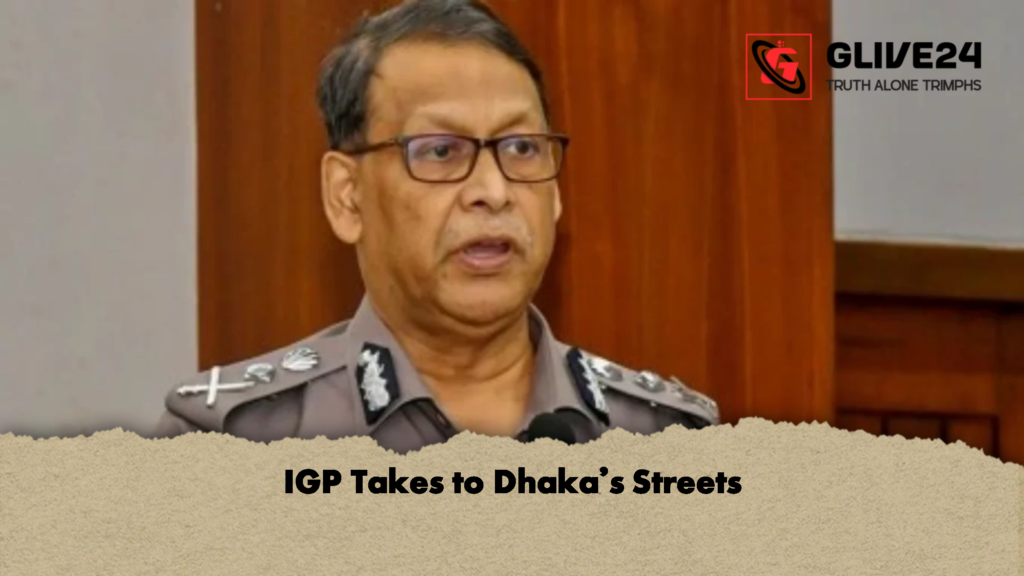
The newly appointed Inspector General of Police, Ali Hossain Fakir, carried out an unannounced midnight inspection of security arrangements in Dhaka on Thursday, declaring that he had “personally taken to the streets” to safeguard city residents.
Mr Fakir, who formally assumed office on Wednesday, began his field visit shortly after midnight in Mohammadpur—an area widely regarded as one of the capital’s more crime-affected neighbourhoods. The tour included stops at Geneva Camp, Mohammadpur Town Hall and the busy Three-Roads intersection, where he reviewed police deployments and spoke directly with officers on patrol duty.
He was accompanied by senior officials of the Dhaka Metropolitan Police (DMP), including Acting Commissioner Mohammad Sarwar, Tejgaon Division Deputy Commissioner Ibn Mizan, and Mohammadpur Police Station Officer-in-Charge Mezbah Uddin.
‘No One Will Be Spared’
At approximately 1:00 am, the IGP made a surprise visit to Mohammadpur Police Station and addressed journalists waiting there.
“I have come onto the streets myself for the safety of city dwellers,” he said. “Whoever the criminal may be, they will be dealt with firmly. No one will be spared.”
He acknowledged that many residents feel unsettled by the activities of juvenile gangs, muggers and narcotics traffickers. To address these concerns, he confirmed that special evening block raids are under way, targeting robbery suspects and individuals involved in the drugs trade.
A Personal Memory
In a candid reflection, Mr Fakir revealed that during his university years in 1986 he was himself a victim of mugging near Geneva Camp while visiting a relative. The experience, he said, left a lasting impression and reinforced his view that Mohammadpur has long grappled with entrenched criminal networks and illegal commerce.
He also drew attention to wider urban management challenges, noting that the encroachment of pavements has increasingly spilled onto main roads, disrupting traffic flow and pedestrian movement.
Policing Under Pressure
The IGP underscored the scale of the challenge facing law enforcement nationwide. Bangladesh, with a population of roughly 200 million, is served by approximately 220,000 police personnel. Dhaka alone is home to an estimated 40 million residents, placing immense pressure on metropolitan policing resources.
| Indicator | Approximate Figure |
|---|---|
| National population | 200 million |
| Total police personnel | 220,000 |
| Estimated Dhaka population | 40 million |
| Date assumed office | Wednesday (this week) |
| Midnight inspection | After 12:00 am, Thursday night |
He stressed that a stable law-and-order environment is essential for economic growth and investor confidence. “If the security situation is not normal, both the economy and investment suffer,” he observed.
At the same time, he called upon citizens to comply with the law and cooperate with police efforts to maintain public order.
Reform Agenda and Eid Security
Mr Fakir announced that restructuring within the traffic division is currently under way, aimed at improving road discipline and congestion management. With the forthcoming festival of Eid-ul-Fitr expected to prompt a large-scale departure of homebound travellers from the capital, he pledged to remain active in night patrols to ensure safe journeys.
He further indicated that enforcement measures would not be limited to street crime. Action would also be taken against so-called “white-collar” offenders, though he emphasised that all operations would remain within the framework of existing law and respect for human rights.
When asked about potential changes to police uniforms, the IGP said the matter was under consideration by the government.
The midnight operation, conducted within 24 hours of his appointment, appears designed to project a proactive leadership style and to reassure citizens that restoring public confidence and visible policing in high-risk areas are among his immediate priorities.