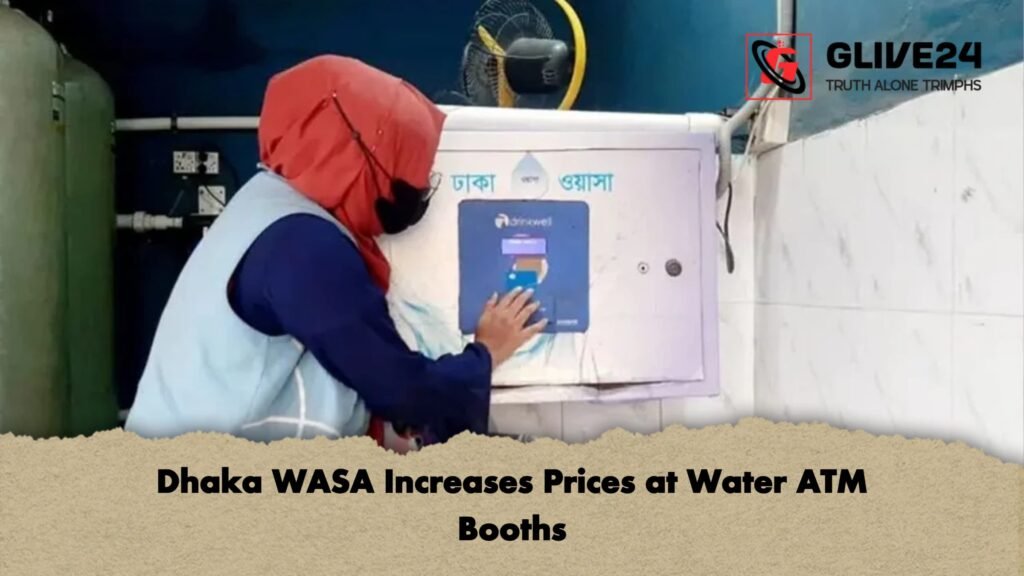
In a move that is set to impact thousands of low-income households and commuters across the capital, the Dhaka Water Supply and Sewerage Authority (WASA) has officially implemented a price hike for water dispensed through its automated ATM booths. This adjustment, which comes into effect today, marks a significant shift in the cost of accessing purified drinking water in a city already grappling with rising utility expenses.
Official Implementation and Justification
The decision was formalised through an official directive signed by SM Jahangir Hossain, the Secretary of Dhaka WASA. According to the office order, the resolution to increase tariffs was finalised during the 14th meeting of Dhaka WASA’s “Performance Support Committee,” held on 28 January.
The primary rationale provided by the authorities for this fiscal adjustment is the escalating cost of Operation and Maintenance (O&M). Maintaining the sophisticated filtration systems, electricity for the cooling units, and the digital payment infrastructure has reportedly become unsustainable at the previous price point. Consequently, the cost per litre has been revised from 80 Paisa (inclusive of VAT and taxes) to 1 Taka (inclusive of VAT and taxes).
Historical Context of Tariff Adjustments
This is not the first time in recent years that Dhaka WASA has adjusted its “Water ATM” rates. The service, which was initially introduced to provide affordable, safe drinking water to those without access to domestic lines, has seen its costs double and then rise again in a relatively short window.
Table: Evolution of Dhaka WASA Water ATM Prices (2022–2026)
| Effective Date | Price Per Litre (Paisa/Taka) | Percentage Increase | Primary Reason Cited |
| Prior to Aug 2023 | 40 Paisa | — | Baseline Rate |
| 1 August 2023 | 80 Paisa | 100% | Rising Maintenance & Logistics |
| 2 March 2026 | 1 Taka (100 Paisa) | 25% | Increased O&M Costs |
Impact on Urban Residents
The Water ATM project, often managed in partnership with international NGOs and social enterprises, was designed as a “pro-poor” initiative. For residents of Dhaka’s informal settlements (slums) and daily wage earners, these booths are the primary source of potable water. While a 20-paisa increase may seem marginal to some, for families consuming 20 to 30 litres a day, the cumulative monthly cost is a notable burden on their domestic budgets.
Critics argue that as a public utility provider, WASA should absorb maintenance costs rather than passing them on to the city’s most vulnerable populations. However, the authority maintains that the 1 Taka per litre rate remains significantly cheaper than commercially bottled water, which typically retails for 15 to 20 Taka per litre.
The new rates are now active across all designated booths in the North and South City Corporations. Users are advised that their pre-paid smart cards will now reflect the adjusted deduction per transaction.