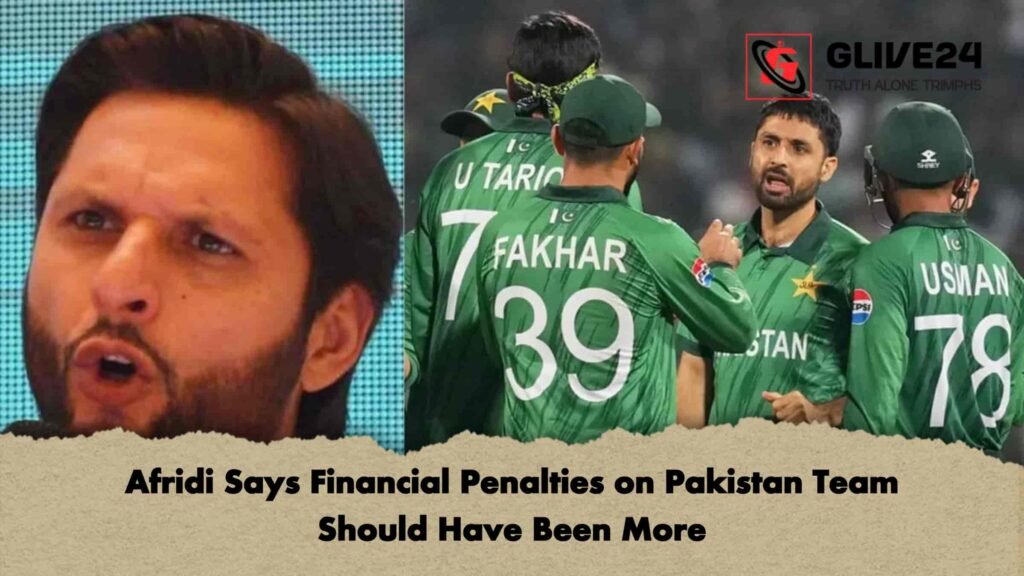
Pakistan’s national cricket side has been thrust into fresh controversy after failing to reach the semi-finals in four consecutive International Cricket Council tournaments. Despite securing victory in their final Super Eight fixture against Sri Lanka at the recent Twenty20 World Cup, the team fell short of a place in the last four, extending a run of disappointing outcomes in global competitions.
In response, the Pakistan Cricket Board announced financial penalties for members of the squad. According to reports, each player has been fined five million Pakistani rupees. The decision has sparked widespread debate across the cricketing fraternity, with questions raised about both its severity and its effectiveness as a corrective measure.
Former captain and celebrated all-rounder Shahid Afridi has been particularly forthright in his criticism. Describing the sanction as reflective of a “narrow mindset”, Afridi argued that while disciplinary action is justified in cases of sustained underperformance, the amount imposed may not deliver the intended message. He suggested that a more meaningful deterrent would involve exclusion from the national side rather than a purely financial penalty.
Afridi elaborated that players who fail to meet performance standards should be required to return to domestic first-class cricket to rebuild form and discipline. He further proposed that, in certain cases, a two-year absence from international selection might serve as a stronger corrective than monetary punishment alone.
Under the central contract structure of the Pakistan Cricket Board, players’ remuneration comprises an annual retainer and a share of International Cricket Council revenue distributions. The relevant figures are outlined below:
| Player Grade | Annual Salary (Million Rupees) | International Cricket Council Share (Million Rupees) | Total Annual Earnings (Million Rupees) |
|---|---|---|---|
| C Grade | 10 | 7.5 | 17.5 |
| D Grade | 10 | 7.5 | 17.5 |
Given these earnings, a five million rupee fine represents a substantial portion of several months’ income, yet Afridi maintains that it falls short of being genuinely punitive.
Meanwhile, Pakistan Cricket Board chairman Mohsin Naqvi has defended the principle of linking financial rewards to performance. He emphasised that remuneration and incentives must correspond with results, adding that constructive encouragement, alongside accountability, remains vital for motivating elite athletes.
Statistically, Pakistan’s absence from the semi-final stage in four successive International Cricket Council events is regarded as a significant warning sign for a team historically associated with resilience and unpredictability on the global stage. Analysts contend that structural reforms, enhanced strategic planning, consistent exposure to high-level competition, and sustained domestic performances are essential to reversing the decline.
As debate continues, supporters hope that administrative resolve and renewed player commitment will combine to restore Pakistan’s standing among cricket’s foremost nations.