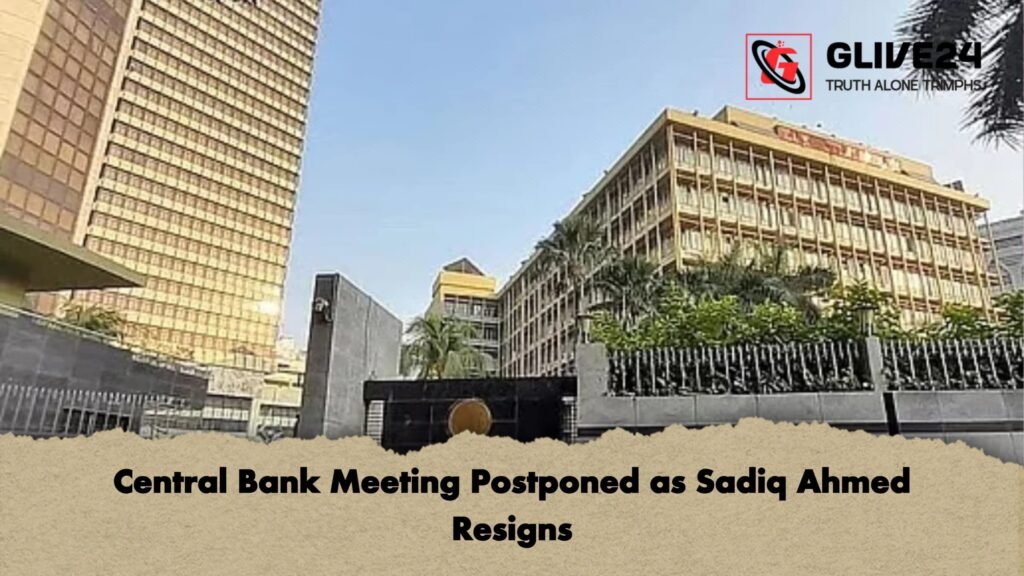
The newly appointed Governor of the Bangladesh Bank, Mostakur Rahman, has encountered a significant institutional hurdle in his debut attempt to pivot the nation’s monetary policy. A critical meeting of the Monetary Policy Committee (MPC), originally scheduled for Wednesday to discuss a reduction in interest rates, has been abruptly postponed. This delay coincides with the high-profile resignation of renowned economist Dr Sadiq Ahmed from the committee, sending ripples through the country’s financial sector.
Table of Contents
A Controversial Shift in Policy
Governor Rahman, upon assuming office, signaled a desire to transition away from the restrictive monetary stance of his predecessor. His objective was to lower the policy rate (repo rate)—currently standing at 10%—by approximately 25 to 50 basis points. The rationale behind this move is to reduce the cost of borrowing for businesses and individuals, thereby stimulating economic activity.
However, the timing of this proposed cut has sparked intense debate among economists and policymakers. With inflation remaining stubbornly high, many analysts argue that loosening the “noose” on interest rates prematurely could exacerbate price instability and undermine the value of the Taka.
The Resignation of Dr Sadiq Ahmed
Adding to the uncertainty is the departure of Dr Sadiq Ahmed, the Vice-Chairman of the Policy Research Institute (PRI) and a former senior official at the World Bank. Dr Ahmed was the sole member of the seven-person MPC nominated directly by the central bank’s Board of Directors.
While the exact reasons for his resignation have not been formally disclosed, central bank officials suggest a potential rift over the proposed rate cuts. Dr Ahmed’s departure is seen as a significant loss of technical expertise, particularly given his long-standing advocacy for market-based, data-driven economic reforms.
Structure of the Monetary Policy Committee
The MPC is the primary body responsible for determining the nation’s interest rate path. Its composition is designed to balance internal central bank expertise with external academic and research perspectives.
| Member Name | Designation | Institutional Affiliation |
| Mostakur Rahman | Chairman | Governor, Bangladesh Bank |
| Md. Habibur Rahman | Member | Deputy Governor, Bangladesh Bank |
| Md. Akhtar Hossain | Member | Chief Economist, Bangladesh Bank |
| A.K. Enamul Haque | Member | Director General, BIDS |
| Ferdousi Nahar | Member | Chair, Dept. of Economics, DU |
| Mahmud Salahuddin Naser | Member | Executive Director, Bangladesh Bank |
| Vacant | (Formerly Dr Sadiq Ahmed) | Board Nominee / PRI Vice-Chairman |
Implications and Next Steps
The Director General of the Bangladesh Institute of Development Studies (BIDS), A.K. Enamul Haque, confirmed that members were notified on Tuesday afternoon that the meeting would not proceed. It is now expected that any decisions regarding rate adjustments will be deferred until after the upcoming Eid holidays.
The postponement provides a temporary reprieve for the central bank to manage the optics of Dr Ahmed’s exit and perhaps reconsider the aggressiveness of the proposed cuts. For the market, the primary concern remains whether the bank will prioritise growth through lower rates or continue the fight against inflation.