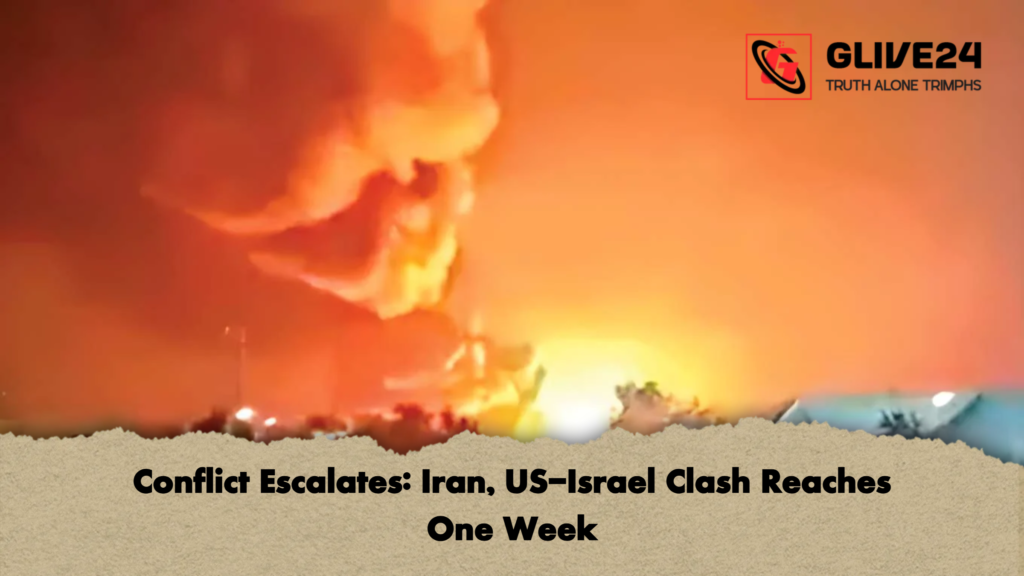
The war in the Middle East between Iran and the US-Israel coalition has now entered its second week, leaving a trail of destruction and human suffering. Intensifying retaliatory strikes centred around Tehran and Tel Aviv have resulted in thousands of casualties, widespread infrastructural damage, and a sharp spike in global oil prices. Analysts warn that lower- and middle-income countries, including Bangladesh, face an acute fuel crisis as a result.
On Friday, the United States and Israel launched a series of aerial and missile strikes targeting Tehran and other major Iranian cities. In response, Iran fired advanced missiles at Israel, striking Ben Gurion Airport, military facilities in Haifa, and multiple urban areas. Israel’s air defence systems were unable to intercept all incoming projectiles, leading to significant damage and casualties.
Meanwhile, Iran has extended its attacks to US installations across Saudi Arabia, Qatar, Kuwait, Bahrain, and the United Arab Emirates. Reports confirm that one Bangladeshi national was killed in Kuwait, adding to the two previously reported fatalities. In Qatar, LNG production has been temporarily halted, threatening energy supplies worldwide.
Iranian President Masoud Pezeshkian condemned foreign aggression, stating: “Those who have devalued the Iranian people should expect no mediation.” Foreign Minister Abbas Araghchi accused the United States and Israel of targeting civilian areas. The Tasnim news agency further reported that any US or Israeli vessel sighted in the Strait of Hormuz would be considered a legitimate target.
Casualty figures remain alarming. Israel’s Ministry of Health reported 140 injuries in a single day, including one critical case. Over the past seven days, Iran has recorded 1,332 fatalities and more than 2,000 injuries, ranging from infants as young as four months to elderly citizens aged 94.
Damage in Iran (Red Crescent Report)
| Affected Structures | Number |
|---|---|
| Residential buildings | 3,090 |
| Commercial/Service centres | 528 |
| Medical facilities/Pharmaceuticals | 14 |
| Red Crescent facilities | 9 |
| Total | 3,643 |
Former US President Donald Trump called for Iran’s unconditional surrender, dismissing further troop deployments as “a waste of time.” However, US military officials, including Hegseth and Brad Cooper, have warned that the conflict is likely to escalate further.
In Lebanon, Hezbollah launched missile and drone attacks on Israeli targets, killing at least five people. Israel has responded with extensive airstrikes.
Global leaders are urging restraint. German Chancellor Friedrich Marz has warned that prolonged conflict could jeopardise Europe’s energy security and stability, while the Spanish and Portuguese prime ministers have strongly condemned the attacks. Sri Lankan President Anura Kumara Dissanayake reported the rescue of 208 crew members from the Iranian vessel IRIS Bushehr. Hundreds of oil and gas tankers remain stranded in the Strait of Hormuz, threatening the global economy.
The Middle East crisis has thus evolved beyond military confrontation, creating a complex global emergency spanning energy markets, maritime security, and human rights, with ramifications set to be felt worldwide.