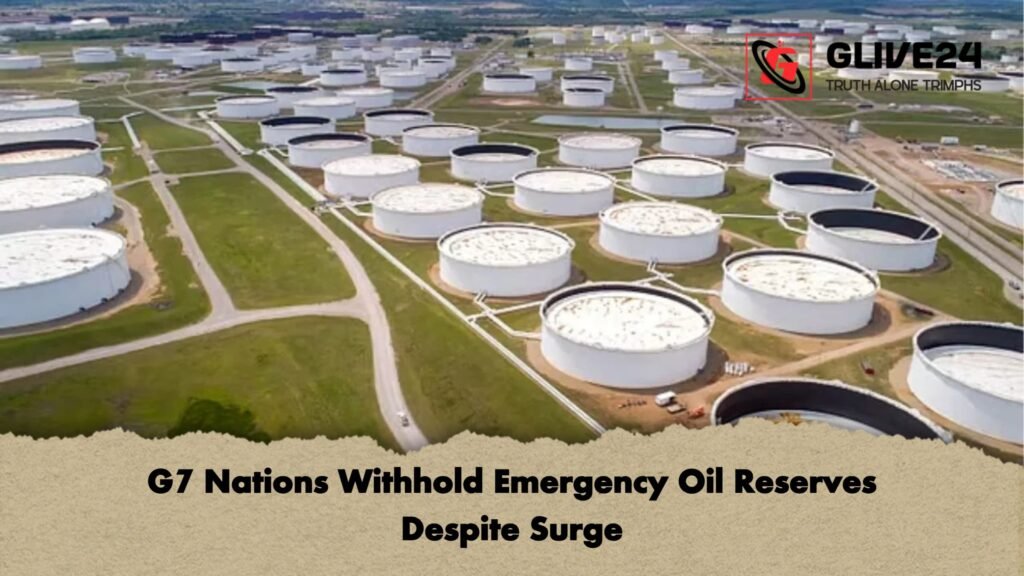
The Group of Seven (G7) industrialised nations have reached a preliminary consensus to maintain their strategic emergency oil reserves for the time being, despite a volatile spike in global energy prices. Following a high-level summit of G7 finance ministers on Monday, the bloc signalled that while they are “ready to act,” the immediate release of stockpiles is not yet deemed the most effective course of action.
The meeting was convened as a matter of urgency following a dramatic surge in crude oil prices late Sunday night, triggered by escalating geopolitical tensions in the Middle East. While the markets remain on edge, the G7—comprising the United Kingdom, United States, Canada, Japan, Italy, Germany, and France—opted for a strategy of “strategic patience” rather than immediate intervention.
A Unified Stance on Market Stability
According to an official privy to the discussions, there was a unanimous agreement among the finance ministers that the current market conditions, though strained, do not yet necessitate the deployment of the Strategic Petroleum Reserve (SPR). The official noted that the decision was not a matter of opposition from any single member state, but rather a calculated assessment of timing and market psychology.
“There was a general consensus that we must remain vigilant,” the official told Reuters. “It is not that the measure was rejected; it is a question of identifying the precise moment where such a release would provide the maximum stabilising effect. Further analysis of the supply-demand deficit is required before we commit.”
Strategic Petroleum Reserves of G7 Nations (Estimated)
| Nation | Strategic Reserve Capacity (Million Barrels) | Daily Consumption (Million Barrels) | Primary Storage Method |
| United States | 714 | 20.5 | Underground Salt Caverns |
| Japan | 500 | 3.4 | Above-ground Tanks |
| Germany | 160 | 2.1 | Salt Caverns & Tanks |
| France | 110 | 1.5 | Commercial/State Hybrid |
| United Kingdom | 80 | 1.1 | Industry-held Stocks |
| Italy | 75 | 1.2 | Private Sector Mandates |
| Canada | N/A* | 2.4 | Direct Production Surplus |
*Note: As a net exporter, Canada does not maintain a formal government-owned SPR but relies on its vast domestic production and commercial inventories.
Looking Ahead: Ministerial Deliberations
The diplomatic efforts to manage the energy crisis are set to intensify. On Tuesday, the G7 energy ministers are scheduled to hold an emergency teleconference to discuss the technical aspects of global supply chains and the potential impact of prolonged high prices on industrial output.
Furthermore, a summit of G7 heads of state is expected later this week. Analysts suggest that any definitive order to flood the market with emergency reserves will likely come directly from these top-tier leaders. For now, the bloc’s official communiqué serves as a warning to speculators: the G7 stands prepared to take “all necessary measures” to ensure the continuity of global energy supplies.