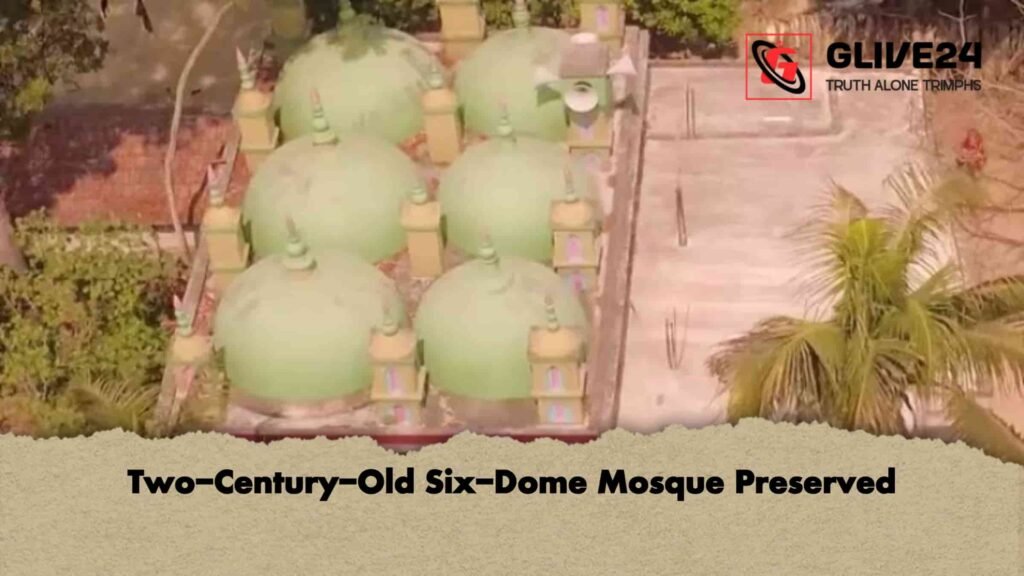
Standing as a silent witness to history, the six-dome mosque of Cherraghat in Kalarao, Satkhira, is one of the region’s most ancient and historically significant monuments. Revered not only for its religious function but also as a cultural heritage site, the mosque has endured nearly two centuries, preserving the architectural and spiritual legacy of the area.
Located approximately four kilometres from the Upazila headquarters, the mosque rests along the banks of a small canal in the Dumdum area, surrounded by serene and shaded landscapes. Locally, it is often referred to as the “Kayem Biswas Mosque,” after its original founder. According to the mosque’s nameplate, construction was completed in Bengali 1269, corresponding to 1862 AD. This places the structure at over 160 years old, making it a prime example of 19th-century Muslim architectural design in southwestern Bangladesh.
Constructed with slender bricks bound with lime mortar, the mosque sits atop roughly twelve acres of land. Its structural highlights include a roof supported by ten pillars, six elegant domes, ten minarets, and seven doors. With a height of approximately fifteen feet, it accommodates over a hundred worshippers for congregational prayers at once.
| Feature | Details |
|---|---|
| Location | Cherraghat Village, Kalarao Upazila, Satkhira |
| Year of Construction | Bengali 1269 (1862 AD) |
| Land Area | 12 acres |
| Domes | 6 |
| Minarets | 10 |
| Pillars | 10 |
| Doors | 7 |
| Capacity | Over 100 worshippers |
Historical accounts suggest that Kayem Biswas was a prominent landowner in the region. Conflict with the Murshidabad Zamindar Durgapad Chowdhury reportedly led to threats on his life. To resolve the matter, he petitioned for forgiveness and was instructed by the Zamindar to construct a mosque. In compliance, Biswas brought skilled workers and materials from Kolkata to Cherraghat to complete the project. The mosque’s construction is also mentioned in Professor Md. Abu Nasar’s book, History of Kalarao Upazila, highlighting its historical and cultural significance.
In recent years, the mosque has undergone modest expansion, including the addition of new staircases linking extended sections, improving both functionality and preservation. Local worshippers emphasise that the mosque is far more than a place of prayer; it is an emblem of their heritage and identity. While they currently maintain it through personal resources, they hope for government support to ensure its long-term preservation.
Residents appeal for urgent official conservation measures, recognising the mosque’s archaeological and historical value. Proper restoration could transform Cherraghat’s six-dome mosque into a major attraction for both domestic and international visitors, safeguarding this heritage for future generations.