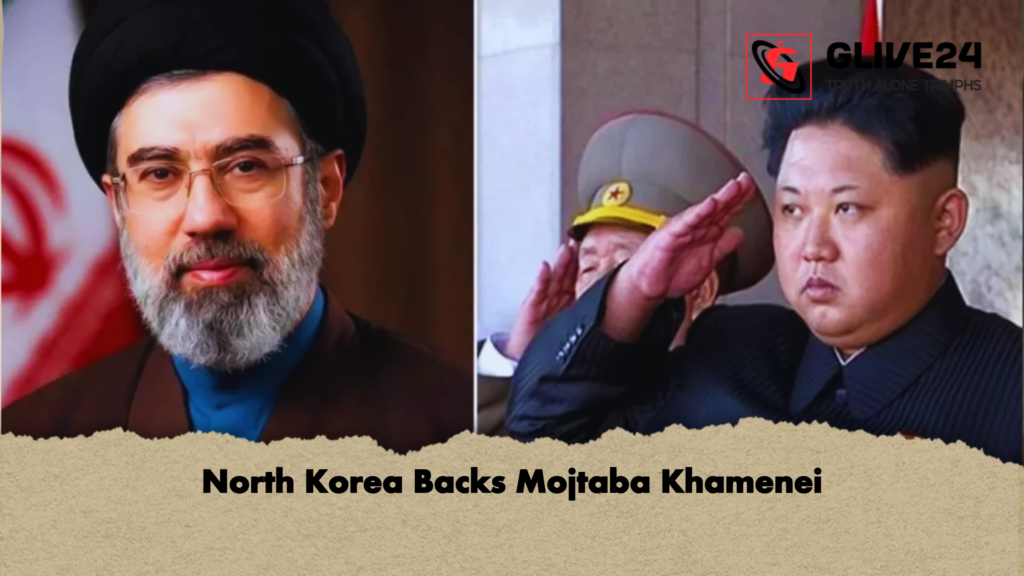
North Korea has expressed support for Iran’s decision to appoint Mojtaba Khamenei as the country’s new Supreme Leader, while also condemning recent military attacks on Iran by the United States and Israel. The position was reported by the Korean Central News Agency (KCNA), Pyongyang’s official state news outlet, which cited comments from a spokesperson for the North Korean Ministry of Foreign Affairs.
According to the report published on Wednesday, the spokesperson said that Pyongyang respects the Iranian people’s sovereign right to determine their own political leadership. The statement came after Iran’s Assembly of Experts announced Mojtaba Khamenei as the successor to his father, Ayatollah Ali Khamenei, following the elder leader’s death in late February.
Mojtaba Khamenei, a cleric long considered influential within Iran’s political and religious establishment, assumed the position after the reported death of Ayatollah Ali Khamenei on 28 February during a military strike attributed to the United States and Israel. Iranian authorities subsequently convened the Assembly of Experts, the constitutional body responsible for selecting the country’s Supreme Leader, to determine the succession.
Quoting the foreign ministry spokesperson, KCNA reported: “The Assembly of Experts in Iran has selected a new leader of the Islamic Revolution. We respect the Iranian people’s right to choose their supreme leadership and acknowledge the decision announced by the Iranian authorities.”
The spokesperson also criticised Washington and Tel Aviv for what North Korea described as an unlawful military strike against Iran. Pyongyang warned that such actions could undermine regional stability and escalate tensions in an already volatile international environment.
“The United States and Israel have carried out illegal military aggression against Iran, weakening the foundations of peace and security in the region and increasing instability in the international situation,” the spokesperson stated. “We express serious concern and strongly condemn these acts of aggression.”
North Korea further argued that military attacks targeting a country’s political system and territorial integrity are unacceptable under international norms. According to the statement, all nations should reject such actions and stand against them.
Previously, North Korean officials had described developments in the Middle East as “gangster-like behaviour”, signalling Pyongyang’s firm opposition to the military actions taken against Tehran.
Missile Test and Naval Developments
In a separate report on Wednesday, KCNA also revealed that North Korean leader Kim Jong Un personally supervised another test launch of a strategic cruise missile from the country’s largest and most advanced naval destroyer, the Choe Hyon. The test marks the second such launch conducted from the warship under Kim’s observation.
During the event, Kim emphasised the importance of maintaining and expanding what he described as a “powerful and reliable nuclear deterrent capability”. North Korea has increasingly highlighted the role of its naval forces in strengthening its strategic defence posture.
Only a week earlier, Kim had praised the effort to equip the country’s navy with nuclear weapons, suggesting a shift towards integrating advanced missile systems into maritime platforms.
Key Developments in the Situation
| Event | Date | Details |
|---|---|---|
| Death of Ayatollah Ali Khamenei | 28 February | Reportedly killed in a US–Israel military strike |
| Selection of new Supreme Leader | Early March | Iran’s Assembly of Experts appoints Mojtaba Khamenei |
| North Korean response | 11 March | Pyongyang expresses respect for Iran’s decision |
| Missile test from destroyer Choe Hyon | Recent days | Strategic cruise missile launch supervised by Kim Jong Un |
For decades, the United States has sought to dismantle North Korea’s nuclear weapons programme through sanctions and diplomatic pressure. However, Pyongyang insists its nuclear and missile capabilities are essential to deter potential attacks by South Korea, the United States, and their allies.
At the same time, there have been indications of renewed diplomatic interest in dialogue. In recent months, the administration of former US President Donald Trump signalled willingness to resume high-level talks with North Korea. Kim Jong Un has also suggested that relations could improve if Washington were to recognise North Korea as a nuclear-armed state, stating that such recognition could allow the two countries to “get along well together”.