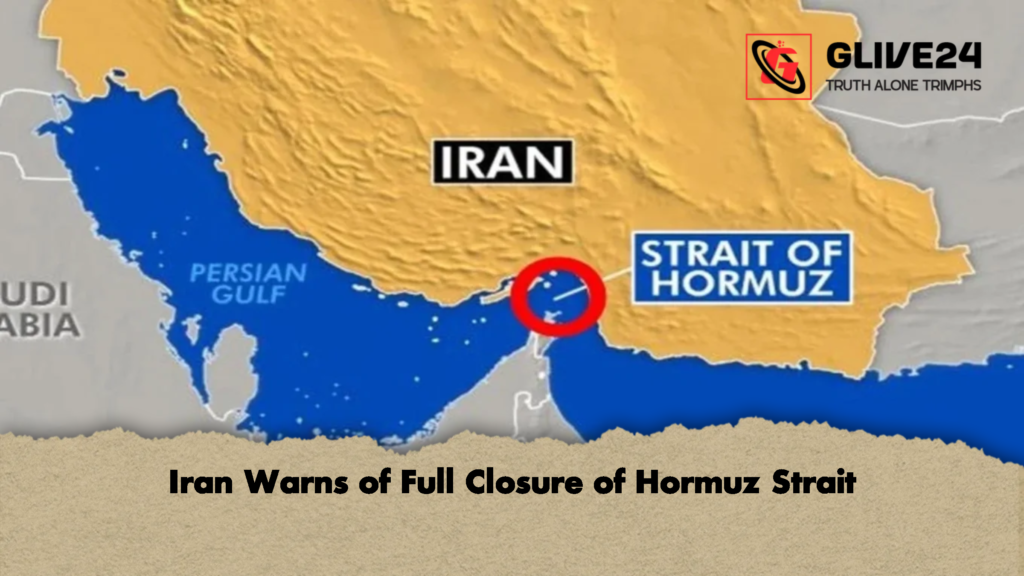
Tehran has issued a stern warning that it could entirely close the Strait of Hormuz if its nuclear power facilities are attacked, signalling a sharp escalation in tensions with the United States and Israel. The announcement follows threats made by US President Donald Trump on Saturday, heightening concerns over regional stability and global energy security.
IRGC Issues Formal Warning
On Sunday, the Islamic Revolutionary Guard Corps (IRGC) released an official statement, declaring that any assault on Iran’s nuclear installations would trigger a complete shutdown of the Hormuz Strait. The statement emphasised that the strait would remain closed until damaged facilities were fully restored.
Brigadier General Ebrahim Jolfagari, speaking on state television, said:
“Any attacks on Iran’s energy infrastructure will be met with decisive and proportional retaliation.”
The IRGC highlighted potential targets for retaliation, including:
- Israel’s electricity grids, fuel facilities, and IT infrastructure
- Companies in the region with American shareholders
- Power plants in neighbouring countries hosting US military bases
The warning underlines Iran’s strategy of deterrence and asymmetric response, demonstrating its willingness to target both regional and international assets linked to perceived adversaries.
Strait of Hormuz Status
Since the joint US-Israel strike on 28 February, Iran has effectively restricted traffic through the strait. Without explicit Iranian permission, commercial vessels and oil tankers are largely barred from transit. The waterway, which carries a significant portion of the world’s oil supply, is a critical chokepoint for global energy markets.
The partial closure has caused sharp volatility in crude prices, which have surged above $100 per barrel, prompting urgent interventions from Washington and other international stakeholders. Iran has made clear that vessels associated with the United States or Israel attempting passage would be considered hostile targets.
International and NATO Response
According to Mehr News Agency, Iran’s representative to the International Maritime Organization (IMO), Ali Mousavi, confirmed that the strait remains open to vessels that meet strict safety protocols. However, ships linked to adversary nations are not permitted to transit.
President Trump has repeatedly called on NATO allies to deploy naval forces to guarantee safe passage, but most nations have refrained, citing the high-risk environment. Only six countries—the United Kingdom, France, Germany, Italy, the Netherlands, and Japan—have expressed readiness to contribute to securing navigation, though no deployments have been confirmed.
Strategic and Economic Implications
The IRGC’s warning raises the stakes for energy security and regional stability. Analysts caution that a full closure of the strait could have profound effects:
| Factor | Current Situation | Potential Impact |
|---|---|---|
| Strait Status | Partially closed; restricted to non-adversary vessels | Global shipping delays, fuel shortages |
| Crude Oil Prices | Surpassing $100 per barrel | Increased inflation, higher energy costs |
| Targeted Retaliation | Israel’s infrastructure, US-linked companies, neighbouring power plants | Regional escalation, potential international conflict |
| International Response | Limited support from six countries | Insufficient to guarantee uninterrupted shipping |
| IRGC Threat Level | Full closure if nuclear sites attacked | Severe disruption of global energy markets |
The warning highlights Iran’s readiness to use energy chokepoints as leverage and signals that any strike on its nuclear facilities could trigger a multi-front regional crisis.
Global observers continue to monitor developments closely, noting that a full-scale escalation could disrupt international energy supply chains and significantly heighten tensions between Iran, the United States, and their respective allies in the Middle East.