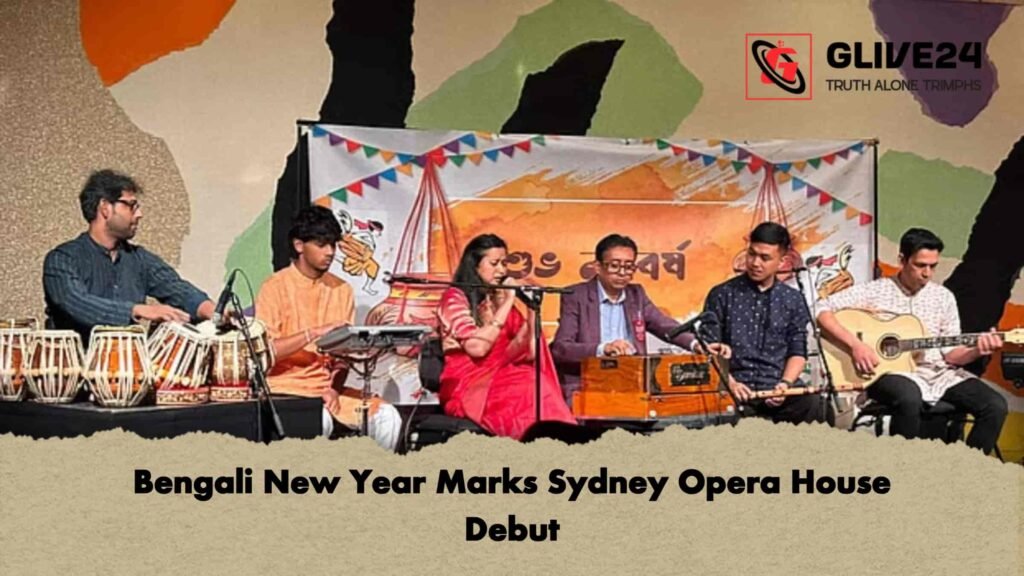
The Sydney Opera House hosted the first-ever celebration of the Bengali New Year festival, known as ‘Baishakhi Festival’, on the evening of 17 April. The event brought together members of the Bangladeshi diaspora in Australia to present a programme of traditional music, dance, and literary performances on one of the world’s most recognisable cultural stages.
Inside the venue, audiences were greeted with the sound of traditional Bengali instruments, including the dhol, khol, cymbals, and ankle bells. The programme featured classical and folk-inspired dance sequences alongside a selection of widely recognised Bengali songs. Group performances included the seasonal anthem “Eso He Boishakh”, which was performed collectively during the opening segment.
Other musical renditions included “Haire Manush Rongin Fanush”, “Aaj Ei Brishtir Kanna Dekhe”, and “Harano Diner Kotha Mone Pore Jai”. Additional performances featured “Rail Line Bohe Somantoral” and the Nazrul Sangeet composition “Alga Koro Go Khopar Badhon”. The combination of classical, modern, and folk elements formed the core of the cultural programme.
The event received formal recognition through a recorded message from the Prime Minister of Australia, Anthony Albanese, who extended greetings to the Bangladeshi community. In his message, he noted, “This diversity is the strength of the country.” The Premier of New South Wales, Chris Minns, attended the programme in person, interacted with attendees, and participated in informal photography sessions. He later stated on social media, “Bangalis are now an integral part of Sydney. The Opera House event reflects their talent and unity.”
Outside the Opera House, members of the Bangladeshi community organised a festive procession carrying national flags and cultural banners. Visitors and tourists present at the site observed the procession, responding with applause and engagement.
The programme was jointly organised by Bornobhumi Media, Bangladesh Ladies Club, and the Bangladesh Press Media and Cultural Club. Organisers described the initiative as an effort to present Bengali cultural heritage on a prominent international platform.
The event included performances across multiple artistic disciplines, including music, dance, poetry recitation, and audio drama. It also brought together a range of artists from the Bangladeshi community in Australia and beyond.
Participants by Category
| Category | Participants |
|---|---|
| Musical Performances | Nabila Afridi, Lubaba Islam, Omia Matin, Mehedi Hasan, Mamun Hasan Khan, Rashnan Zaman, Nishat Siddiqui |
| Dance Performances | Shreyoshi Das, Ankita Roy, Oishita Roy, Swagata Chatterjee, Debjani Pal, Poulomi Panda |
| Poetry & Drama | Moloy Biswas (poetry), Nusrat Jahan (audio drama), Nabila Afridi (audio drama) |
| Instrumental Ensemble | Abhijit Dan (tabla), Sohel Khan (guitar), Rashnan Zaman (keyboard), Sabin Gising (flute), Srijit Dan (sound control) |
| Presenters | Asad Shams, Roksana Hossain Jeba |
The celebration marked a significant cultural showcase for the Bangladeshi community, highlighting their artistic presence within a globally prominent Australian landmark.