In a poignant and deeply emotional narrative shared on social media, a father’s grief has become the focal point for a burgeoning national debate regarding health policy and administrative negligence. Mushfiqur Rahman, a resident currently grappling with his infant son’s severe illness, took to Facebook to express his visceral anguish. His post, which has since gone viral across the country, began with the chillingly ironic sentence: “The State has gifted my child with Measles.”
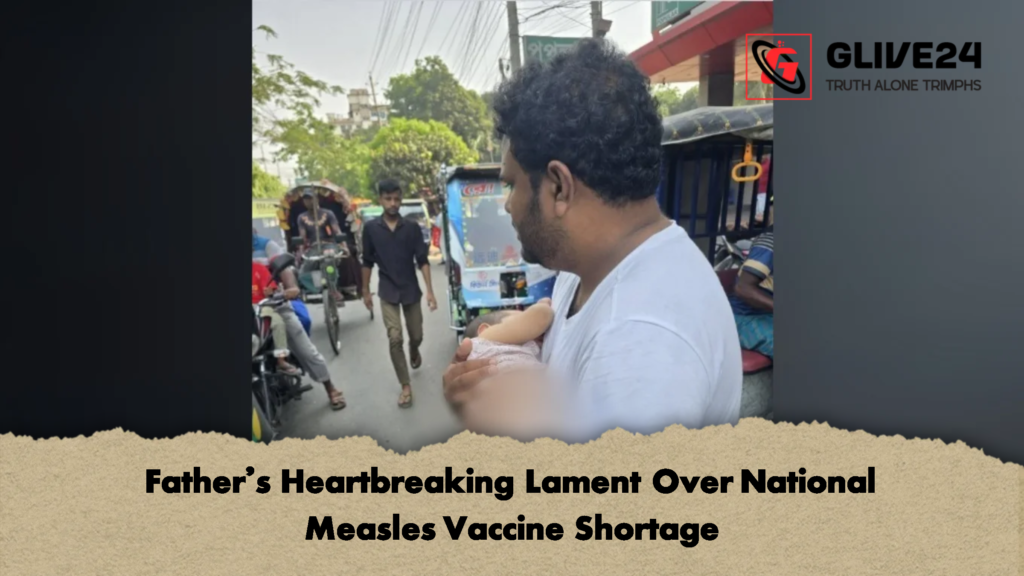
Accompanied by a photograph of Mr Rahman cradling his ailing child as they traversed a city street, the post serves as a heartbreaking testament to the human cost of a systemic failure in the public immunisation programme. The imagery of a father carrying his son towards medical help has struck a chord with thousands of citizens.
Table of Contents
A Journey from Joy to Despair
Mr Rahman’s post chronicles the brief life of his son, a child born six years after his marriage—a long-awaited blessing that has now turned into a nightmare of clinical distress. He described his son as a “perfect child” who rarely cried, even during the initial onset of a high fever reaching 101°F.
“I first held my son seven months ago,” he wrote. “Since then, he grew bit by bit, learning to smile. Whenever I returned from the office and called out ‘Baba…’, he would greet me with a radiant smile. He never kept us awake at night. Even with a high fever, he would still smile when he saw me.”
However, that smile has been extinguished. What began as a fever soon escalated into pneumonia, necessitating immediate hospitalisation. By the following day, the infant’s body was entirely covered in the tell-tale rash of measles. “He has forgotten how to smile; now his only language is crying,” Rahman lamented, describing the physical transformation of his child.
Statistical Context: The Decline of Immunisation
The resurgence of measles in 2026 is being widely attributed to a catastrophic shortage of vaccines during the tenure of the Interim Government led by Dr Muhammad Yunus. Health experts have highlighted a significant and dangerous drop in “herd immunity” thresholds required to prevent such outbreaks.
| Metric | Required Threshold | Reported Level (2025–26) |
| Minimum Vaccine Coverage | 90% – 95% | Below 60% |
| Import Consistency | Continuous | Intermittent / Halted |
| Public Health Alert Level | Low (Containment) | High (Epidemic) |
| Primary Complications | Minimal | High (Pneumonia, Encephalitis) |
A Scathing Critique of the Ruling Class
The emotional weight of Rahman’s message quickly shifted from personal sorrow to a scathing indictment of the nation’s political elite. He described his overwhelming guilt for bringing a child into a country where, he claims, the leadership is fundamentally disconnected from the realities of the average citizenry.
“I have cried all day today. I asked my son for forgiveness many times,” Rahman shared. “I apologised for giving him birth in this country—a country where leaders fly to Singapore for a simple fever while their children enjoy luxurious lives abroad. For the past few years, they apparently did not see the need to purchase vaccines for our children. And now, that measles has become an epidemic, it has manifested on my son’s body. I am sorry, Baba; I am truly, deeply sorry.”
The Administrative Crisis: A Failure to Import
The backdrop to this personal tragedy is a burgeoning medical crisis. Allegations have surfaced that the Interim Government failed to prioritise the procurement and import of essential vaccines from international markets, leading to a depleted stockpile. This administrative inertia has reportedly created a vacuum in the national supply chain, leaving millions of infants vulnerable.
Medical professionals and health activists argue that for a disease as highly contagious as measles, allowing vaccination rates to fall below 60% is tantamount to inviting a public health disaster. The current outbreak is being viewed not merely as a biological event, but as a direct consequence of policy failure. While the government has recently moved to address the shortage, for parents like Mushfiqur Rahman, the intervention has arrived far too late to prevent the suffering of their children.