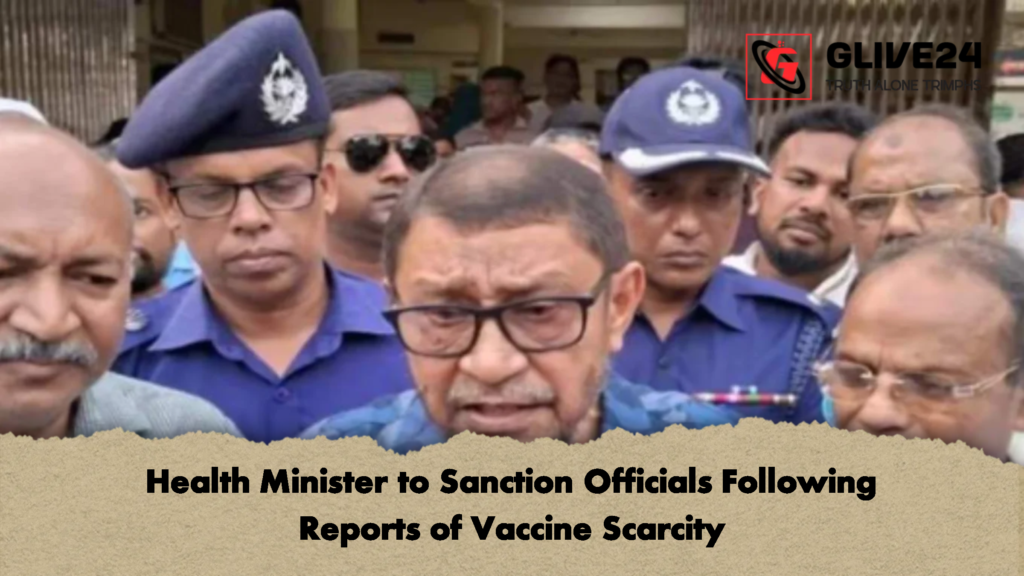
The Minister for Health, Sardar Mohammad Sakhawat Hossain Bakul, has announced the immediate withdrawal and pending disciplinary action against senior health officials in Munshiganj. The announcement follows public disclosures made by these officials regarding a severe shortage of essential vaccines. During an inspection of a local hospital on Friday, 24 April 2026, the Minister declared that the District Civil Surgeon, the Hospital Superintendent, and a staff member would face departmental sanctions for allegedly undermining the government’s reputation through their comments to the media.
The conflict intensified after health officials confirmed to BBC Bangla that the facility was unable to provide the anti-rabies vaccine (Rabix-VC) due to a total depletion of stock. Despite the Minister’s public declaration of their dismissal, the Civil Surgeon of Munshiganj noted on Saturday that no formal documentation regarding their removal or suspension had yet been served.
Table of Contents
Allegations of Sabotage and the Ministerial Rebuttal
Minister Bakul has characterised the officials’ decision to speak with the press as an “anti-state activity” and an act of “sabotage.” He argued that as government employees, the officials had a duty to address shortages through internal administrative channels rather than public broadcasting.
In a press briefing following his hospital visit, the Minister stated:
“The interview provided by the Superintendent constitutes total damage to the government’s image. Claiming a vaccine shortage exists is an act of sabotage. If a deficit occurred, they were required to inform the Director General (DG) or the Deputy Commissioner (DC). Resources such as Medical Surgical Requisition (MSR) funds are available. He cannot give such an interview. We have officially ‘closed’ the Superintendent.”
The Minister further asserted that the government possesses a six-month stockpile of all essential vaccines, including those under the Expanded Programme on Immunisation (EPI). He maintained that any localised shortage was the result of administrative negligence at the district level rather than a failure of central procurement.
Discrepancies in Stock Levels and Procurement Challenges
Contrary to the Ministry’s assurances of a surplus, field-level data and patient testimonies suggest a systemic supply crisis. Relatives of patients at the Munshiganj 250-bed General Hospital reported that they were forced to purchase anti-rabies vaccines from private retailers at high prices, as the “free” government supply was non-existent.
Internal reports indicate that the National Rabies Elimination Programme has been struggling since the start of 2025. This crisis is largely attributed to the discontinuation of the five-year Operational Plan (OP) in 2024—a strategic procurement framework. Under the current interim arrangement, the following issues have been highlighted by health officials:
-
Advance Notifications: Local health offices reportedly alerted the Directorate General of Health Services (DGHS) regarding the impending vaccine exhaustion months prior to the current crisis.
-
Funding Constraints: While the central health department advised district offices to utilise unused tender funds to procure vaccines locally, most annual tenders were concluded by December, leaving officials with no legal mechanism to reallocate the capital.
-
Quantity Gap: The Munshiganj district requires approximately 2,600 vials of rabies vaccine monthly. At the time of the Minister’s visit, only 26 vials remained at the central hospital, with sub-district (Upazila) clinics reporting zero stock.
Concerns Over Measles and Polio Stockpiles
The shortage appears not to be limited to rabies treatment. Reports of scarcity have emerged regarding the Measles and Rubella (MR) vaccine, especially as 91% of districts in Bangladesh have recently reported measles outbreaks, prompting a “high-risk” warning from the World Health Organization (WHO). Furthermore, some immunisation centres in the capital, Dhaka, have reported intermittent unavailability of the Polio vaccine. These findings directly contradict the Minister’s recent public claim that “not a single vaccine is in short supply.”
Expert Reaction and Impact on Health Governance
The decision to penalise field officers for supply chain failures has been met with significant concern by public health specialists. Dr Be-Nazir Ahmed, a renowned public health expert and former director at the DGHS, described the move as a “negative precedent.” He noted that the expertise and legal authority for vaccine procurement are centralised; therefore, holding a Civil Surgeon accountable for a lack of centrally distributed supplies is a misdirection of responsibility.
Experts warn that such punitive measures may lead to:
-
Suppression of Vital Data: Field officers may become reluctant to report shortages for fear of retribution, leading to a distorted view of the country’s health security.
-
Institutional Demoralisation: Mass withdrawals and public shaming of senior doctors could discourage medical professionals from taking up administrative roles.
As of Saturday night, the Ministry of Health has remained silent on follow-up enquiries regarding the legal status of the Munshiganj officials. Meanwhile, the international community and local health advocates continue to monitor the situation, as the 100% mortality rate associated with rabies makes the lack of vaccines a critical public safety concern.