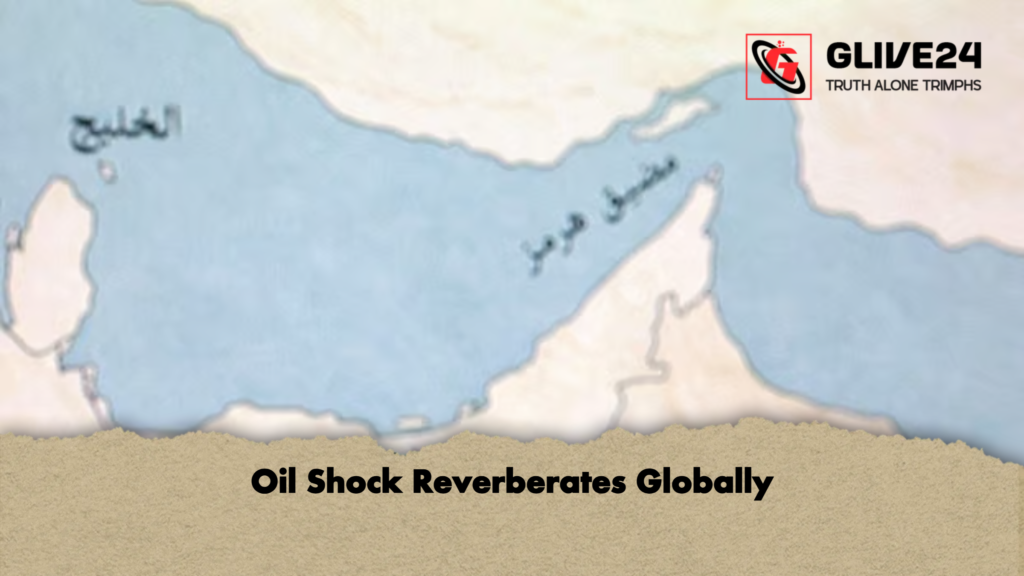
The global energy market is once again under severe strain as escalating instability around the Strait of Hormuz sends shockwaves through oil and gas trading. Futures traders, typically optimistic in outlook, have been forced to reassess risk amid rapid and volatile price swings.
On 17 April, following remarks by Iran’s foreign minister declaring the Strait of Hormuz “fully open”, Brent crude prices plunged by around 10 per cent to approximately 90 US dollars per barrel. However, the situation shifted dramatically within hours. After reports of an attack on an Indian oil tanker, allegedly linked to Iranian forces, prices rebounded by 5 per cent. In the days that followed, Brent climbed back above 100 dollars. At the time of reporting, it stood near 105 dollars per barrel, though earlier in the conflict it had briefly peaked at 119 dollars.
Despite recent stabilisation, the underlying supply disruption remains severe. Over a 50-day period of conflict, roughly 550 million barrels of crude supply from the Gulf have been removed from global markets—equivalent to about 2 per cent of annual global production. In parallel, liquefied natural gas (LNG) flows have also been affected, with an estimated 70 million tonnes per month at risk if the Strait remains disrupted, again around 2 per cent of global annual supply.
Table of Contents
Key Market Disruptions
| Indicator | Pre-crisis level | Current level / impact |
|---|---|---|
| Brent crude price | ~$90 (brief low) | ~$105 (peak $119) |
| Gulf crude disruption | Baseline | 550 million barrels lost (50 days) |
| LNG flow impact | Normal trade | 70m tonnes/month at risk |
| Asian crude inventories | Stable | Down 11% (~67m barrels) |
| Petrol (Asia spot) | $80/bbl | ~$120/bbl |
| Diesel (Asia spot) | $93/bbl | ~$175/bbl |
| Jet fuel (Asia spot) | $94/bbl | $200+ per barrel |
Supply Chains Under Pressure
Although global fuel markets have not yet collapsed, largely due to previously floating stockpiles at sea, these buffers are now largely exhausted. Cargoes that had been delayed or diverted earlier in the year have already reached destinations such as Malaysia and California, leaving little spare capacity in the system.
Asia has been the most exposed region. Historically, around four-fifths of Gulf energy exports are directed towards Asian markets. Several countries are now drawing down emergency reserves. South Korea is reducing strategic stock releases, while Japan is projected to exhaust key stockpiles by May. According to satellite data analysis, non-Chinese Asian crude inventories fell by approximately 67 million barrels in a single month, a decline of around 11 per cent.
Refining activity has also been hit hard, with output cuts exceeding 3 million barrels per day—around 10 per cent of regional capacity. Analysts warn this could rise to 5 million barrels per day in the coming weeks, and potentially reach 10 million if the Strait remains closed into July.
Diverging Regional Responses
China, which holds substantial reserves estimated at 1.3 billion barrels, has so far refrained from releasing significant volumes, instead tightening refined product exports. Meanwhile, Europe has opted for a different approach, maintaining demand through subsidies and tax reductions in 16 EU member states. This has kept consumption relatively stable but at a high fiscal cost.
However, European refineries are under growing pressure. With crude acquisition costs reaching 130–150 dollars per barrel in some cases, many are operating at negative margins. Market backwardation—where current prices exceed future prices—has further eroded profitability, forcing potential output reductions.
Wider Economic Impact
The effects of rising fuel prices are already visible. In Asia, governments have introduced work-from-home directives, fuel rationing, and partial shutdowns in energy-intensive sectors. Fertiliser, fishing, and plastics industries have all reported reduced operations. Overall regional demand is estimated to have fallen by around 3 million barrels per day since February.
In Europe and the United States, summer travel demand and upcoming gas storage cycles are expected to intensify competition for limited supplies. Liquefied natural gas markets, already under strain, face additional pressure as Europe prepares for winter storage.
Despite current stability in futures markets, analysts warn that this may be misleading. Even if the Strait of Hormuz reopens immediately, restoring full production and distribution could take several months. A structural global shortfall of up to 1.5 billion barrels annually—around 5 per cent of world output—appears increasingly likely, with the risk of a deeper deficit if disruptions persist.
The energy system, already stretched, now faces a critical test of resilience.