A series of unconventional digital exchanges between the United States and Iran has garnered significant international attention, utilising imagery from the popular card game Uno to convey geopolitical posturing. This development, which has widely circulated across social media platforms including Truth Social and X, represents an increasingly unorthodox approach to diplomatic messaging between the two adversarial nations during a period of heightened tension.
Table of Contents
The White House Post and Trump’s Card Imagery
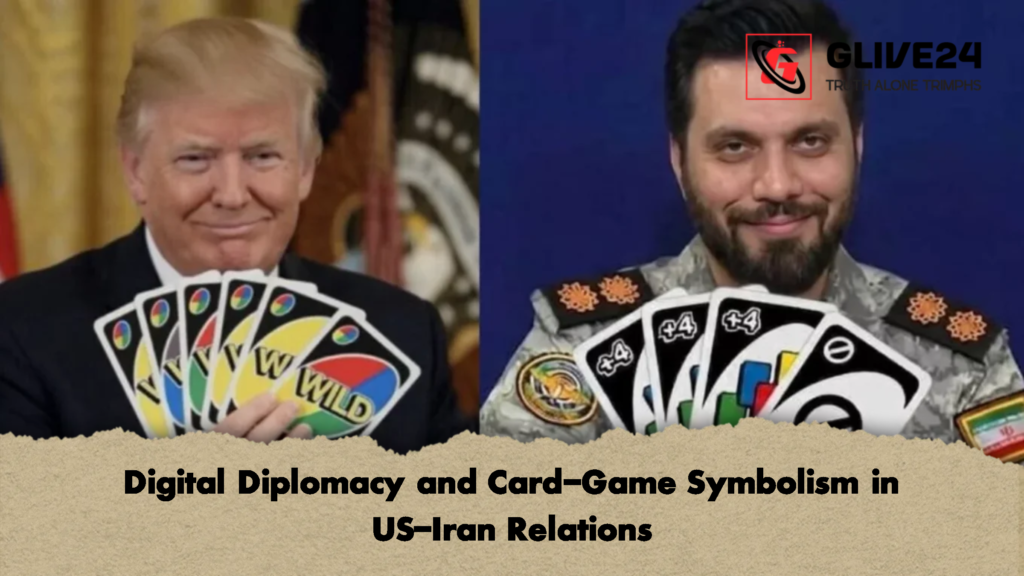
The exchange was initiated by a post from former United States President Donald Trump on his Truth Social platform on 2 May 2026, which was subsequently amplified by official channels. The post featured an AI-generated image of Mr Trump holding a substantial hand of six Wild Uno cards. Within the image, these cards—powerful tools in the game used to change the colour of play—were prominently displayed to represent strategic advantage.
Accompanying the visual was the assertion: “I have all the cards.” The statement appeared to be a metaphorical declaration of strategic superiority and leverage in negotiations concerning the Strait of Hormuz and regional security. Given the context of the “maximum pressure” campaign, observers noted that the imagery was intended to project an image of absolute control. However, social media users quickly pointed out a procedural irony: in the game of Uno, the objective is to deplete one’s hand, meaning that “holding all the cards” technically signifies a losing position.
Iran’s Symbolic Rebuttal
In a direct response to the American post, Iranian sources—most notably the official X account of the Consulate General of Iran in Hyderabad—released a counter-image designed in a similar aesthetic style. Whilst the Iranian depiction featured a much smaller hand of cards, it strategically highlighted specific “action” cards: the “+4” (Wild Draw Four) and the “Skip” card.
In the mechanics of Uno, a “+4” card forces an opponent to draw additional cards whilst relinquishing their turn, and a “Skip” card effectively negates the opponent’s immediate move. The Iranian image depicted a military official in uniform holding these cards with the caption: “Yes, we have less cards.” Analysts have interpreted this as a pointed rejoinder; in the context of the game, having fewer cards indicates a proximity to victory. Symbolically, the post suggested that Iran intended to bypass American pressure or impose its own strategic “penalties” to disrupt US initiatives.
Historical Context of Iranian Digital Provocation
This “meme war” is not an isolated incident of Iranian entities utilising social media for unconventional diplomatic commentary. On 27 April 2026, the Embassy of the Islamic Republic of Iran in Malaysia utilised provocative language regarding the Strait of Hormuz—a vital maritime corridor for global oil shipments. In a post that drew widespread scrutiny, the embassy directed its remarks at the American leadership, using the phrase “little orange man” to refer to the President.
This specific post was accompanied by an animated video clip, designed in a “Lego-like” visual format, featuring a rap-style soundtrack entitled Little Orange Man. The video depicted a fictional scenario in which a character resembling the US President becomes stranded at sea after the Strait of Hormuz is closed. This multimedia content was shared extensively across various digital platforms, prompting discussions regarding the blurring lines between formal diplomacy and digital satire.
The Evolution of Diplomatic Messaging
The viral nature of these Uno-themed posts highlights a broader trend in how state actors communicate in the 21st century. Traditionally, diplomatic signals were sent through demarches or sanctioned press releases. However, the use of card-game metaphors and internet culture suggests a shift towards engaging global audiences through more accessible, albeit confrontational, visual language.
According to reports from NDTV and other international outlets, these exchanges underscore persistent deadlocks in negotiations. Whilst the medium of card games and rap videos appears light-hearted, the underlying messages remain focused on serious issues, including the 8 April ceasefire terms, maritime security, and economic blockades. For now, the “meme war” serves as a digital proxy for the complex and frequently stalled reality of US-Iran relations.