
Khabor Wala Desk
Published: 5th May 2026, 12:28 AM
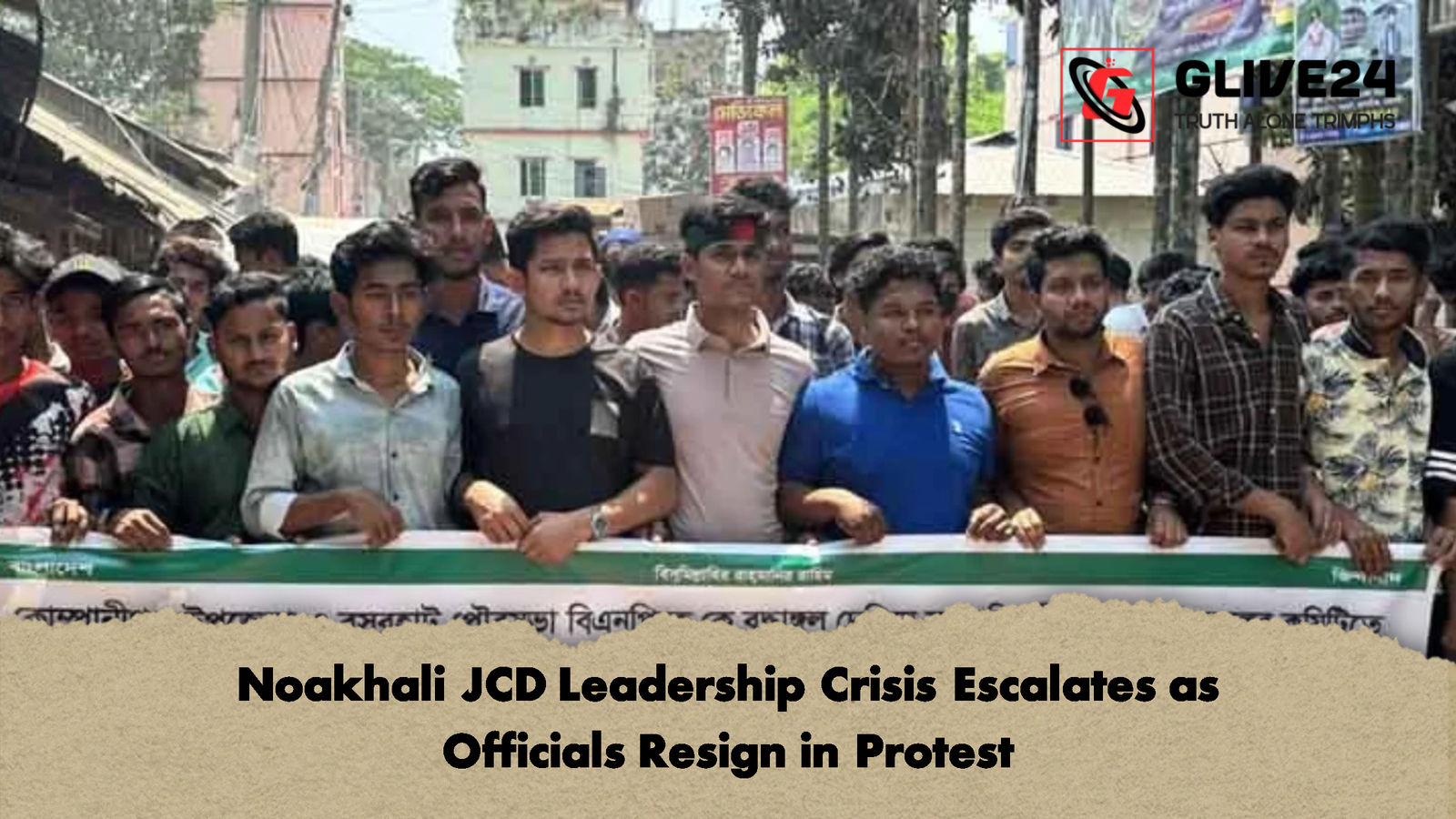
On Monday, 4 May 2026, the political landscape of Noakhali was marked by significant volatility as members of the Jatiyatabadi Chhatra Dal (JCD)—the student wing of the Bangladesh Nationalist Party (BNP)—staged a robust demonstration in the district town of Maijdee. The unrest was precipitated by the recent announcement of newly formed committees for the Noakhali district, Sadar Upazila, and the local municipality. Protesters, comprising aggrieved and marginalised activists, have denounced these appointments as unrepresentative of the party’s veteran grassroots leadership.
The demonstrations commenced in the early afternoon when hundreds of JCD activists gathered near the District Jamme Mosque. From this location, the group initiated a protest march that proceeded through the town’s primary arteries, eventually culminating at the Town Hall intersection. To signal their profound dissatisfaction, the protesters established a blockade at this vital junction, igniting tyres on the main thoroughfare. The resulting obstruction lasted for approximately one hour, leading to severe traffic congestion and halting the movement of vehicles across the urban centre.
The primary target of the protesters’ grievances was Nasir Uddin Nasir, the General Secretary of the JCD Central Committee. Activists at the scene accused Nasir of orchestrating what is locally termed a “pocket committee”—a leadership body allegedly formed through personal bias and nepotism rather than transparent or merit-based selection. The protesters contended that the central leadership had ignored the contributions of long-standing, dedicated members in favour of personal associates.
In a highly symbolic gesture of rejection, the demonstrators burned placards featuring the likeness of the General Secretary and chanted slogans calling for his immediate exclusion from district-level decision-making. Furthermore, the protesters officially declared Nasir “unwanted” (persona non grata) within the territorial jurisdiction of Noakhali. Prominent figures leading the outcry included Anwar Hossain Rocky, the newly appointed Senior Vice-President of the district committee, Shahed Chowdhury Babu, the Vice-President, and Akbar Hossain, the newly named Organising Secretary. They were joined by Md. Wasim, the former Convener of the Municipal JCD, and several other influential local organisers.
Following the street protests, the group marched to the Noakhali Press Club, where they held a formal press conference to announce a decisive rupture with the newly appointed leadership. During the briefing, ten newly appointed officials declared their immediate resignations from their respective posts, citing the “unethical” nature of the committee’s formation.
The list of those who tendered their resignations included:
Shahed Chowdhury Babu (Vice-President, District Committee)
Akbar Hossain (Organising Secretary, District Committee)
Md. Wasim (Former Convener, Municipal JCD)
Seven additional office-bearers from various tiers of the district and municipal units.
The disgruntled leaders argued that the newly sanctioned committees had systematically bypassed “tested and ত্যাগী (sacrificing)” members who had remained loyal to the party during periods of intense political adversity. They issued an urgent appeal to the BNP high command, specifically requesting the direct intervention of the party’s Acting Chairman, Tarique Rahman. The group demanded the immediate dissolution of the current committees and the formation of new bodies comprised of veteran leaders. They warned that failure to rectify these “administrative errors” would result in an intensified movement to secure their organisational rights.
The mass resignation of ten high-ranking officials poses a considerable challenge to the operational integrity of the JCD in Noakhali, a region traditionally considered a stronghold for the student organisation. The public denouncement of a central executive member suggests a widening chasm between the national leadership in Dhaka and the grassroots activists in the coastal districts.
As of Monday evening, the central JCD leadership had not issued a formal response to the allegations of “pocket committee” formation or the mass resignations. However, the blockade at Town Hall and the subsequent press briefing underscore a period of administrative uncertainty. Until the BNP high command addresses the demands for a leadership review, the newly announced committees are expected to face significant resistance, potentially leading to a prolonged period of internal paralysis within the district’s student wing.

Comments