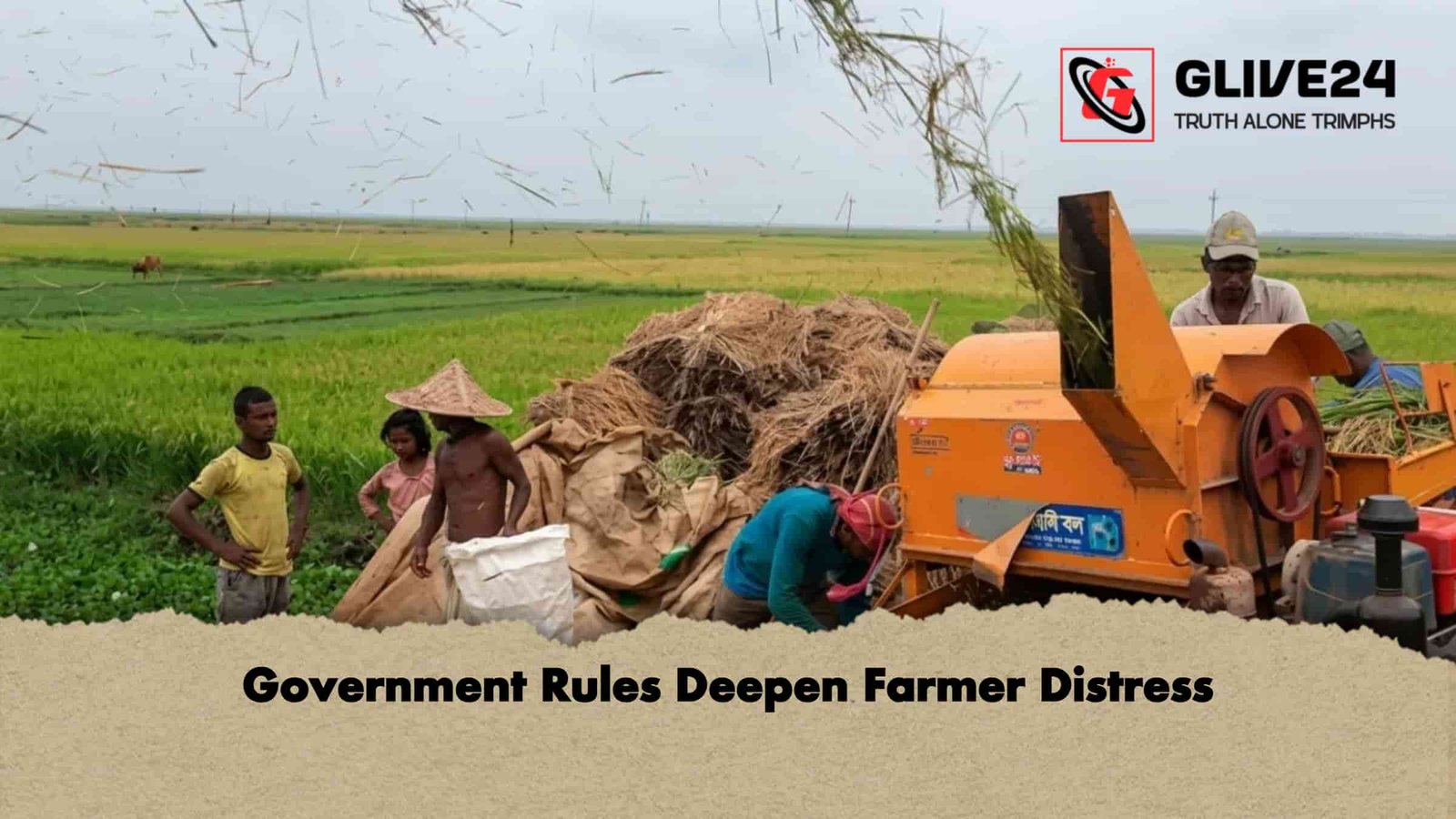
In Bangladesh’s haor basin, Boro rice farmers are facing mounting difficulties as unseasonal heavy rainfall and upstream water inflows have submerged large areas of cropland during the peak harvesting period. Although some farmers have managed to complete harvesting, post-harvest challenges have intensified, including a lack of drying facilities, weak market demand, and strict government procurement conditions.
As a result, harvested paddy has become increasingly difficult to sell at reasonable prices. In several haor regions, farmgate prices have dropped sharply to between 400 and 600 taka per maund, significantly below production costs in many cases. Farmers report that continuous rainfall and persistent cloud cover have prevented proper sun-drying. Traditional drying yards have been submerged, and in many instances, stored paddy has begun to germinate or deteriorate, making it unsuitable for standard market sale.
The government has initiated paddy procurement in six haor districts—Sunamganj, Sylhet, Habiganj, Moulvibazar, Netrokona and Kishoreganj—offering a purchase price of 1,440 taka per maund (36 taka per kilogram). However, participation from farmers has remained limited.
Officials require that procured paddy meet specific quality standards, including a maximum moisture content of 14 per cent, proper colour, and acceptable grading. Due to ongoing adverse weather conditions, much of the harvested paddy does not meet these requirements. Farmers also cite procedural requirements such as registration, inclusion in official lists, transport arrangements, and banking formalities as barriers to participation.
Under existing rules, each farmer is permitted to sell up to 75 maunds of paddy to the government, with payments made directly through the banking system. While authorities argue this ensures transparency and accountability, many farmers say it is difficult to comply under current field conditions.
| Category | Information |
|---|---|
| Early-season market price | 750–1,100 taka per maund |
| Current farmgate price | 400–600 taka per maund (in many areas) |
| Government procurement price | 1,440 taka per maund |
| Maximum quantity per farmer | 75 maunds |
| Government procurement target | 500,000 tonnes |
| Recent Boro production (2021–22) | 21.0 million tonnes |
| Latest estimated production | 21.3 million tonnes |
| Current production target | 22.4 million tonnes |
The situation has also led to increased activity by local intermediaries, who are purchasing wet or partially damaged paddy at 600–800 taka per maund. Many farmers, already under pressure from informal credit arrangements, are compelled to sell at these reduced rates.
Boro rice accounts for around 55 per cent of the country’s total rice output, making it the most significant rice season. Despite rising production levels in recent years, farmers report that production costs have increased due to higher prices of diesel, fertilisers, irrigation, seeds and labour. Government procurement prices, unchanged from previous periods, have therefore drawn concern among farming communities.
Field reports from Netrokona indicate that prices have fallen steadily within days, largely due to difficulties in drying harvested paddy. In Sunamganj’s Jalilpur area, farmers report widespread spoilage and germination caused by excessive moisture. In Kishoreganj’s Karimganj upazila, many farmers remain unaware of procurement procedures or unable to meet the required conditions, forcing them to sell at lower market rates.
Officials state that procurement is ongoing but acknowledge limited farmer participation due to quality constraints. Some measures, including drying support at storage centres, are being considered, though the moisture threshold remains strictly enforced.
Agricultural analysts suggest that purchasing wet paddy followed by controlled drying could reduce farmer losses and improve procurement efficiency. Government representatives, however, maintain that strict standards are necessary for long-term storage and food security.
The Ministry of Agriculture has indicated that awareness campaigns and procurement access may be expanded, while the Ministry of Food has reiterated that direct payments to farmers will be strengthened to reduce intermediary involvement.
> Court Grants Three-Day Remand for Former MP Ashika
> Orthohin Return to Stage After Extended Hiatus
> Four Dead from Toxic Gas in Chittagong Septic Tanks
> Dhaka Concert Featuring Anupam Roy Postponed Indefinitely
> Personal Loan Repayment Period Extended to Eight Years
> Four More Children Die of Measles as Toll Hits 702
> Bangladesh’s Foreign Exchange Reserves Climb Above $36 Billion
> Celebrating the Legacy of Gauhar Jaan, India’s Recording Pioneer
> Bangladesh Name 15-Member ODI Squad for Zimbabwe Tour
> Bulbul Seeks ICC Funding Freeze Amid BCB Governance Dispute
> Iran launches new strikes against Kurdish groups in Iraq
> Anupam Roy Live Concert Announced Dhaka
> Oxford Authorities Contradict Claims by Hasnat, Sadik
> Club Goal Rankings in World Cup History
> Sanjoy Joins World Cup Album
> Two Arrested With Tapentadol
> Armed Drug Dealer Apprehended in Banani Police Raid
> Simrin Lubaba Begins New Life After Marriage Shift

সম্পাদক ও প্রকাশক: এ বি এম জাকিরুল হক টিটন
যোগাযোগের ঠিকানাঃ পশ্চিম কাফরুল, বেগম রোকেয়া সরণি, ঢাকা
© Copyright 2026 Khaborwala। All Rights Reserved



Comments