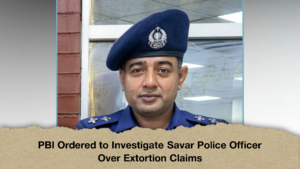
The government has decided to introduce a partial modification to the existing uniform of the police force, citing dissatisfaction expressed across various levels of the service. The announcement was made by Home Affairs Adviser Salah Uddin Ahmed, who confirmed that the revision aims to balance tradition with practicality.
Under the new arrangement, the upper portion of the uniform will remain unchanged, retaining the familiar deep navy-blue shirt. However, the lower portion will be replaced with a military-style brownish-grey design. The change is expected to be implemented gradually across the country, following necessary administrative and logistical preparations.
The adviser made these remarks while speaking to journalists after the inaugural meeting of the National Committee on the Management, Coordination, and Law and Order of Forcibly Displaced Myanmar Nationals, held at the Secretariat on Monday.
Key Features of the Revised Police Uniform
| Aspect | Previous Specification | New Specification |
|---|---|---|
| Upper garment | Deep navy-blue shirt | Remains unchanged |
| Lower garment | Previously designated colour | Military-style brownish-grey |
| Implementation | Existing system in use | Gradual nationwide rollout |
| Preparedness | Fully in circulation | Fabric production in progress |
According to the adviser, full implementation will require time as the production of fabric, supply chain arrangements, and inter-departmental coordination must first be completed. The rollout will be carried out in phases to ensure smooth transition without disrupting operational duties.
On the subject of recent transfers and compulsory retirements within the police administration, he clarified that these measures are not politically motivated. Instead, they form part of routine administrative procedures. Decisions regarding recruitment, transfers, promotions, and disciplinary actions are being undertaken through established mechanisms, following verification by internal committees to ensure fairness and accountability.
Addressing the broader law and order situation, he acknowledged that certain complexities have arisen due to longstanding administrative weaknesses. The current administration, he stated, is working progressively to restore stability. Security agencies are being strengthened to ensure more effective enforcement and public safety.
A nationwide special joint operation targeting narcotics, illegal arms, and extortion networks began on 1 May. The coordinated effort involves the police, Rapid Action Battalion, Department of Narcotics Control, and various intelligence agencies. The primary objective is to dismantle major drug trafficking syndicates and organised criminal networks. The government has declared a policy of zero tolerance towards such offences.
Regarding the Rohingya situation, the adviser noted that approximately 1.2 to 1.4 million displaced individuals are currently residing in camps across the Cox’s Bazar and Teknaf regions. Strengthened measures are being implemented to improve camp management, maintain discipline, and prevent unlawful activities. Plans are also underway to intensify joint security operations within the camps.
He further added that the recent parliamentary session concluded in a peaceful and constructive atmosphere, which he described as a positive development.
In response to questions about a journalist being prevented from travelling abroad, he said the matter is under review and appropriate action will be taken after verification of all relevant information.