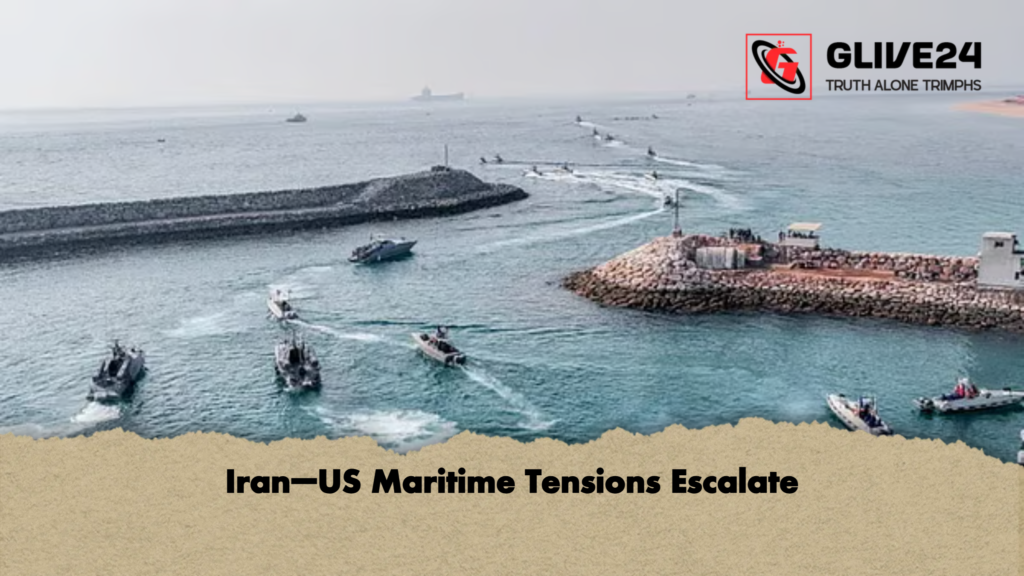
Iran’s Islamic Revolutionary Guard Corps (IRGC) has seized an oil tanker in the Sea of Oman during what it described as a “special operation”, while the United States military has claimed it disabled two tankers attempting to enter an Iranian port. The conflicting accounts were issued on Friday, amid heightened tensions in the region.
The developments occurred only hours after reports of heavy exchanges of fire in the Strait of Hormuz between Iranian and United States forces, raising further concern over the stability of an already fragile ceasefire framework and ongoing diplomatic efforts.
Table of Contents
Iranian account of tanker seizure
According to Iran’s semi-official Fars News Agency, the IRGC navy seized a vessel identified as Ocean Koi in the Sea of Oman. Iranian authorities stated that the ship was allegedly attempting to interfere with Iran’s oil exports and national interests.
State media outlet Press TV released footage showing Iranian forces boarding the Barbados-registered tanker. Iran has not independently verified additional operational details beyond the official statement.
United States military claims
In contrast, the United States Central Command (United States Central Command) stated that its forces disabled two oil tankers flying the Iranian flag in the Sea of Oman after they allegedly attempted to enter an Iranian port.
The CENTCOM commander, Admiral Bradley Cooper, said in a statement that United States forces remain committed to enforcing what Washington describes as maritime restrictions on Iran.
Disputed escalation and casualties
Further escalation was reported by multiple parties. Former United States President Donald Trump stated that Iranian forces had fired on three United States destroyers in the Strait of Hormuz. However, Iran’s military leadership rejected this account and instead accused the United States of violating a ceasefire agreement by striking an oil tanker and another vessel.
Iranian authorities claimed that the alleged attacks injured 10 Iranian sailors, while five others remain missing.
Iran also reported that United States aircraft struck civilian areas on Qeshm Island, a strategically located territory near the entrance of the Strait of Hormuz. In response, Iranian forces stated they carried out retaliatory strikes on United States naval assets east of the Strait and south of Chabahar port. These claims have not been independently verified.
United States President Donald Trump described the exchange of fire as a “minor skirmish” and rejected suggestions that a ceasefire had been breached.
Diplomatic developments
Diplomatic efforts continue alongside the military tensions. United States Secretary of State Marco Rubio stated that Washington is awaiting Tehran’s response to a proposed framework aimed at ending the conflict permanently.
Meanwhile, United States Vice President JD Vance met Qatar’s Prime Minister in Washington to discuss mediation efforts, reportedly involving Qatar and Pakistan in attempts to reduce regional tensions.
Iranian Foreign Ministry spokesperson Esmaeil Baghaei confirmed that Tehran is reviewing the United States proposal while condemning recent military actions. He added that Iranian forces are closely monitoring developments and are prepared to respond to what Tehran described as any aggression or reckless behaviour.
Proposed maritime policy changes
Iran has also announced plans to introduce a new maritime regulatory framework in the Strait of Hormuz and the broader Persian Gulf region. The proposed system includes the establishment of a body referred to as the “Persian Gulf Strait Authority”.
Under the proposed rules, vessels transiting the Strait of Hormuz would be required to submit advance electronic notification to Iranian authorities, including details such as cargo, origin, and destination, and obtain clearance before passage. The plan also includes the introduction of transit fees for ships using the waterway.
Analysts cited in regional reporting suggest that such measures would significantly increase Iran’s regulatory control over one of the world’s most strategically important maritime chokepoints.
Summary of competing claims
| Issue | Iran’s position | United States position |
|---|---|---|
| Tanker in Sea of Oman | IRGC seized Ocean Koi | No acknowledgement |
| Tankers near Iranian port | Not confirmed | Disabled by US forces |
| Strait of Hormuz clash | US initiated strikes and violations | Iran fired on US destroyers |
| Casualties | 10 sailors injured, 5 missing | Not confirmed |
| Qeshm Island strike | US airstrike reported | Not confirmed |
| Retaliation | Iranian counterattacks claimed | Described as minor skirmish |
The situation remains highly contested, with both sides presenting sharply differing accounts of the same sequence of events, while diplomatic channels continue to operate in parallel with ongoing military activity.