The foreign exchange market in Bangladesh continued to show mixed movements on Wednesday, reflecting ongoing global economic uncertainties and persistent pressures linked to geopolitical tensions in the Middle East. Over recent months, the currency market has experienced noticeable volatility, with a general upward bias in foreign currency prices, although today’s session presented a relatively stable picture for the US dollar.
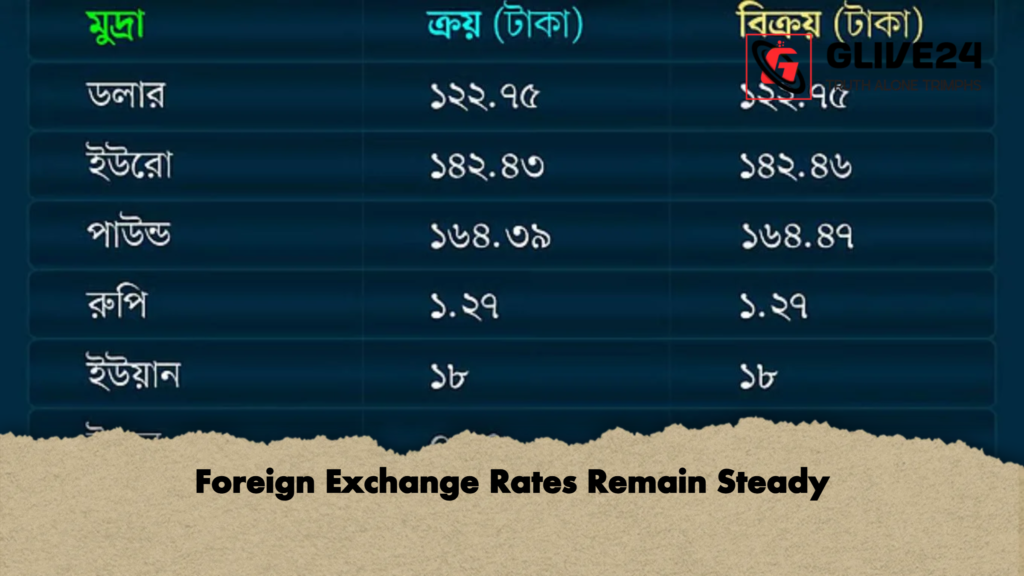
According to data released by Bangladesh Bank, the average exchange rate of the US dollar remained unchanged at 122.75 taka. This stability comes after a prolonged period of fluctuations, during which the dollar had repeatedly strengthened against the local currency due to import demand pressures, external payment obligations, and global financial conditions.
While the dollar held steady, most other major foreign currencies recorded a slight decline in value in the domestic market. The euro, British pound, Chinese yuan, Australian dollar, and Singapore dollar all edged lower compared to previous trading sessions. Market analysts suggest that these marginal declines may be linked to reduced international demand signals and short-term adjustments in global currency indices.
In contrast, the Indian rupee and Japanese yen remained unchanged, indicating a more balanced trading position for these currencies in the local foreign exchange framework. The stability of these currencies is often associated with regional trade consistency and relatively predictable demand flows.
It is important to note that exchange rates published by the central bank typically differ slightly from those in the open market, where foreign currencies are often traded at higher prices due to supply constraints and informal market dynamics. This gap between official and open-market rates continues to influence import costs, business expenses, and overall price levels in the domestic economy.
Foreign Exchange Snapshot (Wednesday)
| Currency | Movement in Market | Central Bank Rate/Status | Market Note |
|---|---|---|---|
| US Dollar (USD) | Unchanged | 122.75 BDT | Stable after recent volatility |
| Euro (EUR) | Slight decrease | Not specified | Weakened marginally |
| British Pound (GBP) | Slight decrease | Not specified | Minor downward adjustment |
| Chinese Yuan (CNY) | Slight decrease | Not specified | Softening trend observed |
| Australian Dollar (AUD) | Slight decrease | Not specified | Reduced demand pressure |
| Singapore Dollar (SGD) | Slight decrease | Not specified | Mild depreciation |
| Indian Rupee (INR) | Unchanged | Not specified | Stable regional trading |
| Japanese Yen (JPY) | Unchanged | Not specified | Steady positioning |
The foreign exchange market’s movements continue to play a crucial role in shaping Bangladesh’s broader economic environment. Fluctuations in currency values directly affect import costs, especially for fuel, raw materials, and consumer goods, while also influencing export competitiveness. As global uncertainties persist, market participants are likely to remain cautious, with exchange rate stability depending heavily on external economic conditions and domestic monetary policy management.