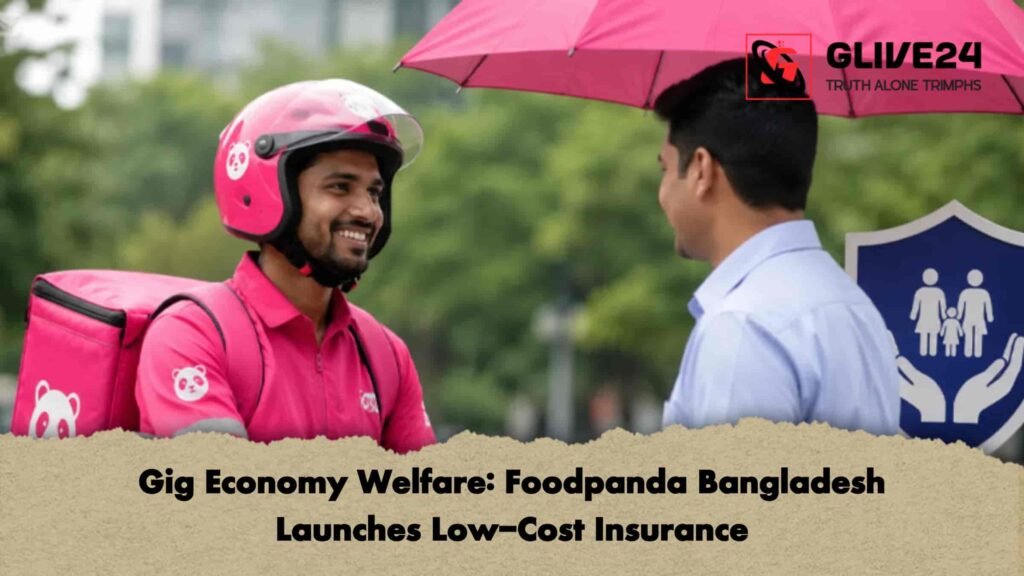
The expansion of digital fast-commerce networks has integrated online food and grocery delivery services into the daily routines of urban consumers across Bangladesh. Over the past decade, Foodpanda Bangladesh has been a primary catalyst of this structural shift, positioning itself as a major corporate employer within the nation’s emerging gig economy.
Labour market analysts observe that while the logistics and delivery sector continues to experience rapid growth, providing institutional security, consistent income, and social safety nets for delivery riders remains a critical challenge. In response to these vulnerabilities, Foodpanda’s voluntary introduction of structured insurance products marks an important step toward formalising rider protections within the platform economy.
Expansion Framework and Fleet Scale
Launched in Bangladesh in 2013, Foodpanda operates under the ownership of Berlin-based delivery conglomerate Delivery Hero. Following a series of regional asset reorganisations, the parent company manages active operations across approximately 10 countries and 400 Asian municipalities.
Initially launching exclusively in Dhaka, Foodpanda has expanded its geographic reach to cover all major urban municipalities across Bangladesh, integrating thousands of local commercial merchants and eateries into its digital ecosystem. Industry data suggests that the company has generated more than 20,000 direct and indirect economic opportunities nationwide, primarily consisting of independent delivery couriers.
Market experts attribute the platform’s sustained footprint to its algorithmic dispatch routing, integrated digital billing setups, and the introduction of its proprietary dark-store model, “Pandamart,” which transitioned the platform from restaurant deliveries to immediate consumer grocery distribution.
Comparative Insurance Mechanics and Safeguards
Operating within high-density urban traffic networks exposes independent couriers to continuous operational risks, including severe weather, hazardous road conditions, and traffic accidents. To mitigate these occupational hazards, Foodpanda Bangladesh has collaborated with regional insurance firms to offer tiered accidental coverage structures.
The technical specifications of these active insurance programs are detailed in the table below:
| Protection Initiative | Corporate Underwriter / Partner | Premium Structure | Maximum Payout Limit | Defined Inclusions & Terms |
| Bimafy Micro-Insurance Plan | Bimafy (Insurtech platform) | BDT 70 annually | BDT 100,000 | Co-paid accidental death or permanent disability coverage sustained during active shifts. Vehicles and personal devices are excluded. |
| Panda Riders Personal Accidental Insurance | Green Delta Insurance PSC | Fully Subsidised by Foodpanda | BDT 100,000 | Awarded to the top 1,000 performers; provides BDT 100,000 for death/total disability and up to BDT 50,000 for partial impairment. |
Institutional Execution and Corporate Financial Context
The micro-insurance policy, developed alongside local insurtech provider Bimafy, allows delivery riders to secure an accidental coverage pool for a low annual premium of BDT 70. To streamline operations, the claims submission framework is entirely digital, enabling couriers to file claims directly through their courier mobile application, field dispatch units, or dedicated online portals. However, independent labor analysts point out that the financial risk of vehicular damage or personal smart device breakdown remains entirely with the riders, as the policy covers bodily harm only.
In a separate performance-linked welfare initiative launched in October 2025, Foodpanda partnered with Green Delta Insurance PSC to establish the “Panda Riders Personal Accidental Insurance” program. Under this framework, the company fully absorbs the premium costs for its top-performing 1,000 delivery riders based on operational metrics. This policy guarantees a BDT 100,000 payout for accidental death or total permanent disability, alongside a tiered allocation reaching up to BDT 50,000 for partial physical impairment. Financial analysts view this dual-tier approach as a targeted retention tool that uses corporate social protections to improve rider efficiency and build institutional loyalty.
These welfare investments are being maintained despite a challenging domestic financial environment. Multiple corporate financial filings indicate that Foodpanda Bangladesh’s cumulative operational losses had surpassed BDT 10 billion by the end of 2023. Macroeconomists state that because the local quick-commerce sector is still in a high-growth phase, heavy capital expenditure remains necessary for technological scaling and geographic expansion.
While global regulatory frameworks are increasingly compelling gig-economy platforms to formalise rider employment rights and safety mandates, Bangladesh’s legal architecture regarding digital platform workers remains in its infancy. Consequently, Foodpanda’s voluntary implementation of underwritten rider protections could serve as a foundational benchmark for future labor policy and corporate compliance within the country’s service sector.