A roadside snack vendor in West Bengal who rose to widespread prominence after serving the Indian Prime Minister, Narendra Modi, during a political campaign has been placed under static police protection. The administrative intervention follows formal complaints by the shop owner detailing serious cross-border security concerns.
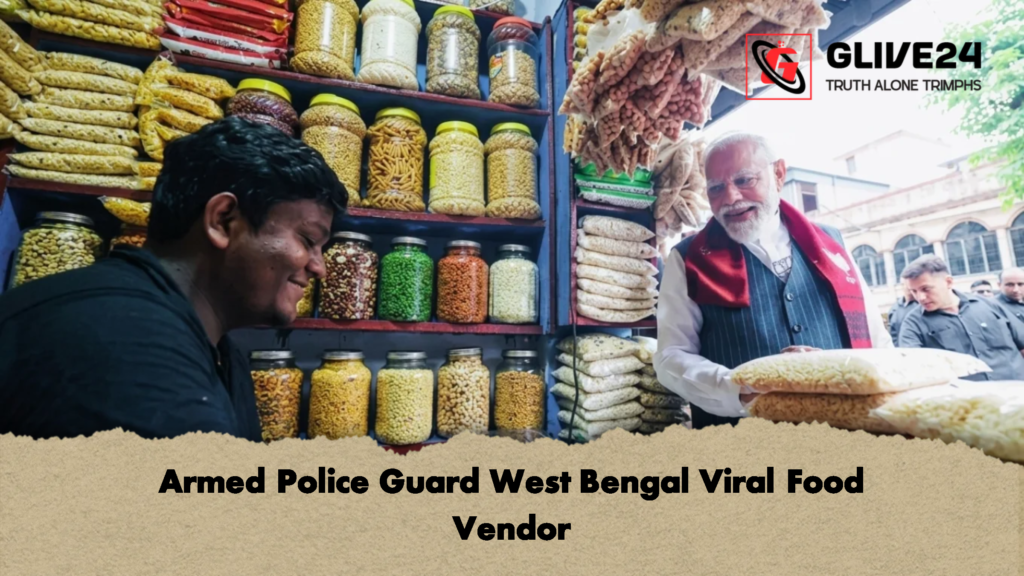
The merchant, identified as Bikram Kumar Sau (also reported as Vikram Sao), operates a modest street stall situated at the Raj College crossroad (Raj College More) within Jhargram Town, West Bengal. Local administrative authorities confirmed that four law enforcement personnel have been deployed to secure the stall and monitor the vicinity. The security deployment was enacted after the trader reported receiving explicit threats to his life and business operations from numbers associated with foreign telecommunications networks.
Origin of High-Profile Publicity and Political Context
The security incident traces back to an unscheduled event on 19 April, during the West Bengal legislative campaign. Prime Minister Narendra Modi halted his official convoy at the Raj College intersection in Jhargram Town after completing a series of political rallies. The Prime Minister approached the roadside establishment to purchase and consume jhalmuri, a traditional regional snack comprised of spiced puffed rice, whilst interacting briefly with local residents.
Visual recordings and photographs of the interaction were widely disseminated across digital networks, accumulating millions of views within a short duration. The brief interaction subsequently emerged as a focal point of discussion within the state’s political landscape. Leaders of the Bharatiya Janata Party (BJP) integrated the event into public activities, distributing the puffed-rice snack at subsequent political gatherings. Conversely, representatives of the ruling Trinamool Congress (TMC), including Chief Minister Mamata Banerjee, publicly critiqued the stop, characterizing the interaction as a pre-arranged publicity exercise.
Nature of Cross-Border Threats and Investigation
Following the substantial digital exposure, the vendor alleged that his sudden visibility attracted continuous harassment. According to the written statement submitted by Sau to the Jhargram Police Station, he received repeated threatening mobile text messages and Voice-over-IP (VoIP) calls via WhatsApp. The complainants noted that the anonymous individuals making the communications explicitly identified themselves as citizens originating from Pakistan and Bangladesh.
The merchant stated that the communications included specific declarations that his commercial premises were actively targeted for a bomb attack during peak business hours. He further alleged that unknown persons displayed weapons during a video call to intimidate him. The escalating pattern of harassment caused considerable distress to his family, prompting the brief closure of the commercial stall before he approached local authorities on Thursday, 21 May.
Law Enforcement Measures and Security Framework
An official from the Jhargram Police Station confirmed that a general diary entry and formal complaint had been registered regarding the matter. Cybercrime investigators and district intelligence units have initiated a comprehensive probe to trace the electronic origins and network headers of the international phone numbers, including a profile displaying a country code corresponding to Pakistan.
| Guard Assignment | Protective Posture | Operational Mandate | Supervisory Authority |
| Static Guard Force | Four Personnel | Persistent Stall Monitoring | Jhargram District Police |
| Cyber Intelligence | Active Tracking | International Number Analysis | West Bengal Cyber Cell |
While police guards have been stationed at the commercial site during standard operational hours, Sau expressed ongoing concerns regarding his safety during his daily commute, as he travels to his residence by bicycle after dark. Senior police officials assured the public that all necessary dimensions of local security are being systematically reviewed to prevent any breach of public order, and the local administration continues to monitor the situation.