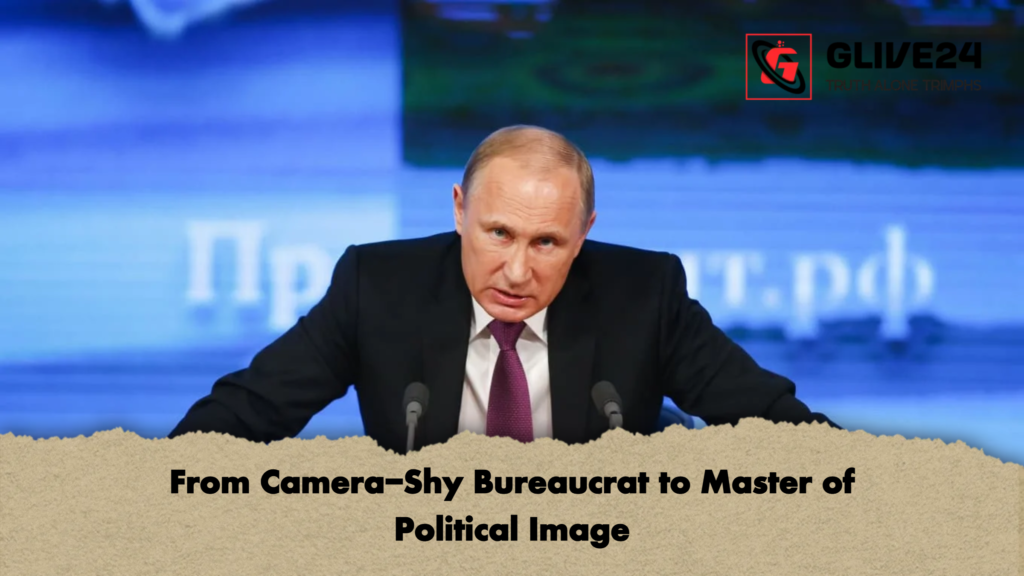
Throughout his decades at the helm of the Russian state, Vladimir Putin has maintained a sophisticated understanding of the strategic value of visual media. This acute awareness was evident as early as 2001, during his first official interview with BBC journalist Bridget Kendall.
Just before recording commenced, an assistant hastily removed small water glasses from the table. When Kendall asked about the sudden adjustment, Putin explained directly:
“We don’t want anyone to think they are glasses of vodka. Besides, during a live broadcast, we cannot risk a glass being knocked over and spilling water. In terms of dissemination, television is akin to a nuclear bomb.”
Table of Contents
From the Television Era to the Hall of Mirrors
Political analyst Peter Pomerantsev notes that Putin, alongside the wider Russian political apparatus, recognised early on that state television was the primary instrument for consolidating domestic power.
Raised in the 1960s and 1970s, Putin was a product of the Soviet television era. He grew up idolising the stoic, silent intelligence operatives depicted in state-approved espionage films—characters he credits with inspiring him to join the KGB.
As a state security officer and subsequent mid-level bureaucrat, Putin initially avoided the public eye entirely. However, his sudden appointment as acting president in late 1999 forced a rapid transformation. Alongside his public relations advisers, Putin set about constructing a highly manufactured public persona designed to project order, stability, and physical strength.
The Strategic Creation of an “Action Man”
To reverse the public perception left by his predecessor, Boris Yeltsin—whose frequent public intoxication caused significant domestic and international embarrassment—Putin’s team carefully cultivated an image of absolute sobriety and physical vitality.
Leadership Visual Strategies: Yeltsin vs. Putin
| Feature | Boris Yeltsin (1991–1999) | Vladimir Putin (2000–Present) |
| Physical Projection | Frail, unpredictable, visibly uncoordinated. | Disciplined, athletic, physically active. |
| Alcohol Perception | Frequently associated with public intoxication. | Carefully framed as an absolute teetotaller. |
| Core Message | Political volatility and institutional decay. | National restoration, strength, and order. |
Any personal habits that contradicted this image were strictly hidden. At the annual Valdai Discussion Club meetings, while international delegates were served fine wines, Putin opted for a single cup of tea mixed with honey.
A local Russian museum curator once privately admitted to Bridget Kendall that she had shared traditional pancakes with the President, which had been lightly drizzled with vodka. She immediately implored the journalist:
“Please do not tell anyone. They are incredibly strict about this. If this becomes known, I could face severe trouble.”
Instead of standard political appearances, Putin’s image makers produced choreographed media packages showing the leader flying fighter jets, demonstrating judo throws, and famously riding a horse bare-chested through Siberia.
Platon, the British photographer who captured Putin for Time magazine’s 2007 “Person of the Year” cover, observed that the Russian leader deliberately used the portrait session to project absolute authority, a look highly popular among his nationalist supporters.
Erasing the “Moth” Identity
This overt presentation of power represents a stark departure from Putin’s early career. Archival footage from the 1990s shows a slender, self-conscious bureaucrat who appeared physically uncomfortable in front of cameras.
During his time in the KGB, he was explicitly trained to blend into crowds and remain unnoticed. Nina Khrushcheva, the great-granddaughter of Soviet Premier Nikita Khrushchev, noted that within old intelligence circles, Putin was colloquially referred to as the “Moth”—a low-profile official adept at operating entirely within the shadows.
After the dissolution of the Soviet Union in late 1991, Putin transitioned into civil administration, working behind St Petersburg Mayor Anatoly Sobchak and later joining the Yeltsin administration in Moscow. In photographs from this decade, Putin is almost exclusively positioned at the periphery of the frame, consistently avoiding direct eye contact with the lens.
The Hardening of the Autocratic Mask
As Putin systematically restricted independent journalism, weakened parliamentary oversight, and marginalised political opposition, his physical presentation underwent a notable shift. By 2011, his facial expressions had become remarkably static and rigid, prompting international speculation regarding the use of cosmetic treatments or medical steroids to mask the signs of ageing.
Following his return to the presidency in 2012 amidst widespread domestic protests, Putin was filmed crying openly during a victory rally. While some observers viewed the tears as a genuine expression of relief after a high-stakes campaign, other analysts interpreted it as a calculated performance to position himself as the emotional savior of the nation.
Now aged 73, following the isolation of the pandemic and the prolonged invasion of Ukraine, Putin is rarely seen in unscripted public settings. His current media appearances are tightly managed and deliberately staged to maintain a stark physical distance from the outside world.
US Russia expert Fiona Hill notes that this extreme level of media control underscores a profound sense of personal insecurity and paranoia, leaving the aging leader increasingly isolated within the rigid political machine of his own creation.