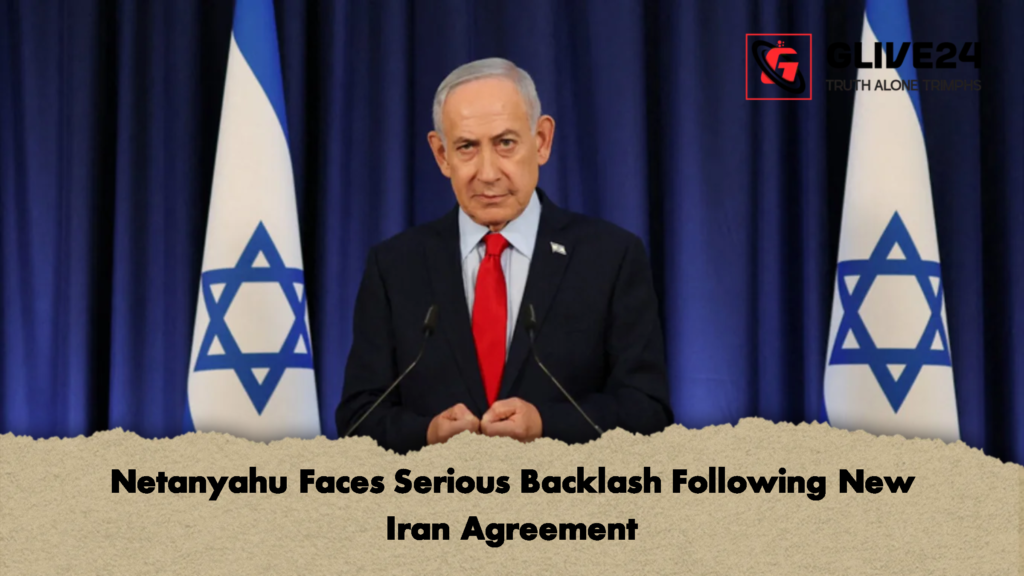
The political future of Israeli Prime Minister Benjamin Netanyahu appears increasingly precarious as the country approaches a general election scheduled for October this year. For several months, the 76-year-old leader had maintained hopes of retaining his position through the ballot box, but those strategic calculations have now been completely disrupted. A recent agreement concluded between the United States and Iran has plunged his broader political strategy into a severe crisis and heightened complexity.
US President Donald Trump made a definitive decision to halt conflicts involving Iran and Lebanon well before Israel could achieve its stated military objectives in the region. Consequently, Netanyahu’s public declaration from March—in which he confidently asserted that Israel was actively changing the face of the Middle East—is now widely viewed by political commentators and the public as empty rhetoric.
Multiple Crises Facing the Prime Minister
Even prior to the sudden geopolitical shift brought about by the new Washington-Tehran agreement, Netanyahu was already under immense pressure due to a combination of internal and external factors:
-
Corruption Charges: The veteran leader continues to be dogged by long-standing legal battles, court proceedings, and formal allegations of corruption that have spanned several years of his recent terms.
-
Security Failures: He faces severe domestic criticism for the intelligence and security lapses that failed to prevent the sudden, large-scale assault launched by Hamas into southern Israel on 7 October 2023.
-
Strained Alliances: His management of the war effort has led to a drastic deterioration in relations with Israel’s most vital global ally, the United States.
Opinion polls consistently indicate that Netanyahu’s right-wing coalition is on track to suffer a resounding defeat in the upcoming election. Despite these dire projections, political analysts caution against completely writing off the seasoned politician, who has successfully dominated Israeli parliamentary politics and coalition building since the 1990s.
The Collapse of a Hardline Image
Netanyahu’s political party, the Likud Party, has historically packaged and promoted him to the electorate as an unyielding “security guardian” capable of protecting the nation from external threats. Throughout his career, he has steadfastly opposed the creation of a sovereign Palestinian state and consistently advocated for direct military action to neutralise Iran’s regional influence. As recently as 2025, he publicly reaffirmed his policy, declaring that he would never permit the establishment of a Palestinian state anywhere west of the Jordan River.
However, this carefully cultivated image of absolute security has effectively crumbled. The combination of pre-attack intelligence blind spots, the subsequent loss of thousands of lives in Gaza and Lebanon, and the highest toll of Israeli military casualties seen in decades has deeply eroded public trust. Although a majority of the Israeli public supported the military campaigns conceptually, public sentiment has decisively turned against Netanyahu’s specific strategic execution of the wars.
While the high-profile assassinations of Hezbollah leader Hassan Nasrallah and Iranian Supreme Leader Ayatollah Ali Khamenei were openly celebrated inside Israel, the strategic reality on the ground remains unchanged. Hamas continues to maintain control over substantial portions of the Gaza Strip, and Hezbollah remains functional and resilient within Lebanon.
Reacting to the news of the US-brokered deal, Israeli Opposition Leader Yair Lapid expressed sharp condemnation, stating that Netanyahu had lost the war. Lapid remarked that the Prime Minister failed to deliver on his core promises and ultimately broke down when forced to confront the final moment of truth.
Growing Domestic and International Isolation
The scale of destruction in the Gaza Strip has triggered severe international repercussions. Israel now faces formal accusations of genocide on the global stage, and the International Criminal Court (ICC) has issued an official arrest warrant for Netanyahu on charges of war crimes.
Furthermore, Netanyahu’s efforts to maintain Western backing have backfired, resulting in openly hostile relations with successive US leaders. According to biographical accounts, former US President Joe Biden used profanity in private conversations to describe the Israeli Prime Minister. Similarly, Donald Trump—historically viewed as Netanyahu’s closest American ally—referred to him as “crazy” during a telephone conversation in June. This friction reflects a broader societal shift within the United States, where public support for Israel is actively declining among both Democrat and Republican voters.
Historical Context: Netanyahu originally entered the political arena following the death of his older brother, Yoni, who was killed in 1976 during the famous hostage rescue operation at Entebbe airport in Uganda. By 1996, Netanyahu had become Israel’s youngest-ever Prime Minister, forming a coalition government alongside hardline and ultra-Orthodox factions.
In 2022, despite the ongoing corruption trials against him, he secured power for a record sixth time. Shortly thereafter, his government introduced legislative measures designed to curtail the authority of the Israeli Supreme Court. This move triggered the largest mass public protests in the nation’s history throughout 2023.
Netanyahu had initially envisioned securing a historic legacy through the 2020 Abraham Accords, aiming to normalise diplomatic relations with the Arab world while entirely bypassing the issue of Palestinian statehood. However, the 7 October Hamas attacks and the ensuing bloody conflict in Gaza have permanently shattered those long-term aspirations. With Israel’s geopolitical standing in the Western world now severely compromised, the final chapter of Netanyahu’s lengthy political career is turning out to be deeply bitter and highly controversial.