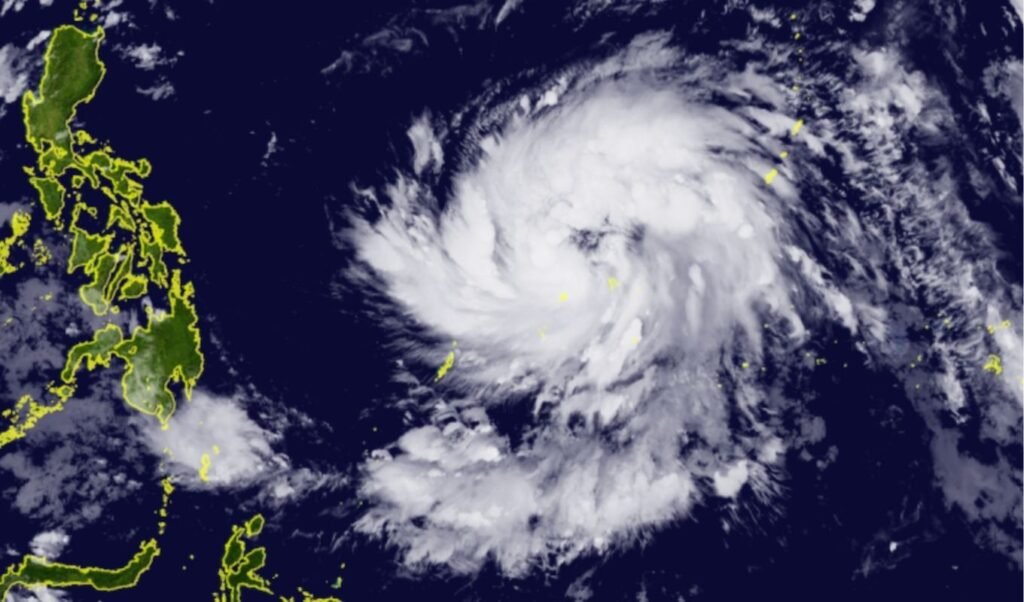
Nearly one million people were forced to evacuate their homes as floodwaters continued to rise across the Philippines on Sunday, ahead of the anticipated late-night landfall of Super Typhoon Fung-wong along the country’s eastern coast.
According to the Philippine Atmospheric, Geophysical and Astronomical Services Administration (PAGASA), the massive storm, moving westwards, was packing sustained winds of up to 185 kilometres per hour (115 mph) near its centre, with gusts reaching 230 kph (143 mph) as of 11 a.m. local time (0300 GMT).
With an immense radius covering almost the entire archipelago, Fung-wong is expected to unleash destructive winds and torrential rainfall over vast areas of the country. The storm comes just days after Typhoon Kalmaegi battered the Philippines, claiming more than 220 lives and leaving scores missing.
Schools and government offices across Luzon — the nation’s largest island and home to the capital, Manila — were ordered closed on Monday. Nearly 300 domestic and international flights have already been cancelled due to the approaching cyclone.
In Catanduanes, a small island province identified by PAGASA as potentially taking a “direct hit”, fierce winds and relentless rain pounded communities early Sunday. Storm surges sent waves crashing over coastal roads while floodwaters inundated low-lying areas.
“As we speak, they are feeling the full force of the typhoon, particularly in Catanduanes, where the storm’s eye is closest,” said Civil Defence Deputy Administrator Rafaelito Alejandro, noting that 916,863 residents had been evacuated nationwide.
Local resident Edson Casarino, 33, described the terrifying scene in the provincial capital Virac: “The waves started roaring around 7 a.m. When they hit the seawall, it felt like the ground was trembling. Heavy rain is pouring now, and I can hear the wind whistling.”
Verified footage shared by AFP showed a church in Virac surrounded by waist-deep floodwaters. In southern Luzon’s Bicol region, severe flooding was reported as rivers overflowed, including in Guinobatan, a town of about 80,000 in Albay province, where streets turned into fast-flowing torrents.
Government meteorologists warned that Fung-wong could bring over 200 millimetres (eight inches) of rain in many areas, raising fears of landslides and flash floods. Scientists have repeatedly cautioned that such storms are becoming stronger and wetter due to human-induced climate change, as warmer seas fuel rapid storm intensification and a hotter atmosphere traps more moisture.
On Saturday, residents of Catanduanes scrambled to brace their homes for the oncoming tempest. “They did what has become our tradition — strapping down the roofs with thick ropes and anchoring them to the ground, so they won’t be blown away by the wind,” said Roberto Monterola, a provincial rescue officer.
In Sorsogon, a coastal city in southern Luzon, many sought shelter in local churches. “I’m here because the waves near my house are enormous now. I live close to the shore, and the winds there are very strong,” said Maxine Dugan, a resident who fled her home on Saturday evening.
Only a few days earlier, Typhoon Kalmaegi had ravaged the central islands of Cebu and Negros, submerging towns, sweeping away vehicles and riverside shanties, and toppling massive shipping containers. The storm, the deadliest of 2025, killed at least 224 people and left 109 missing, according to government data released on Sunday morning.
Rescue operations in Cebu, the province hardest hit by Kalmaegi, were suspended as the new typhoon approached. “We cannot risk the safety of our rescuers. We don’t want them to become the next casualties,” said Myrra Daven, a local disaster response official.
As Fung-wong bears down on the Philippines, authorities remain on high alert, warning that the coming hours could bring catastrophic winds, flash floods, and further devastation to a nation still reeling from its last deadly storm.