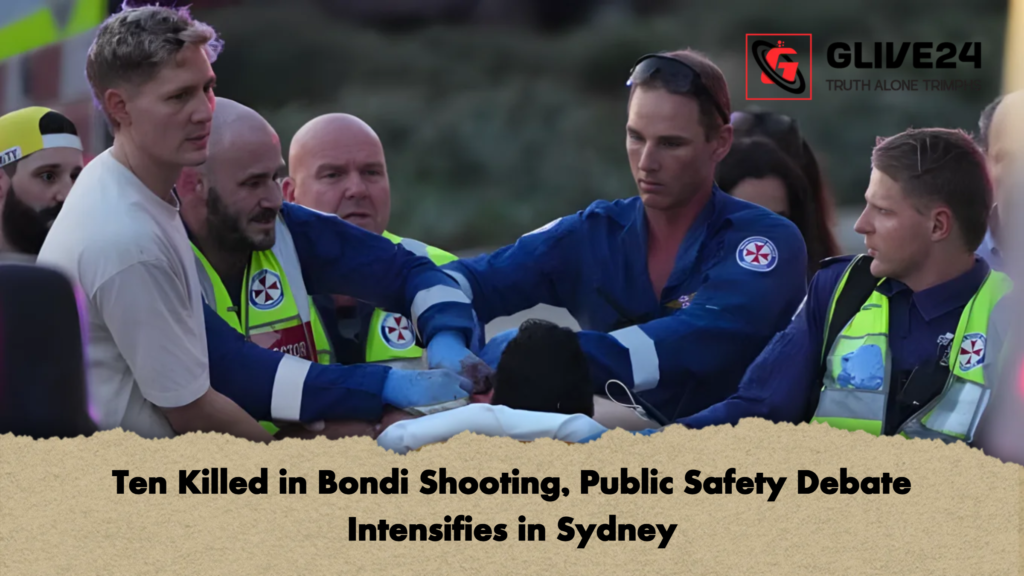
At least ten people have been killed in a deadly gun attack at Sydney’s world-famous Bondi Beach, with one of the perpetrators among the deceased. Police have confirmed that an additional 14 people were injured, including 12 civilians and two police officers on duty. The wounded are currently undergoing medical treatment, with several in critical condition.
Authorities have stated that two gunmen were responsible for the attack. One assailant was killed instantly at the scene, while the second, injured during the confrontation, was taken into police custody. Both injured officers received immediate medical attention, reflecting the swift emergency response. The incident has thrown Australia’s most visited beach into a state of emergency and highlighted the challenges of maintaining security in public spaces frequented by tourists.
Police established a secure perimeter around the area within minutes and deployed specialised units to detect and neutralise any potential improvised explosive devices (IEDs). An exclusion zone was created to prevent further casualties, though its exact location has not been made public. Authorities continue to reassure the public while conducting forensic and investigative procedures.
Analysts argue that the attack will have wide-ranging social and political consequences. Bondi Beach, a global tourist attraction, is symbolic of Sydney’s cultural and social life. The attack has therefore sparked renewed debate over urban security measures, the protection of civilians in public areas, and the preparedness of emergency response teams. The involvement of multiple attackers and the potential for explosives signals a sophisticated level of planning and intent.
City officials have already indicated that a review of public safety protocols is underway. There are calls to strengthen crowd management, enhance policing presence in tourist-heavy locations, and integrate intelligence with emergency response planning. The psychological impact on the local community and visitors alike is significant, as many residents express shock and concern over safety at high-profile public spaces.
The incident has raised broader questions regarding urban security and public confidence, with experts recommending long-term reforms to minimise the risks posed by coordinated attacks in densely populated areas. It serves as a stark reminder of the need for constant vigilance and the critical importance of rapid, coordinated emergency response in mitigating harm.