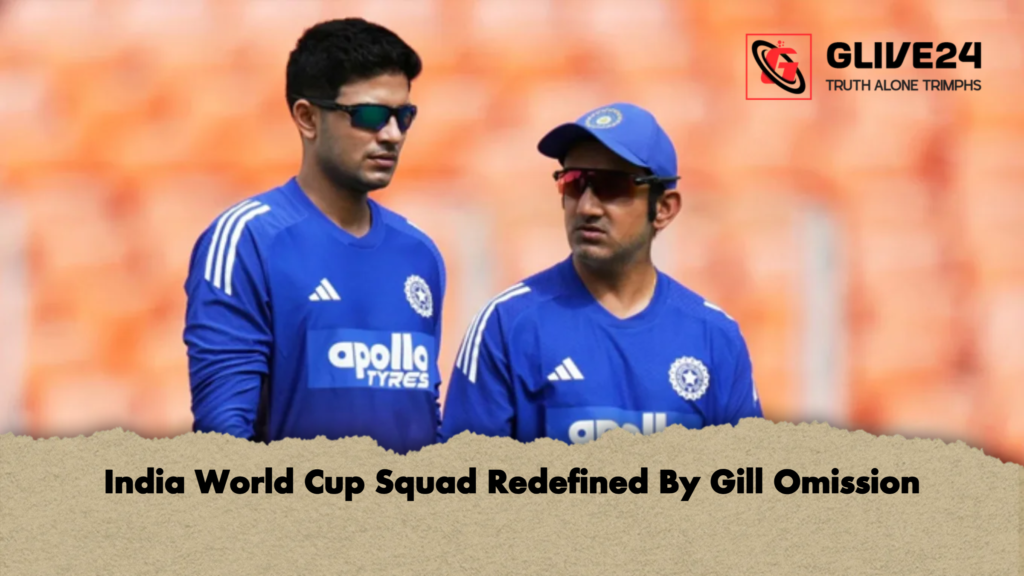
India’s announcement of their squad for the upcoming ICC Men’s T20 World Cup has sent shockwaves through the cricketing world, underlining a clear shift in selection philosophy by the Board of Control for Cricket in India (BCCI). The most eye-catching and widely debated decision has been the omission of Shubman Gill, one of the country’s most consistent performers across formats in recent seasons and, notably, the vice-captain during the recent T20 series against South Africa. Gill’s exclusion from the final World Cup roster has sparked intense discussion among former players, analysts, and fans, many of whom had viewed him as a cornerstone of India’s future leadership group.
Gill’s absence appears even more striking given his steady run of form and growing stature within the national setup. For many observers, he represented continuity and long-term planning. However, the selectors’ latest move suggests a deliberate departure from conventional thinking, favouring tactical clarity and role-specific impact over established reputation. In the high-octane T20 format, where margins are fine and momentum can shift within a few deliveries, India’s think tank seems determined to assemble a squad capable of delivering instant results under pressure.
Sources close to the selection panel indicate that the emphasis this time has been firmly on explosive batting, finishing ability, and multi-dimensional skill sets. Within this framework, Gill’s more classical approach appears to have been edged out in favour of players deemed better suited to defined match situations. As a result, left-handed wicketkeeper-batter Ishan Kishan has earned a recall, completing a remarkable comeback after nearly two years in the international wilderness.
Kishan last featured in a T20 international for India on 28 November 2023 against Australia in Guwahati. A prolonged slump in form subsequently saw him fall out of favour, with his international future appearing increasingly uncertain. Yet the aggressive opener responded in emphatic fashion, using domestic cricket as a platform to force his way back into contention. Leading Jharkhand in the Syed Mushtaq Ali Trophy, Kishan delivered one of the most dominant individual campaigns in the tournament’s history.
He finished as the leading run-scorer with an outstanding tally of 517 runs, highlighted by two centuries and two half-centuries. His defining moment came in the final, where he unleashed a breathtaking 101 against Haryana to guide his team to a commanding 69-run victory. Striking at an extraordinary rate of 206.12, his innings featured 10 sixes and six fours, combining raw power with composure on the biggest stage. Adding to his value, Kishan also impressed behind the stumps with two catches, earning the Player of the Final award and underlining his all-round contribution.
Another notable returnee is Rinku Singh, whose calm temperament and proven finishing ability have once again earned the selectors’ trust. Despite missing the recent South Africa series, Rinku’s past performances in pressure situations weighed heavily in his favour, resulting in Jitesh Sharma making way.
India will enter the home World Cup under the leadership of Suryakumar Yadav, with Axar Patel named as his deputy. The squad reflects a careful attempt to balance firepower and control. Jasprit Bumrah will lead the pace attack, supported by Harshit Rana and Arshdeep Singh, while Kuldeep Yadav and Varun Chakravarthy form the spin department.
The presence of all-rounders Hardik Pandya, Shivam Dube, Axar Patel, and Washington Sundar further enhances the squad’s flexibility, offering multiple options with both bat and ball.
Collectively, the omission of vice-captain Shubman Gill, the high-profile returns of Ishan Kishan and Rinku Singh, and several bold selection calls have given India’s World Cup squad a fresh and daring identity. The central question now is whether this calculated gamble will pay dividends, as Suryakumar Yadav’s side seeks to convert bold vision into silverware on home soil.