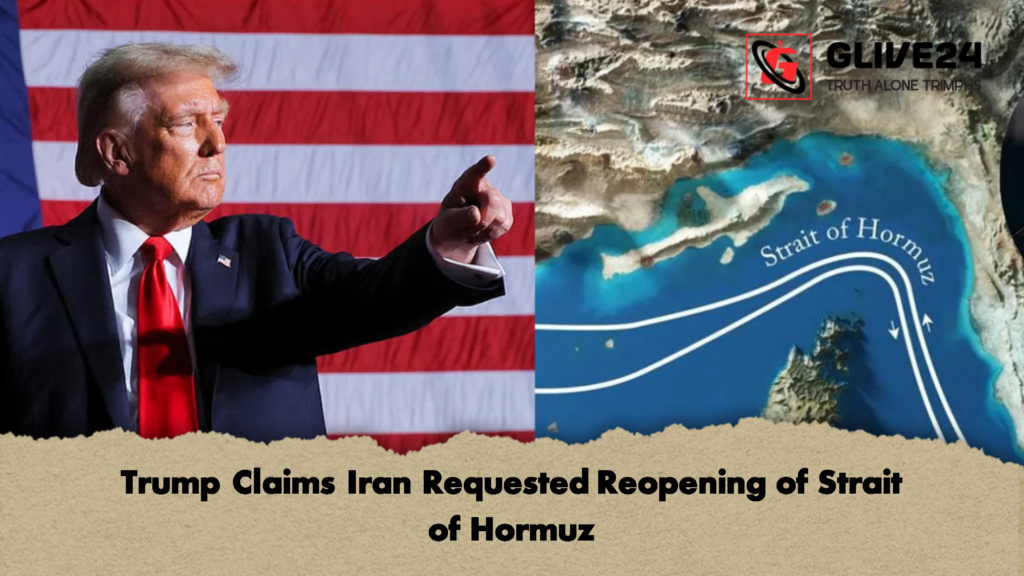
In a series of formal statements issued on Tuesday, 28 April 2026, United States President Donald Trump asserted that the Iranian government has approached Washington with a request to facilitate the reopening of the Strait of Hormuz. This waterway remains one of the world’s most vital maritime corridors, serving as a primary artery for the global supply of petroleum and liquefied natural gas. The President’s claim suggests a significant shift in the regional dynamic, implying that Tehran may be seeking a de-escalation of maritime friction despite a history of defiant rhetoric.
Table of Contents
Assertions of Iranian Instability and Leadership Crisis
Writing on his social media platform, Truth Social, President Trump characterised the current state of the Islamic Republic as “collapsed.” He further alleged that the nation is currently enduring a profound internal power vacuum, suggesting that the Iranian leadership is uncertain as to who holds the position of supreme authority within their own government following recent domestic developments.
According to the President’s social media post:
“They want us to get the Strait of Hormuz open as soon as possible, while they try to figure out their leadership situation (which I believe they will do successfully!).”
These comments are situated within a period of heightened geopolitical tensions in the Persian Gulf, where the free movement of international shipping has frequently been disrupted by seizures, drone activity, and naval standoffs. The President’s remarks imply that the Iranian administration is prioritising the restoration of maritime traffic through the narrow passage, potentially to alleviate economic pressures or to stabilise domestic logistics during a period of transition.
The Strategic Significance of the Strait
The Strait of Hormuz serves as a critical maritime choke point connecting the Gulf of Oman and the Persian Gulf. As the sole sea route from the Persian Gulf to the open ocean, it is a linchpin for global energy security. Historically, approximately 20% of the world’s total oil consumption and a significant portion of global LNG exports pass through this narrow waterway, which measures only 21 miles wide at its narrowest point.
Under international maritime law, specifically the United Nations Convention on the Law of the Sea (UNCLOS), vessels are generally entitled to the right of “transit passage.” However, Iran has historically asserted its right to monitor and control the waters within its territorial limits. This has led to frequent and often dangerous confrontations with Western naval forces, including the United Kingdom’s Royal Navy and the United States Fifth Fleet, who maintain a presence in the region to ensure the freedom of navigation.
Russian Support and the United Nations Response
The claims made by President Trump have met with stark opposition from the Kremlin and its representatives. Speaking at the United Nations, the Russian Permanent Representative, Vassily Nebenzia, defended Tehran’s recent actions regarding maritime regulation. Nebenzia dismissed Western criticisms as “hypocrisy” and accused Western powers of engaging in activities that he likened to “piracy,” specifically referring to the historical seizure of Iranian tankers.
The Russian envoy argued that Iran is acting within its rights as a sovereign coastal state, particularly when faced with perceived external threats or military encirclement. He stated:
“An attempt was made to pin all the blame on Iran. It was as if Iran had attacked its neighbour. In a time of war, a coastal country that has been attacked can regulate shipping for the sake of its security.”
Nebenzia’s comments highlight a deepening diplomatic rift between the P5+1 nations and their allies. Russia maintains that Iran’s measures to monitor and control the Strait are defensive necessities rather than unprovoked acts of aggression, directly contradicting the American narrative of Iranian instability.
Broader Context of the Maritime Crisis
The current standoff follows a protracted period of economic sanctions and military posturing. While the United States continues to exert “maximum pressure” via stringent economic restrictions, Iran’s regional adversaries and international allies remain divided on the legality of naval blockades and the boarding of commercial vessels.
The Strait has seen numerous incidents over the last decade, including the mining of tankers and the shooting down of surveillance drones, which have contributed to an atmosphere of volatility. If President Trump’s claims of an Iranian request are verified, it would mark a departure from Tehran’s usual stance of self-reliance and territorial assertiveness.
Though President Trump expressed confidence that Iran would eventually resolve its internal “leadership crisis,” the immediate focus for international markets and energy analysts remains the physical security of the Strait. A formal request from Tehran to Washington would mark a significant shift in the diplomatic landscape, potentially opening a narrow channel for broader negotiations in the Middle East. At present, neither the Iranian Foreign Ministry nor the Islamic Revolutionary Guard Corps (IRGC) has officially confirmed the communications mentioned by the US President.