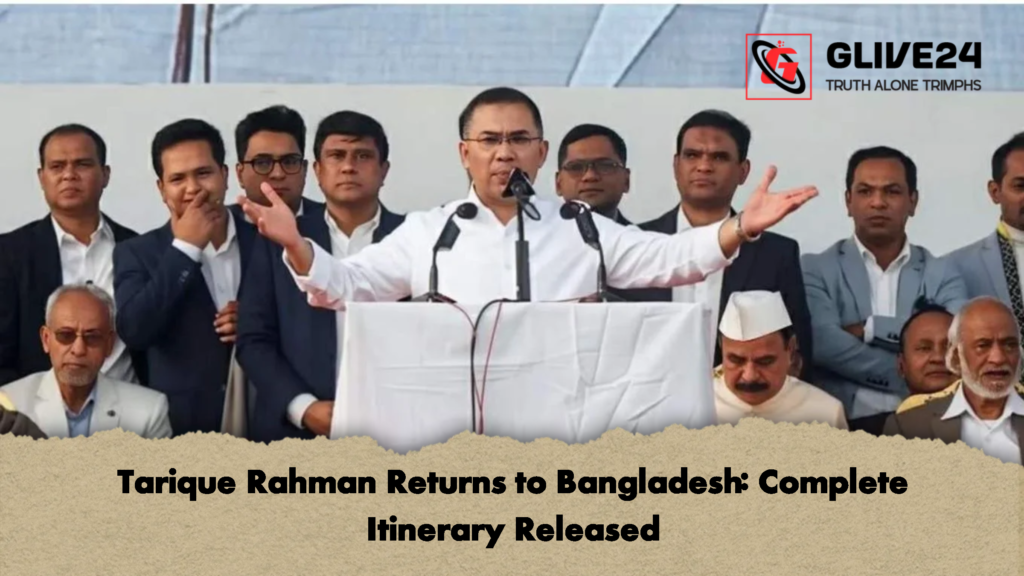
After 17 years in exile, BNP’s acting chairman Tarique Rahman returned to Bangladesh on Thursday, 25 December, in a homecoming that has captured nationwide attention. His arrival has already stirred the political landscape, raising expectations of renewed momentum within the party.
As part of his initial engagements, Rahman is scheduled to pay homage to the late President and BNP founder, Ziaur Rahman, by visiting his grave immediately following Friday prayers. He will then proceed to the National Memorial (Jatiya Smriti Soudho) to offer respects, underscoring both his recognition of the nation’s historical legacy and his political commitments.
At a press briefing on Wednesday, 24 December, Salahuddin Ahmed, a member of BNP’s Standing Committee, confirmed that extensive preparations had been made for Rahman’s return. “His itinerary is carefully structured to balance political engagement with honouring national heritage and significant historical sites,” Ahmed stated.
Detailed Schedule: 26–27 December
| Date | Time | Activity | Location / Details |
|---|---|---|---|
| 26 December | After Jumu’ah prayers | Visit to the grave of Shaheed President Ziaur Rahman | Mirpur, Dhaka |
| 26 December | After prayers | Tribute at the National Memorial | Shahid Minar, Dhaka |
| 27 December | Morning | Visit to the grave of Shaheed Sharif Osman Bin Hadi, convenor of Inquilab Munch | Inquilab Munch, Dhaka |
| 27 December | Midday | Cast vote as a registered voter | Designated polling centre |
| 27 December | Afternoon | Provide care and support to individuals injured during the July unrest | Pangu Hospital, Dhaka |
Salahuddin Ahmed further highlighted the political and social significance of Rahman’s itinerary. Visits to historical gravesites and the National Memorial are expected to reflect his profound respect for the country’s heritage, while simultaneously enhancing his visibility and profile as a political leader.
On 27 December, Rahman will also pay respects at the grave of Shaheed Sharif Osman Bin Hadi before casting his vote in the ongoing electoral process. Later, he is scheduled to visit Pangu Hospital to provide care and support for individuals injured during the July political unrest, demonstrating his commitment to social welfare and community engagement.
Political analysts observe that Rahman’s return after nearly two decades in exile could provide a fresh impetus to BNP’s internal cohesion. His presence and activities are likely to strengthen party unity and foster direct engagement with ordinary citizens. By combining religious observances, historical tribute, and participation in the electoral process, the programme conveys an important message about political stability, national heritage, and civic responsibility.
The itinerary has drawn widespread attention from party supporters across Bangladesh. Thousands of BNP activists and sympathisers are expected to participate, highlighting the social and cultural significance of Rahman’s return.
In summary, this two-day programme represents both a political and civic milestone. By blending heritage, social service, and electoral participation, it underscores Tarique Rahman’s renewed engagement and commitment to the nation.