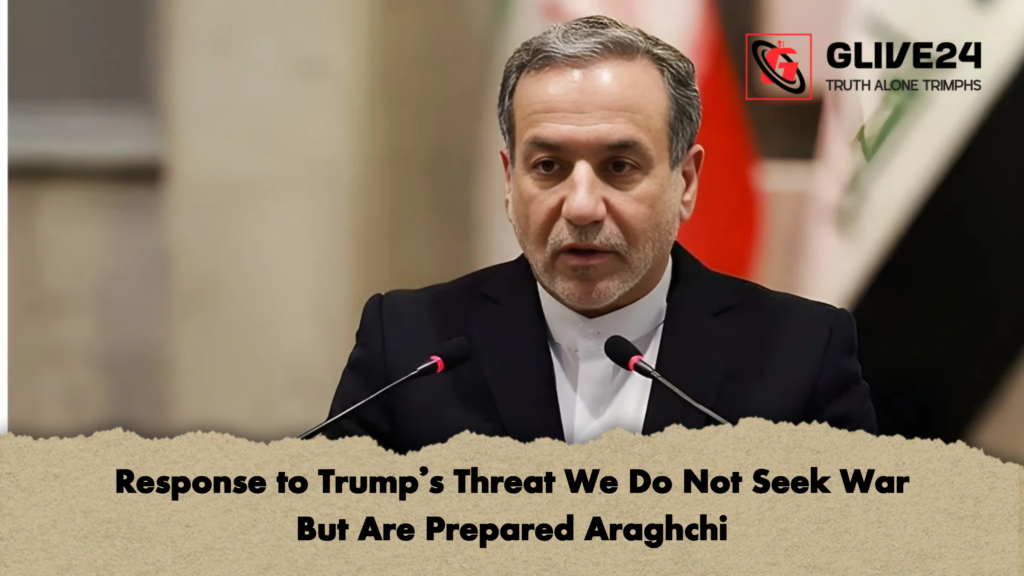
In response to repeated threats of military action from U.S. President Donald Trump, Iran has issued a clear and firm statement: the nation does not desire war, but remains fully prepared to confront any scenario. On Saturday, Iran’s Foreign Minister, Abbas Araghchi, emphasised that while Tehran remains committed to peace and diplomacy, it will not compromise on its sovereignty or security.
Speaking to the media, Araghchi highlighted that Trump’s threats primarily embolden destabilising forces and terrorist groups operating in the region. He alleged that both demonstrators and security forces are being targeted in ways that facilitate foreign intervention, further complicating Iran’s domestic situation. “Such statements and threats serve only to muddy the political waters,” he remarked.
Meanwhile, President Trump has publicly insisted that he possesses “very powerful options” against Iran. According to the U.S. administration, the situation in the Middle East is being closely monitored, and they remain in contact with anti-Iranian political actors. Tehran, however, interprets these declarations as deliberate pressure tactics rather than genuine diplomatic overtures.
Iran’s Foreign Ministry spokesperson, Esmail Baghai, clarified that diplomatic channels with the United States are not entirely closed. Limited communication continues through Switzerland’s mediation. Nevertheless, Baghai expressed concern over the contradictory messages emanating from Washington, which he said are undermining trust.
Addressing Trump’s recent claim that Iran had approached him to discuss its nuclear programme, Baghai stated that Iran is open to dialogue—but only on the basis of mutual interest, respect, and recognition of legitimate concerns. He stressed that Tehran will not accept unilateral demands, coercion, or dictatorial posturing.
Baghai further alleged that ongoing violence within the country is part of a “terrorist war” orchestrated against the Iranian people, consistent with the aggressive policies of the United States and Israel. He claimed that Iran possesses solid evidence of foreign armed forces’ involvement in attacks on civilians and intends to raise the matter in international forums.
Reiterating his stance, Foreign Minister Araghchi said that Iran is willing to engage in talks with Washington “on the basis of dignity and mutual respect.” At the same time, he cautioned: “We do not seek war, but we are fully prepared to defend ourselves if necessary.”
The following table summarises the recent positions of Iran and the United States:
| Issue | Iran’s Position | United States’ Position |
|---|---|---|
| War | Does not seek war, but fully prepared | Threat of military options |
| Dialogue | Willing to engage on mutual respect | Indicates dialogue under pressure |
| Communication | Limited contact via Switzerland | Contact with opposition actors |
| Domestic Situation | Accuses foreign interference | Concerns over human rights and security |
Overall, Tehran has made it clear that respect and diplomacy remain the only viable path to de-escalation, rejecting coercion and threats as counterproductive.