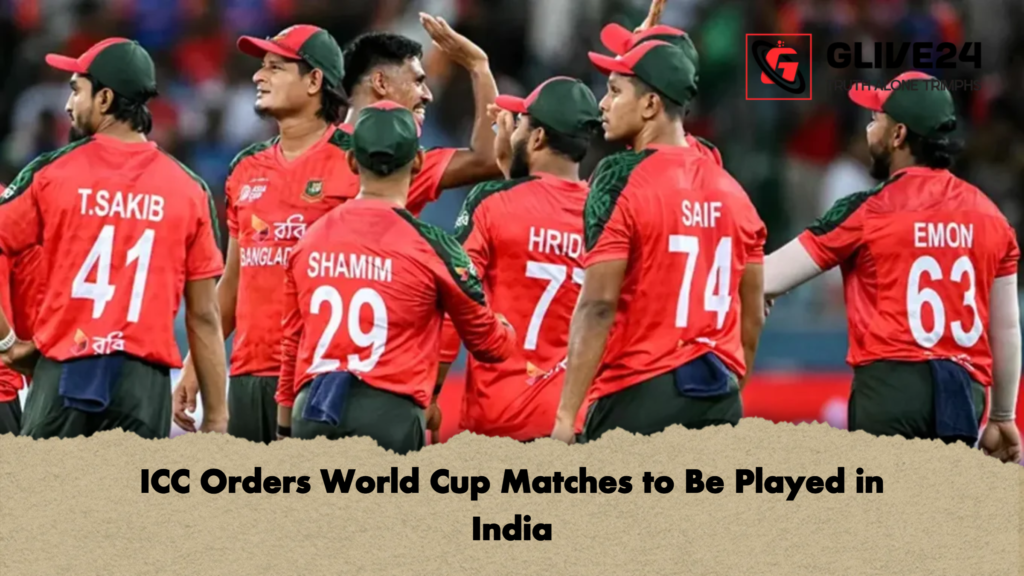
Bangladesh’s participation in the upcoming ICC Men’s T20 World Cup has been thrown into serious doubt after the International Cricket Council formally informed the Bangladesh Cricket Board (BCB) that all of the team’s matches must be played in India. The decision was communicated following a full ICC board meeting, with the governing body issuing a clear ultimatum: Bangladesh must confirm its acceptance within 24 hours or risk being replaced in Group C by an alternative team.
The ICC confirmed its stance through an official media release, underlining that the matter had reached a decisive stage. In response, senior BCB officials convened an emergency meeting late on Wednesday night with the government’s sports adviser to determine the next course of action. The meeting was still ongoing near midnight, reflecting the gravity of the situation and the political as well as sporting implications involved.
Several former cricketers and administrators have warned that withdrawing from a global tournament of this scale could expose Bangladesh cricket to long-term consequences. Beyond immediate reputational damage, they fear financial losses, strained international relations and reduced influence within the ICC’s decision-making structure.
The dispute originated from Bangladesh’s refusal to play World Cup matches in India, citing security concerns. In an effort to resolve the issue, the ICC and BCB engaged in weeks of dialogue. ICC officials even travelled to Dhaka to personally request Bangladesh’s participation in India. Despite these efforts, the BCB remained firm and proposed relocating its matches to Sri Lanka instead.
With no breakthrough in sight, the ICC convened a board meeting involving all 12 Full Member nations. The final decision was taken through a formal vote, in which Bangladesh failed to secure support from any member board. Associate nations also voted against Bangladesh’s position. Pakistan reportedly appealed to the ICC to consider Bangladesh’s circumstances, but that request did not influence the outcome.
In its post-meeting statement, the ICC explained that an emergency session had been called after the BCB formally requested a venue change. The board reviewed independent security assessments, venue-specific safety plans and written assurances from Indian authorities. According to the ICC, all evaluations reached the same conclusion: there is no credible or verifiable security threat to Bangladesh’s players, officials, media personnel or supporters at any Indian venue.
An ICC spokesperson said the organisation had held “consistent and constructive discussions” with the BCB over several weeks, with the sole objective of ensuring Bangladesh’s participation. However, the spokesperson added that the BCB continued to link World Cup participation to an unrelated domestic league issue involving one Bangladeshi player, a matter the ICC described as irrelevant to tournament security or hosting conditions.
Should Bangladesh ultimately withdraw, the ICC is expected to invite a replacement team. Speculation within the cricketing world suggests Scotland, eliminated in the European qualifiers, could be among the leading contenders.
The risks for Bangladesh extend far beyond this tournament. Non-participation would result in the loss of ICC revenue distributions and could discourage future bilateral tours. There are growing concerns that India may cancel its scheduled tour of Bangladesh later this year, while Australia’s proposed visit could also fall into uncertainty. With no major board backing its stance, Bangladesh faces the prospect of isolation within international cricket.
Possible Consequences of Non-Participation
| Area | Potential Impact |
|---|---|
| World Cup place | Replacement team added to Group C |
| Financial revenue | Loss of ICC tournament earnings |
| Bilateral series | India and Australia tours at risk |
| ICC relations | Reduced influence and diplomatic support |
| Long-term outlook | Increased isolation in global cricket |
As the deadline approaches, the final decision now rests with the Bangladeshi government and the BCB. Whether Bangladesh chooses to comply with the ICC’s directive or stand firm on its position may shape the future of the country’s cricket for years to come.