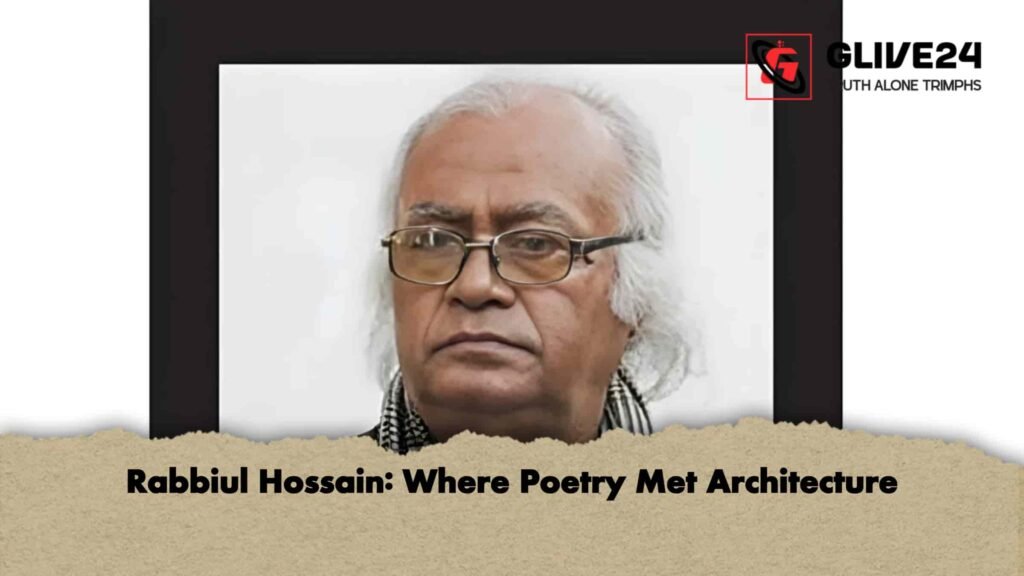
Rabbiul Hossain occupies a singular place in Bangladesh’s cultural history, standing out as a rare figure who moved with equal authority through the worlds of architecture and poetry. His life’s work demonstrates how the disciplines of space, language and memory can converge to create a unified creative vision. As an accomplished architect, he enriched the country’s built environment; as a sensitive and reflective poet, he left behind a body of writing marked by emotional depth, historical awareness and humanist concern. National recognition came in 2018, when he was awarded the Ekushey Padak, the country’s highest civilian honour, in acknowledgement of his outstanding contribution to language, literature and culture. Nearly a decade earlier, in 2009, he received the Bangla Academy Literary Award for his achievements in poetry, firmly establishing him as one of the most significant literary voices of his generation. Yet poetry represented only one dimension of Rabbiul Hossain’s creative life. He was also an art critic, short-story writer, essayist and committed cultural activist. A particularly important chapter of his professional career was devoted to projects associated with the memory and interpretation of the 1971 Liberation War. In these works, architectural responsibility merged with poetic sensitivity, resulting in structures that transcend brick and concrete to serve as repositories of collective history and remembrance. Born on 31 January 1943 in Ratidanga village of Shailkupa upazila, Jhenaidah, Rabbiul Hossain completed his secondary and higher secondary education in Kushtia. He later enrolled in the Department of Architecture at the then East Pakistan University of Engineering and Technology—now Bangladesh University of Engineering and Technology (BUET)—from which he graduated in 1968. Even before completing his formal education, he began professional practice, while simultaneously nurturing the literary pursuits he had embraced during his student years. Throughout his life, he remained actively involved with a wide range of cultural and professional institutions. As a life member of Bangla Academy, and through his engagement with organisations such as Kachi-Kachar Mela, the National Poetry Council, the Bangabandhu Sheikh Mujibur Rahman Memorial Museum, the Bangladesh International Film Critics Association and the Institute of Architects Bangladesh, he played a sustained role in shaping the country’s intellectual and cultural discourse. His architectural works are characterised by a careful balance of history, aesthetics and function. University buildings, research institutes, memorials and ceremonial gateways across the country bear testimony to his vision. Alongside this, his literary output—spanning poetry, fiction, children’s literature and essays—amounts to more than twenty-five published books, each contributing a distinctive voice and perspective to modern Bangla literature. Rabbiul Hossain passed away on 26 November 2019. His multifaceted legacy continues to inspire new generations, reminding them that creative disciplines do not exist in isolation, but achieve their fullest expression when they illuminate one another. Life and Work at a Glance Aspect Details Birth 31 January 1943, Ratidanga, Jhenaidah Education Architecture, BUET (graduated 1968) Major Awards Bangla Academy Literary Award (2009); Ekushey Padak (2018) Notable Architectural Works Bangladesh Agricultural Research Council Building; University of Dhaka Liberation and Independence Gate; Jahangirnagar University gates and halls; Wazed Mia Science Complex; University of Chittagong Auditorium and Academic Complex Publications Over 25 books including poetry, fiction, essays and children’s literature Death 26 November 2019 Rabbiul Hossain’s thought and work continue to command deep respect, transcending time and reaffirming the enduring bond between art, architecture and the human spirit.