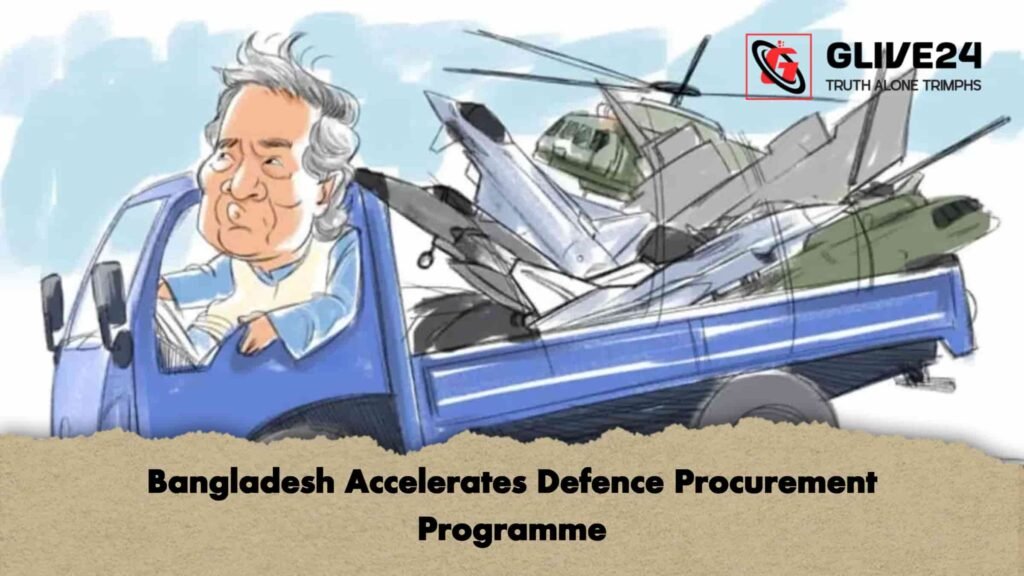
Over the past eighteen months, Bangladesh’s caretaker government has undertaken a series of high-priority initiatives, ranging from institutional reforms to overseeing justice for the 2016 July killings and preparing for early national elections. Among these, the modernisation of the defence sector stands out as the most tangible and strategically significant endeavour. The government’s stated objective is to enhance the country’s military capabilities through international agreements, equipment acquisition, and technology transfers.
Bangladesh has engaged in procurement discussions and contracts with multiple countries, including Pakistan, China, Turkey, South Korea, the United States, and several European nations. The acquisitions encompass fighter jets, attack helicopters, submarines, and naval vessels. A recent example is the contract signed with China’s CETC International for the production of drones and technology transfer, valued at approximately BDT 608 crore.
Key Defence Acquisitions and Projected Expenditure
| Procured Equipment | Source Country / Company | Quantity / Plan | Estimated Cost (BDT crore) | Purpose / Notes |
|---|---|---|---|---|
| JF-17 Block III Fighter Jet | Pakistan | 12 | 8,856 | Multi-role 4.5-generation jet with advanced radar and missiles |
| J-10C Fighter Jet | China | 20 | 27,060 | MRCA jet for multi-role operations; expansion of 10 existing squadrons |
| Eurofighter Typhoon | Europe (UK, Germany, Italy, Spain) | 10 | – | Supersonic jet capable above 55,000 feet |
| T-129 Attack Helicopter | Turkey | 6 | – | Day-night operational capability with 20mm gun and missiles |
| BNS Khalid Warship Upgrade | Turkey / Designated Company | 1 | 650 | Enhances naval power and continuous maritime surveillance |
| Submarine | South Korea | Negotiations ongoing | – | Strategic maritime security and cooperation |
| Black Hawk Helicopter | United States | 4 | – | Military transport, medical support, and special operations |
| Fixed-Wing Aircraft | United States | 2 | – | Augments Air Force operational capacity |
These acquisitions form part of Bangladesh’s “Goal 2030” plan, which aims to strengthen the army, navy, and air force. Defence analysts note that this multi-faceted procurement strategy balances regional security imperatives, technology transfer opportunities, and long-term maintenance considerations. Critics, however, argue that the government should prioritise institutional reform, judicial accountability, and election preparedness before embarking on such an extensive military modernisation drive.
Bangladesh’s defence procurement is closely intertwined with international diplomacy and economic strategy. Agreements with Pakistan and China for fighter jets, acquisitions of Typhoon jets from Europe, and technology transfers with China reflect a phased approach to military modernisation. Analysts contend that while these measures involve significant expenditure, they are crucial for consolidating the country’s long-term security posture.