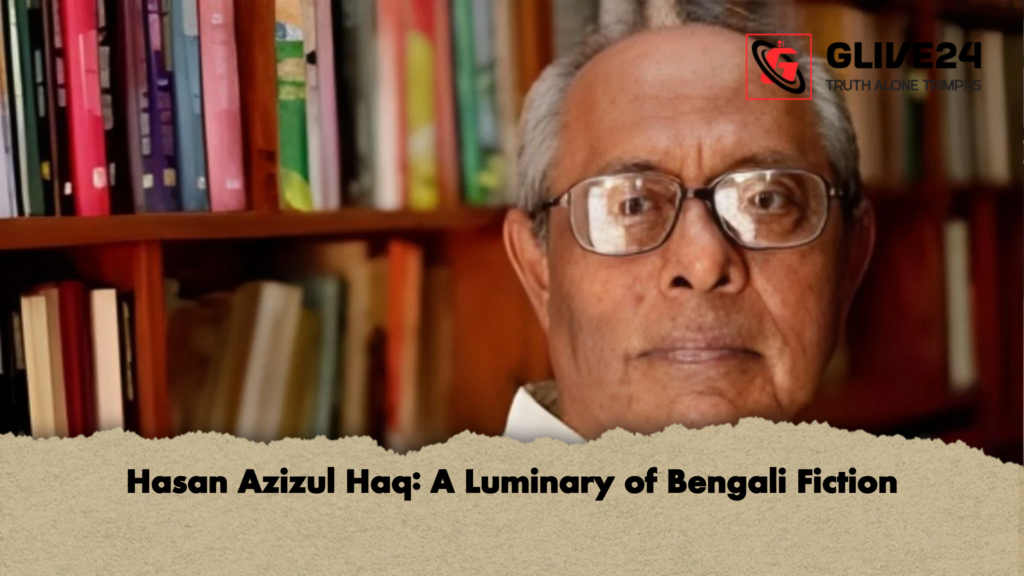
Hasan Azizul Haq stands among the quietly luminous figures in Bengali literature, celebrated for his fearless portrayal of human struggle and the silent anguish of society’s marginalised. Emerging in the 1960s, this eminent short story writer and novelist carved a distinctive space in Bengali literature through his cohesive prose, unsparing vision, and poignant narrative style.
At the heart of his work lies the human condition: suffering, hunger, love, anger, and existential crisis. The arid landscapes of Rarh Bengal, the parched soil, and the relentless daily grind of impoverished communities form the backdrop for many of his stories, leaving an indelible impression on readers. Unlike ornate literary pursuits, Haq’s writing is a stark document of life’s raw realities.
His literary brilliance was formally recognised with the Bangla Academy Literary Award in 1970. In recognition of his outstanding contribution to literature and culture, the Government of Bangladesh conferred upon him the Ekushey Padak in 1999. Further international acknowledgment came in 2012 when Assam University, India, awarded him an honorary Doctor of Letters (D.Litt).
Born on 2 February 1939 in Yabgram, Burdwan district, West Bengal, Haq hailed from a distinguished family. His father, Mohammad Doya Bakhsh, and mother, Zohra Khatun, nurtured a household steeped in values. He was married to Shamsun Nahar Begum and spent most of his life in Rajshahi, a city that became the centre of his intellectual and creative pursuits.
A brilliant student, Haq completed his undergraduate degree with honours in Philosophy from Rajshahi Government College in 1958, followed by a master’s degree in 1960. His philosophical training, especially in logic and humanism, profoundly shaped his literary outlook.
Between 1960 and 1973, he taught at Rajshahi City College, Sirajganj College, Khulna Girls College, and Daulatpur Brojolal College. In 1973, he joined Rajshahi University’s Department of Philosophy as a professor, remaining there until his retirement in 2004. As an educator, he was wise, sensitive, and student-friendly.
Haq’s literary career began during his college years with a piece in the foldout magazine Charpata, edited by Misbahul Azim, celebrating the mangoes of Rajshahi. Although modest in theme, it foreshadowed the mature voice that would later define Bengali fiction.
The progressive cultural organisation Sondipan in Khulna played a pivotal role in nurturing his literary energy. By the early 1960s, Haq was already recognised in literary circles, and the collective of young writers including Nazim Mahmud, Mustafizur Rahman, and others helped shape the progressive literary movement in Bangladesh.
His debut short story collection, Shomudrer Shopno Shiter Oronno, opens with “Shokun”, revealing the oppressive power of the rural moneylender and the plight of village society. Over nearly five decades, Haq gifted Bengali literature a remarkable corpus of stories, including Trishna, Uttorbosonte, Bimorsho Ratri, Prathom Prohor, Porobashi, Amrittu, Jibon Ghose Agun, Khacha, Fera, Maa-Meyer Songshar, and many more.
His 2006 novel Agunpakhi represents a singular achievement in Bengali literature, portraying Partition, women’s struggles, and historical silences. The novel was widely acclaimed and awarded as the best novel of the year.
On 15 November 2021, Hasan Azizul Haq passed away at his residence in Rajshahi. Yet, his literary legacy endures—the infinite narratives of human struggle he immortalised continue to illuminate Bengali literature.
Selected Works of Hasan Azizul Haq
| Year | Type | Title |
|---|---|---|
| 1965 | Short Story Collection | Shomudrer Shopno Shiter Oronno |
| 1970 | Short Story Collection | Trishna |
| 1975 | Short Story Collection | Uttorbosonte |
| 1980 | Short Story Collection | Bimorsho Ratri |
| 1985 | Short Story Collection | Porobashi |
| 2006 | Novel | Agunpakhi |
| 2010 | Short Story Collection | Maa-Meyer Songshar |