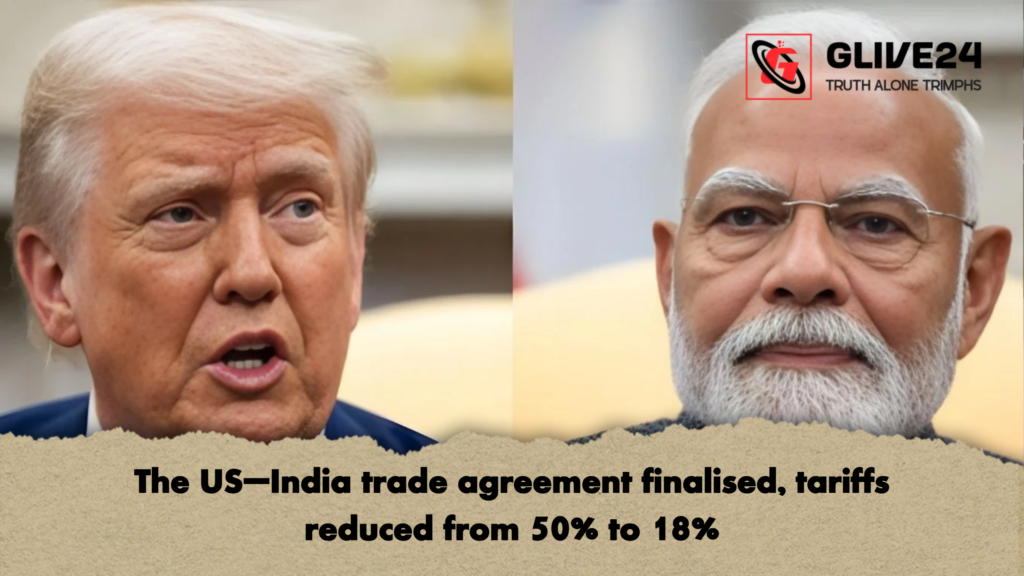
On Monday, US President Donald Trump announced a landmark trade agreement with India, under which American tariffs on Indian goods will be reduced from 50% to 18%. In return, India has agreed to halt oil imports from Russia and to ease barriers for American products entering its market—a long-standing demand of the United States.
True to form, President Trump made the announcement via his social media platform, Truth Social, following a phone conversation with Indian Prime Minister Narendra Modi. Trump stated that, under the agreement, India would purchase oil from the United States, with Venezuela likely to be the primary alternative supplier. Earlier, he had emphasised that India would source oil from Venezuela rather than Iran, Reuters reported.
While Trump did not explicitly address the 25% punitive tariffs previously imposed on Indian goods for purchasing Russian oil, a White House official told Reuters that the additional tariffs will be withdrawn. Following the announcement, Prime Minister Modi confirmed that the framework of the deal had been finalised.
India’s appointed US ambassador, Sergio Gor, also signalled the development in remarks to Indian media, noting that Indian goods would now face an effective tariff of 18%—lower than that imposed on Pakistan (19%), China (30–35%), and Bangladesh (20%).
It is worth noting that of the original 50% US tariff on Indian goods, 25% represented retaliatory duties, while the remaining 25% was a punitive measure linked to India’s purchase of Russian oil.
Prime Minister Modi expressed his satisfaction on X (formerly Twitter), writing: “I was delighted to speak to my dear friend President Trump today. I am pleased that tariffs on Made-in-India goods have been reduced to 18%. On behalf of 1.4 billion Indians, I thank President Donald Trump for this excellent announcement. When two large economies and the world’s largest democracy work together, people benefit, and new avenues of cooperation are created.”
Modi further highlighted the importance of Trump’s leadership for global peace, stability, and prosperity, stating India’s full support for his efforts and his commitment to closely collaborate to elevate bilateral partnership to unprecedented heights.
President Trump added that India would significantly increase its purchases of American goods, pledging imports worth over $500 billion, including energy commodities such as coal. The deal is also expected to boost purchases of technology, agricultural products, and other goods. India has committed to reducing both tariff and non-tariff barriers to nearly zero.
According to World Trade Organization data, India was among the countries with the highest tariffs globally before Trump’s return to office last year, with a simple applied tariff of 15.6% and an effective rate of 8.2%.
Economic analyst Madhavi Arora of MK Global remarked that the agreement brings India closer to the average Asian tariff range of 15–19%, easing long-standing pressures on exports and the rupee.
However, formal implementation remains pending. As of Monday afternoon, the White House had not issued the necessary presidential proclamation or Federal Register notice, and neither India’s trade and foreign ministries nor the Russian embassy in Washington provided immediate comment.
US–India Tariff Comparison
| Country | US Tariff on Exports (%) |
|---|---|
| India | 18 |
| Pakistan | 19 |
| China | 30–35 |
| Bangladesh | 20 |