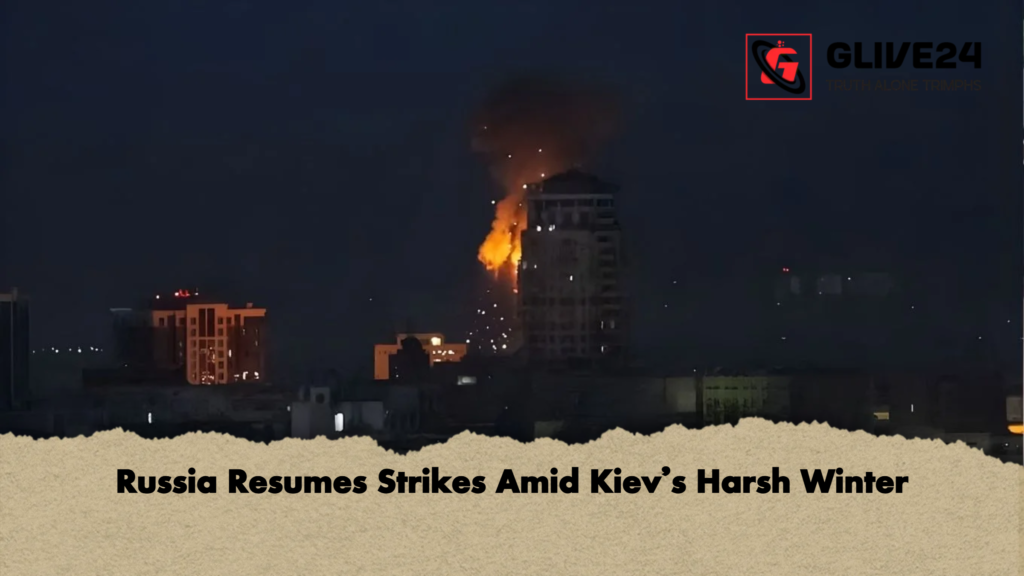
As the one-week ceasefire announced by U.S. President Donald Trump expired, Russia resumed heavy attacks on Kyiv amid freezing winter conditions, Ukrainian officials confirmed on Tuesday. Temperatures plunged to minus 17 degrees Celsius in the capital, while Kharkiv in the east recorded a chilling minus 23 degrees Celsius, exacerbating the humanitarian impact of ongoing hostilities.
Last Thursday, President Trump had declared that Russian President Vladimir Putin had agreed to halt winter assaults on Kyiv and other strategic cities. The Kremlin had indicated that the ceasefire would remain in effect until Sunday. However, Ukraine reported that Russia conducted indiscriminate strikes even during the ceasefire period.
Timur Tkachenko, head of the Kyiv City Military Administration, wrote on Telegram: “In the extreme cold of the night, Russia launched another major attack on Kyiv. Residents are advised to remain in emergency shelters.” He confirmed that two civilians were injured in the assault.
In Kharkiv, Russian shelling also resulted in two injuries. Regional military chief Oleg Synegubov said that the strikes primarily targeted fuel and energy infrastructure over several hours. “The intent was to inflict maximum destruction and leave the city without heat in severe snowfall,” he explained.
This escalation comes as Ukraine approaches the fourth anniversary of Russia’s February 24, 2022 invasion. Second-round talks involving Ukrainian, Russian, and U.S. officials are scheduled to begin on Wednesday in Abu Dhabi, though territorial disputes remain unresolved. Russia continues to seek full control over the eastern Donetsk region, a demand firmly rejected by Kyiv.
The effects of the attacks and extreme weather conditions are summarised below:
| City | Night Temperature | Injuries | Targeted Infrastructure | Damage Status |
|---|---|---|---|---|
| Kyiv | -17°C | 2 | Fuel infrastructure | Damage reported; partial destruction |
| Kharkiv | -23°C | 2 | Fuel infrastructure | Partial destruction |
Experts warn that Russia’s strategy aims to trigger a winter crisis, worsening energy shortages and leaving civilians without electricity and heating. With temperatures so low, these disruptions pose an extreme risk to public safety.
International observers stress that without renewed diplomatic efforts, such attacks are unlikely to cease. Authorities urge citizens to remain in shelters and for emergency fuel supplies to be prioritised to mitigate the humanitarian toll.