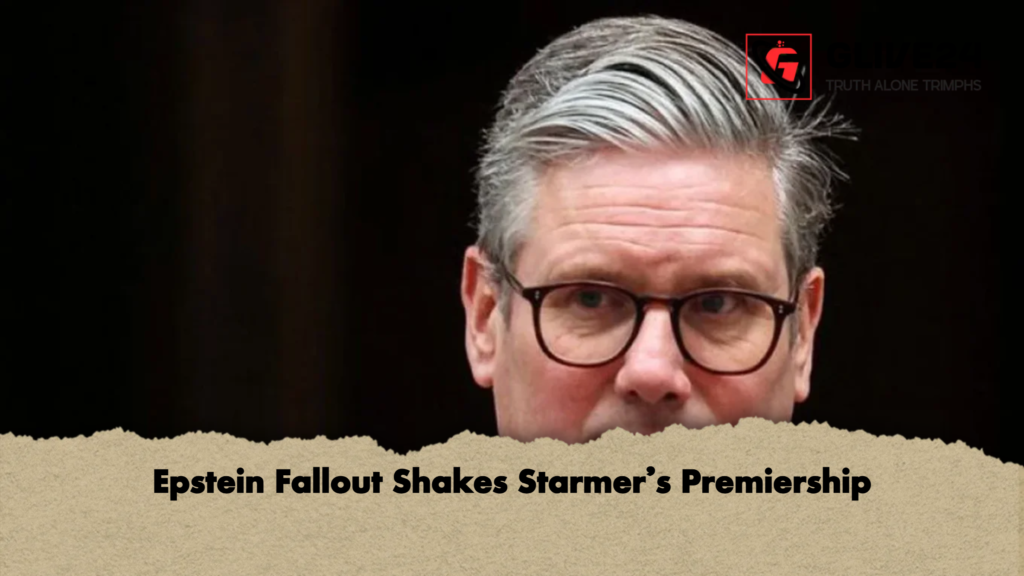
Although Sir Keir Starmer has no personal ties to Jeffrey Epstein, the aftershocks of the disgraced financier’s scandal are now reverberating powerfully through British politics, placing the Prime Minister in acute difficulty. Political analysts argue that the so-called “Epstein storm” has exposed vulnerabilities in Starmer’s leadership and could ultimately cost him his office. Amid mounting controversies and party unrest, his premiership at 10 Downing Street is widely described as hanging by a thread.
As political turbulence intensifies on the eastern side of the Atlantic, a striking contrast has emerged with the United States. There, Epstein’s victims continue to demand justice and accountability, criticising what they see as institutional inertia in Washington. This divergence highlights the relative strength of Donald Trump’s political position in the US and the existential fragility now confronting Starmer in the UK.
Observers note that Britain’s political system places a heavier emphasis on scrutiny, accountability, and parliamentary investigation. Independent institutions, an assertive press, and an emboldened legislature have combined to amplify pressure on the Prime Minister. In the United States, by contrast, Trump’s influence over the Department of Justice and his firm grip on the Republican-controlled Congress have largely insulated him from sustained oversight, despite recurring references to his name in Epstein-related documents.
One of the most significant aspects of the affair is the global reach of the Epstein files. From Norway to Poland, the scandal’s shadow has spread across Europe, underlining the breadth and depth of its implications. Numerous influential figures across politics, finance, and academia have found themselves under renewed scrutiny, reinforcing the sense that this is not an isolated controversy but a transnational reckoning.
Public anger in the United Kingdom has been particularly intense. King Charles III took the extraordinary step of stripping his brother, Prince Andrew—a long-time associate of Epstein—of royal patronages and requiring him to vacate a residence at Windsor Castle. The move was widely interpreted as an attempt to shield the monarchy from further reputational damage and to reflect the gravity of public sentiment.
In the United States, investigators maintain that Epstein’s death in prison in 2019 occurred by suicide before he could stand trial. Yet there has been little evidence that political figures with alleged connections to him have paid a substantial price. One notable exception is former US Treasury Secretary Larry Summers, who withdrew from public life after emails revealed a close association with Epstein, including remarks widely criticised as misogynistic. Summers publicly expressed deep remorse and acknowledged serious errors of judgement.
Donald Trump, meanwhile, has sought to close the chapter on the controversy. The Department of Justice has stated that no new cases will be brought, asserting that there is no evidence to support criminal charges against Trump or others named in recently released documents. While some references to Trump are described as benign, the files also contain unverified allegations of sexual misconduct and harrowing accounts from Epstein’s victims. Trump has insisted that the country should “move on” and focus on other priorities.
It is Sir Keir Starmer, however, who appears most imperilled. His position weakened dramatically following a rebellion by Labour MPs, which further destabilised Downing Street. During a heated parliamentary session, Starmer admitted that he had been aware of former minister Peter Mandelson’s friendship with Epstein when appointing him as ambassador to Washington—a revelation that proved politically damaging.
Documents published last year showed that Mandelson maintained contact with Epstein even after his 2008 conviction for sexual offences in Florida. Starmer later dismissed Mandelson, but newly surfaced materials suggest that during the 2008 global financial crisis Mandelson may have passed sensitive information to Epstein, potentially benefiting Epstein and his Wall Street associates. Mandelson is now the subject of a criminal investigation and has resigned from both the House of Lords and the Labour Party.
Addressing Parliament, Starmer accused Mandelson of betraying “our country, our Parliament, and my party”. In a subsequent statement to the BBC, Mandelson apologised unreservedly to Epstein’s victims, admitting that continuing to trust Epstein after his conviction had been a grave mistake. He said his resignation was intended to spare Labour further embarrassment.
Analysts argue that the crisis engulfing Britain extends well beyond Epstein’s crimes. It has intensified three pre-existing dramas in British public life: distrust of political elites, instability of party leadership, and the relentless scrutiny of media and institutions. Starmer’s recent performances in Parliament, often marked by visible discomfort, have reinforced perceptions of weakness and fuelled speculation about a leadership challenge within Labour.
While US presidents serve fixed terms, British prime ministers face constant speculation about their longevity. The UK has seen five prime ministers in the past eleven years, eroding its long-standing reputation for political stability. Against this backdrop, the Epstein affair has become entwined with the long, tragic arc of Peter Mandelson’s career—a gifted yet repeatedly self-undermining figure whose desire to move among the wealthy and powerful ultimately led him into association with Epstein, and to his political downfall.
Key Figures and Developments
| Figure | Role | Current Status |
|---|---|---|
| Jeffrey Epstein | Disgraced financier | Died in prison in 2019 |
| Sir Keir Starmer | UK Prime Minister | Facing severe political pressure |
| Peter Mandelson | Former UK minister | Under criminal investigation |
| Prince Andrew | Member of UK royal family | Stripped of royal roles |
| Donald Trump | Former US President | No charges filed |
Together, these developments have turned the Epstein scandal into a defining test of leadership and accountability—one that may yet determine the fate of Britain’s Prime Minister.