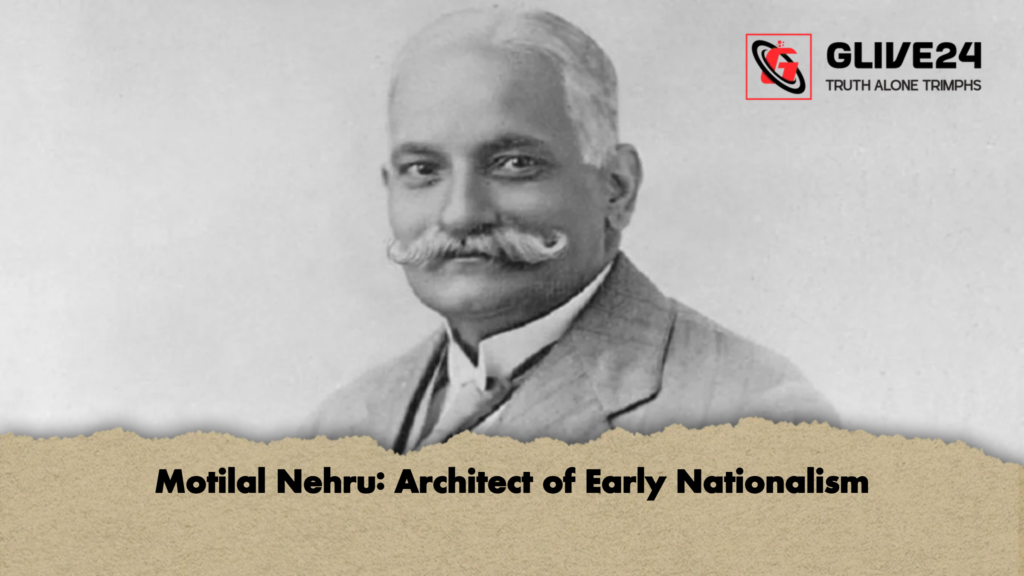
Motilal Nehru stands among the foremost lawyer-statesmen of British India and an early architect of the country’s constitutional nationalism. A distinguished barrister, an astute political organiser and a central figure in the formative decades of the Indian National Congress, he helped shape the intellectual and strategic foundations of India’s struggle for self-government. Although widely remembered as the father of India’s first Prime Minister, Jawaharlal Nehru, Motilal’s own achievements secure him an independent and honoured place in modern Indian history.
Born on 6 May 1861 in Agra, in present-day Uttar Pradesh, he was the son of Gangadhar Nehru, a former Kotwal of Delhi. Educated among the first generation of Indians exposed to Western learning, Motilal studied at Muir Central College in Allahabad. Though he did not complete a degree there, he pursued legal training in England and was called to the Bar. On returning to India, he established a highly successful practice at the Allahabad High Court. Renowned for his clarity of argument and formidable courtroom presence, he soon became one of the most sought-after advocates in northern India, amassing both wealth and influence.
Yet his legacy extends far beyond the law. Entering active politics in the early twentieth century, Motilal Nehru rose to the highest ranks of the Indian National Congress. He served as Congress President twice—first in 1919–1920, during a period of profound political unrest following the First World War, and again in 1928–1929. Under his stewardship, the Congress strengthened its organisational structure and sharpened its constitutional demands.
In 1923, alongside Deshbandhu Chittaranjan Das, he co-founded the Swaraj Party. The party adopted a strategic approach: contesting elections to the legislative councils established under British reforms and using those platforms to obstruct colonial governance from within. This marked a significant tactical shift in nationalist politics, balancing non-cooperation with constitutional engagement.
Motilal Nehru’s most enduring political contribution came in 1928, when he chaired the committee appointed to draft a constitutional framework for India. The resulting document, known as the Nehru Report, proposed Dominion Status within the British Commonwealth, a parliamentary system of government, fundamental rights, and greater provincial autonomy. Though rejected by the British authorities, the report laid critical groundwork for later constitutional developments and intensified demands for complete independence.
A brief overview of key milestones in his life is set out below:
| Category | Details |
|---|---|
| Born | 6 May 1861, Agra |
| Profession | Barrister, Political Leader |
| Congress Presidency | 1919–1920; 1928–1929 |
| Political Initiative | Co-founder, Swaraj Party (1923) |
| Major Contribution | Nehru Report (1928) |
| Died | 6 February 1931, Allahabad |
In his personal life, Motilal Nehru was married to Swaruprani Thussu. Their son, Jawaharlal Nehru, would later lead independent India as its first Prime Minister. His daughters, Vijayalakshmi Pandit and Krishna Hutheesing, also achieved distinction—Vijayalakshmi as a diplomat of international standing, and Krishna as a writer and participant in the nationalist cause.
Motilal built the grand Anand Bhavan in Allahabad, which became a centre of nationalist deliberation. He later donated the family’s earlier residence, Swaraj Bhavan, to the Congress, where it served as a hub of political mobilisation.
He passed away on 6 February 1931 in Allahabad. His life embodied education, dignity, political foresight and personal sacrifice. In the annals of India’s freedom movement, Motilal Nehru remains a pivotal figure whose constitutional vision helped prepare the path to independence.