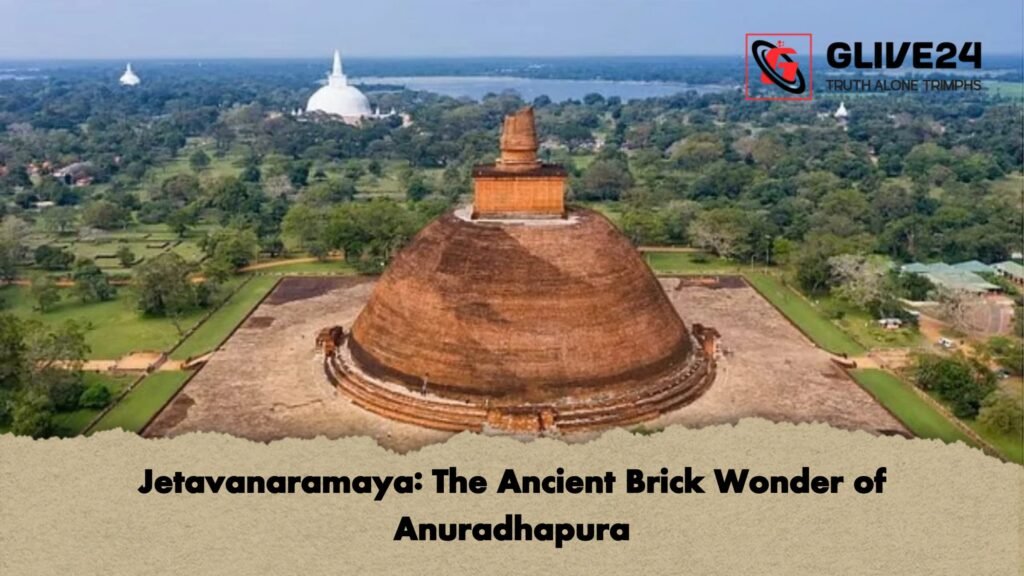
While the Great Pyramids of Giza dominate the global imagination of ancient engineering, a similarly breathtaking marvel lies much closer to home in Sri Lanka. Nestled in the sacred city of Anuradhapura, the Jetavanaramaya stupa remains a towering testament to Buddhist devotion and architectural genius. Despite being over 1,700 years old, this monument continues to stand defiant against time, though its historical significance remains tragically undersold to the wider world.
A Rival to the Pyramids
The comparison to Egypt is not mere hyperbole. When construction was completed in 301 AD under the reign of King Mahasena, Jetavanaramaya was the third-tallest man-made structure in the world, surpassed only by the two largest pyramids at Giza. At its zenith, the stupa soared to a height of 400 feet. Although the centuries have taken their toll, reducing its current stature to 233 feet, its sheer presence is still overwhelming.
What truly distinguishes Jetavanaramaya is its medium. Unlike the pyramids, which were fashioned from massive stone blocks, this is a masterpiece of masonry. It remains the largest structure ever built entirely of bricks.
| Feature | Statistical Detail |
| Year of Completion | 301 AD |
| Original Height | 400 feet (approx. 122 metres) |
| Current Height | 233 feet (approx. 71 metres) |
| Bricks Used | Estimated 93.3 million |
| Location | Anuradhapura, Sri Lanka |
| Primary Patron | King Mahasena |
The Scale of Ambition
To grasp the magnitude of this achievement, one must look at the raw materials. Approximately 93.3 million baked terracotta bricks were used in its construction. To put this into a modern perspective: if those bricks were laid to form a wall three feet high, it would stretch from New York City to Pittsburgh—a distance of roughly 600 kilometres.
Godamune Pannaseha, a senior archaeological officer in Anuradhapura, notes that the stupa was the heart of the Jetavana Vihara, a massive monastery that housed roughly 200 monks. The complex was meticulously designed so that the monks, upon stepping out of their quarters, would immediately be greeted by the sight of the colossal dome, a constant reminder of their spiritual aspirations.
Engineering Against the Odds
Archaeologists and historians remain fascinated by the techniques employed 1,700 years ago. Professor Anura Manatunga of the University of Kelaniya highlights that while stone is naturally resilient, bricks are susceptible to significant erosion. The fact that Jetavanaramaya survives today is a tribute to the precision of ancient Sri Lankan craftsmanship.
Historical records suggest a massive mobilisation of labour, including local devotees and workers brought back from the King’s campaigns in India. It is widely believed that heavy lifting was facilitated by elephants and bullock carts, a traditional method seen in other regional wonders like the Ruwanwelisaya.
Jetavanaramaya represents the pinnacle of ancient stupa construction. No Buddhist monument of this scale was ever attempted again in Sri Lanka, nor does anything in Southeast Asia quite match its brick-bound majesty.