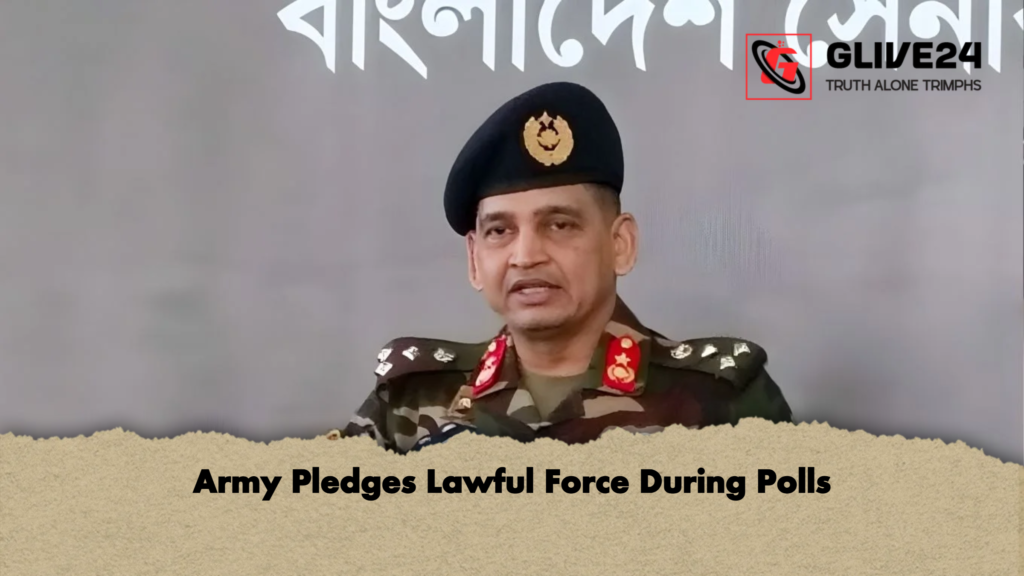
The Bangladesh Army has reiterated that, if necessary, it may employ the highest permissible level of force to maintain overall law and order before, during and after polling day—strictly within the bounds of the law and under clearly defined rules. The assurance was given by Brigadier General Dewan Mohammad Manzur Hossain, Director of Military Operations at Army Headquarters, who stressed that all actions would be governed by established and transparent Rules of Engagement.
Speaking at a press conference on Thursday (5 February) at the Roller Skating Complex in Gulistan, Dhaka, Brigadier General Manzur Hossain outlined the army’s responsibilities and preparedness for the election period under the framework of “in Aid to the Civil Power”. He emphasised that the military’s role is supportive, designed to assist civilian authorities in ensuring a peaceful, credible and orderly electoral process.
Responding to questions on the potential use of force at polling centres, he explained that any escalation would follow a graduated and proportional approach. The army, he said, would assess conditions on the ground and apply force in stages only when circumstances demand it. There would be no scope for sudden, arbitrary or excessive action, and under no circumstances would the army operate outside legal and constitutional limits.
Addressing concerns about mob violence and organised attacks, Brigadier General Manzur Hossain noted that the security forces possess substantial experience in dealing with such situations. Through close coordination with the Election Commission, the civil administration and other law enforcement agencies, the army has developed a comprehensive security plan aimed at safeguarding a free, fair and peaceful vote. He affirmed that troops would remain alert not only on polling day itself but also in the critical periods immediately before and after the election, when tensions can sometimes escalate.
On questions relating to sensitive regions, including the Chattogram Hill Tracts and the Rohingya refugee camps, he acknowledged the inherent security challenges in these areas. He said that election-related risks in such locations have been fully incorporated into the army’s threat assessments, with regular deployments and patrols continuing to deter any disruptive activity.
To bolster public confidence, the army has established camps at both upazila and, where necessary, polling-centre level. This expanded presence will allow a greater number of patrol teams to operate simultaneously, enhancing visibility and reinforcing voters’ sense of safety. Reaffirming the army’s neutrality, Brigadier General Manzur Hossain described the force as professional and disciplined, committed to acting impartially in line with directives from the Army Chief. Ensuring that citizens can cast their votes freely and without fear, he said, remains the army’s overriding objective.
As part of its election preparedness, the army has adopted several key measures, summarised below:
| Area of Preparation | Details |
|---|---|
| Deployment Plan | Upazila-based and centre-specific camps |
| Risk Assessment | Pre- and post-election threat analysis |
| Equipment | Non-lethal weapons and riot-control gear |
| Patrol व्यवस्था | Regular and enhanced mobile patrols |
| Coordination | Joint operations with civil administration and other forces |
In closing, Brigadier General Manzur Hossain added that vigilance has also been increased to counter cyber threats and the spread of misinformation. Overall, he said, the Bangladesh Army’s central commitment is to protect citizens’ voting rights and uphold a democratic environment through lawful, measured and responsible conduct throughout the election period.