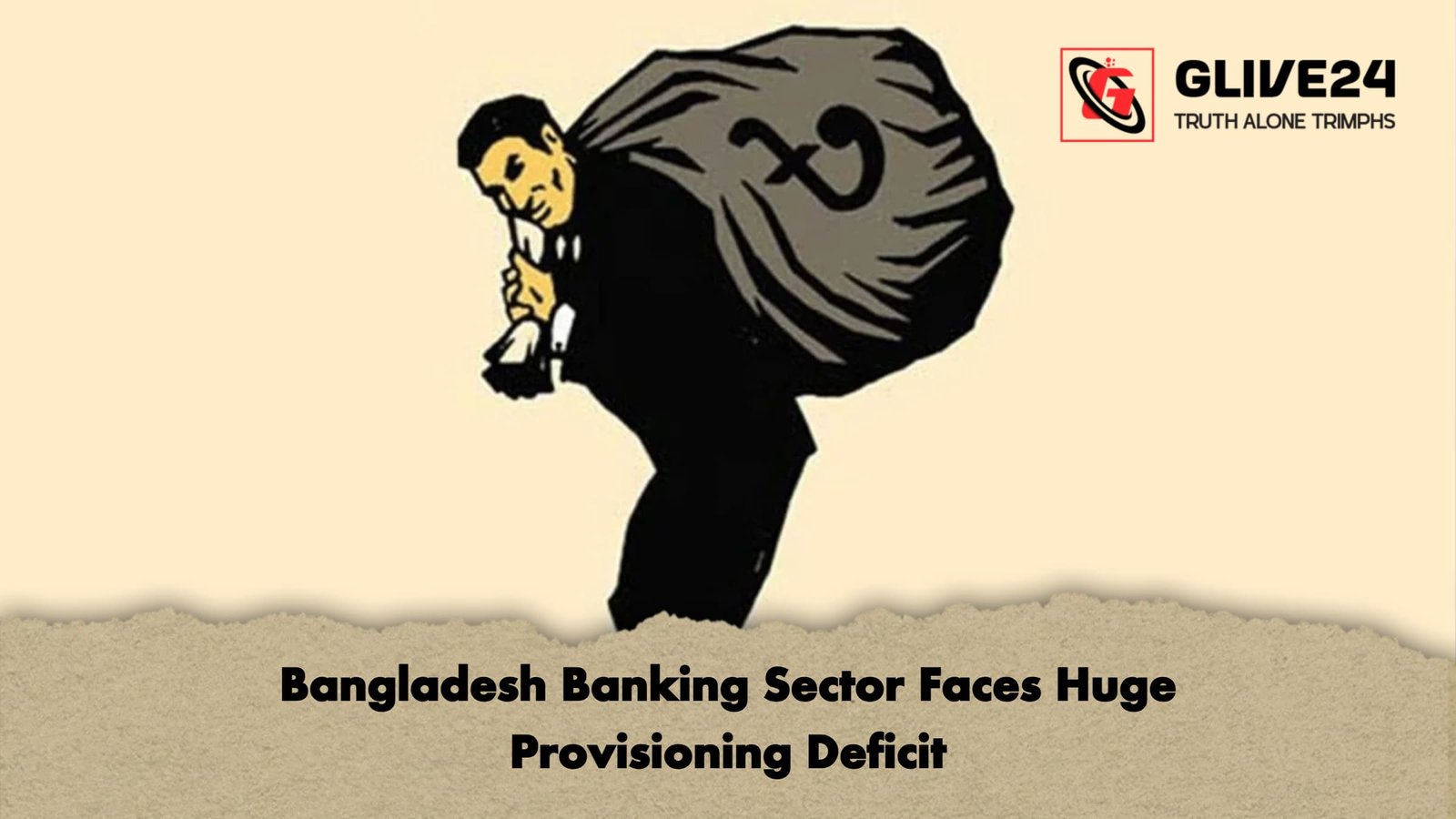
The Bangladeshi banking industry is currently grappling with a severe financial crisis as the weight of non-performing loans (NPLs) continues to hollow out institutional balance sheets. According to the latest data released for December 2025, the sector is reeling under a staggering provisioning shortfall of 191,780 crore BDT, a situation that threatens the very stability of the nation’s financial architecture.
Table of Contents
The Mechanism of Financial Atrophy
Under Bangladesh Bank regulations, commercial banks are legally mandated to set aside a specific percentage of their operating profits as “provisions” to cover potential loan losses. This security reserve is calculated based on the quality of the disbursed loans. While regular loans require a modest reserve of 0.5% to 5%, “Bad or Loss” category loans demand a 100% provision, effectively wiping out the bank’s ability to count that capital as profit.
As of December 2025, the total required provision for the sector stood at 441,091 crore BDT. However, the banking system managed to set aside only 249,649 crore BDT, leaving a massive deficit that reflects years of systemic mismanagement and political interference.
Comparative Provisioning Deficits by Bank Category
The crisis is most acute within private and state-owned commercial banks, whereas foreign entities operating in the country have managed to maintain a modest surplus, shielding them from the local volatility.
| Bank Category | Provisioning Shortfall (crore BDT) |
| Private Commercial Banks | 121,214.19 |
| State-Owned Commercial Banks | 70,364.44 |
| Specialised Banks | 201.02 |
| Foreign Banks | 338.00 (Surplus) |
A Legacy of Irregularities
Senior officials at the central bank attribute this precarious state to a decade of “crony capitalism” and relaxed regulatory oversight during the previous administration. In 2009, NPLs stood at a manageable 22,481 crore BDT. By late 2025, despite a slight recovery in the final quarter, NPLs remained at a bloated 557,217 crore BDT, accounting for roughly 31% of all outstanding credit.
Economic analysts, including M. Helal Ahmed Jony, a Research Fellow at Change Initiative, warn that this shortfall creates a “capital adequacy” trap. When banks fail to meet provisioning requirements, their ability to disburse new loans is crippled, leading to investment stagnation and a broader economic slowdown. “The long-term impact on capital sufficiency is devastating,” Jony remarked, noting that without urgent intervention, the risk of a total loss of public confidence remains high.
Tactical Manoeuvring and Paper Profits
Throughout 2025, many banks resorted to accounting “window dressing” to hide the extent of their fragility. Policies introduced as far back as 2019 allowed banks to delay classifying loans as overdue for up to six months, creating a facade of financial health. However, the current liquidity crisis—where many banks are struggling to honour customer withdrawals—suggests that these “paper profits” have finally collided with reality.
While the final quarter of 2025 saw a reduction in NPLs by 87,298 crore BDT through aggressive rescheduling and improved recovery efforts, experts suggest this may be a temporary reprieve rather than a structural cure.